Question
What are financial statements? What information do they provide.

Answer

Every business firm wants to know its financial position at the end of an accounting period. In order to assess its financial position, profit earned or loss incurred during an accounting period, the book value of its assets and liabilities is to be ascertained. In order to serve this purpose, financial statements are prepared. Financial statements are the statements showing profitability and financial position of a business at the end of the year. It includes:
  1. Income statements, viz., Trading and Profit and Loss Account, which represents direct and indirect expenses incurred to generate revenues. On one hand, trading account discloses either gross profit or gross loss, on the other hand, profit and loss account discloses either net profit or net loss.
  2. Statement of financial position, viz., Balance Sheet, which enlists the book value of all the assets and liabilities of the firm. Balance Sheet discloses the true financial position, solvency and credit worthiness of the business. The information provided by the financial statements is in the form of gross profit or gross loss, net profit or net loss and book value of the assets and their liabilities. The value and relevance of the information provided by the financial statements varies from one user of accounting information to another.
Various users of accounting information can be explained as below:
  1. Internal: Internal users are those persons who are directly related to the business. For example, owners, management, employees, workers, etc.
  1. Owners: The information required by owners about profit earned or loss incurred during an accounting period. This information is provided by the financial statements in form of gross (net) profit or gross (net) loss.
  2. Management: Financial statements provide vital information to the management for decision making, designing policies and future plans. There are various parameters such as ratio of direct (indirect) expenses to gross (net) profit, by the help of which management can check the adequacy, control and relevance of various expenses incurred and plans and policies implemented.
  3. Employees and workers: They expect bonus at the year end, which is directly related to the profit of that particular period. The net profit as disclosed by the profit and loss account forms the basis of this expectation.
  1. External: External users are those persons and institutions that are indirectly related to the business. For example, government, tax authorities, investors, etc.
  1. Government: Government needs information in order to ascertain various macroeconomic variables, such as national income, GDP, employment opportunities generated, etc.
  2. ax authorities: Tax department is interested in knowing the actual sales, production, turnovers and exports and imports by the business. Tax department levies various taxes, such as income tax, VAT, excise tax, etc. The information disclosed by the financial statements form the basis of estimation of the tax dues of the business.
  3. Investors: Financial statements help to know about the earning capacity, scope and potential to grow and to assess financial position of the business. It also helps in knowing various investments made by the business and also investments made by the organisations and individuals in the business. This information helps the investors to assess and determine whether investments by them will be fruitful or not.
  4. Bank and other financial institutions: Financial statements provide information to banks and other financial institutions, such as LIC, GIC, etc., about the credit worthiness, solvency and repaying capacity of the business.
  5. Creditors: Financial statements provide information to the creditors about the goodwill of the business and its credit worthiness and repaying capacity.

Need a full question paper?

Generate a complete, print-ready paper with questions like this in minutes — across 16+ boards, with answer keys.

Start Generating Free

Similar questions

Write a detailed note on Transaction Processing System (TPS).
On 1st April, 2016, a machinery was purchased for ₹ 20,000. On 1st October, 2017 another machine was purchased for ₹ 10,000 and on 1st April, 2018, one more machine was purchased for ₹ 5,000. The firm depreciates its machinery @ 10% p.a. on the Diminishing Balance Method.
What is the amount of Depreciation for the years ended 31st March, 2017, 2018 and 2019? What will be the balance in Machinery Account as on 31st March, 2019?
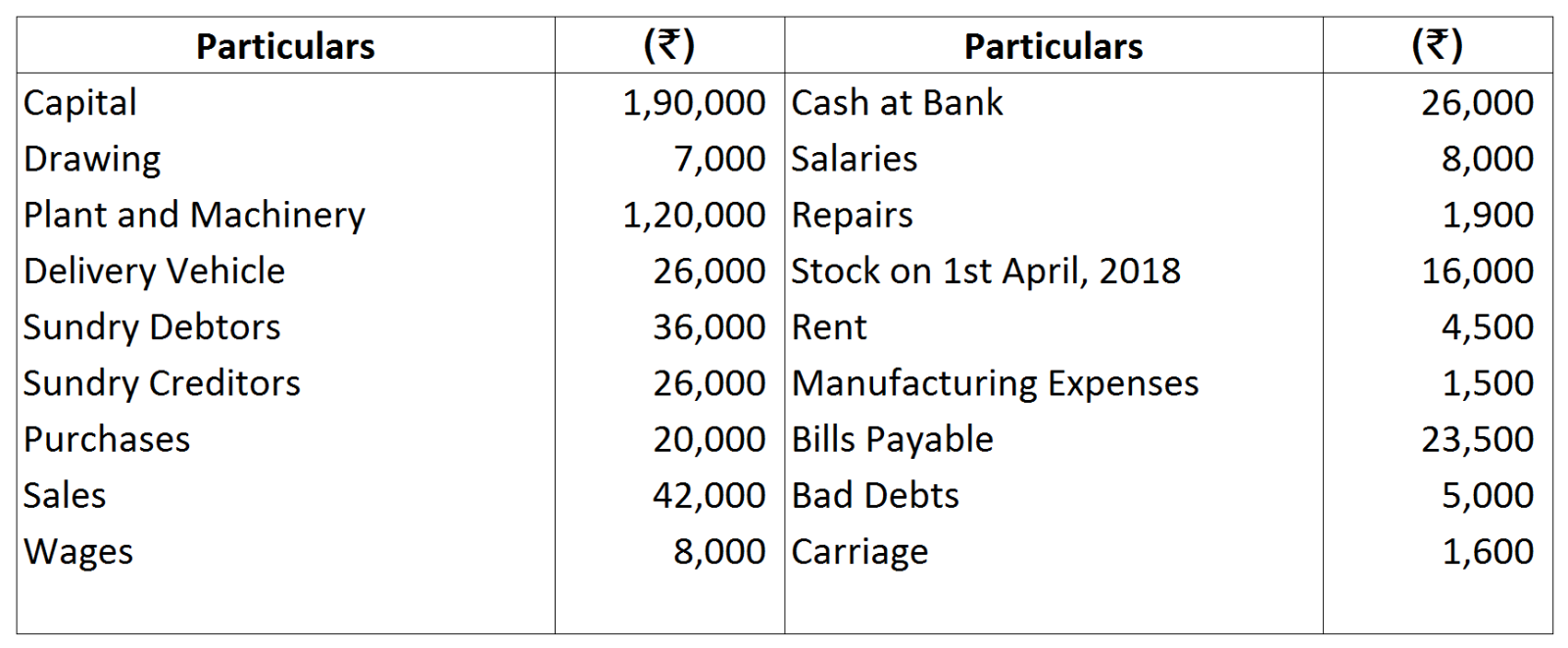
Following are the balance extracted from the books of Manish on 31st March, 2019:

Prepare Trading and Profit and Loss Account and Balance Sheet as 31st March, 2019 after following adjustments are made:
  1. Closing Stock was ₹ 16,000.
  2. Depreciation Plant and Machinery @ 10% and Delivery Vehicle @ 15%.
  3. Unpaid Rent amounted to ₹ 500.
Prepare Bank Reconciliation Statement from the following:On 31st March, 2019, a merchant's Cash Book showed a credit bank balance of ₹ 10,500 but due to the following reasons the Pass Book showed a difference:
  1. A cheque of ₹ 540 issued to Mohan has not been presented for payment.
  2. A post-dated cheque for ₹ 100 has been debited in the bank column of the Cash Book but under no circumstances was it possible to present it.
  3. Four cheque of ₹ 1,200 sent to the bank have not been collected so far. A cheque of ₹ 400 deposited in the bank has been dishonoured.
  4. As per instructions, the bank paid ₹ 50 as Fire Insurance premium but the entry has not been made in the Cash Book.
  5. There was a debit in the Pass Book of ₹ 15 in respect of bank charges and a credit of ₹ 25 for interest on Current Account but no record exists in the Cash Book.
  6. Cheque of ₹ 5,000 dated 15th April, 2019 issued to M & Co. was dishonoured being post dated. It was also not recorded in the books of account yet.
A owed B ₹ 8,000. He gave a bill for the same on 1st August, 2018 payable after 4 months at the Bank of India, Chandni Chowk, Delhi. Immediately after receiving the bill, B endorsed it to C in payment of his debt. On 1st September, C discounted the bill at 12% p.a. The bill is met on due date.
Pass the necessary Journal entries in the books of A, B and C.
Draw Bank Reconciliation Statement showing adjustment between your Cash Book and Pass Book as on 31st March, 2011.
  1. On 31st March, 2011 your pass book showed a balance of ₹ 6,000 to your credit.
  2. Before that date, you had issued cheques amounting to ₹ 1,500 of which cheques of ₹ 900 have been presented for payment.
  3. A cheque of ₹ 800 paid by you into the bank on 29th March, 2011 is not yet credited in pass book.
  4. There was a credit of ₹ 85 for interest on Current Account in the pass book.
  5. On 31st March, 2011 a cheque for ₹ 510 received by you and was paid into bank but the same was omitted to be entered in cash book.
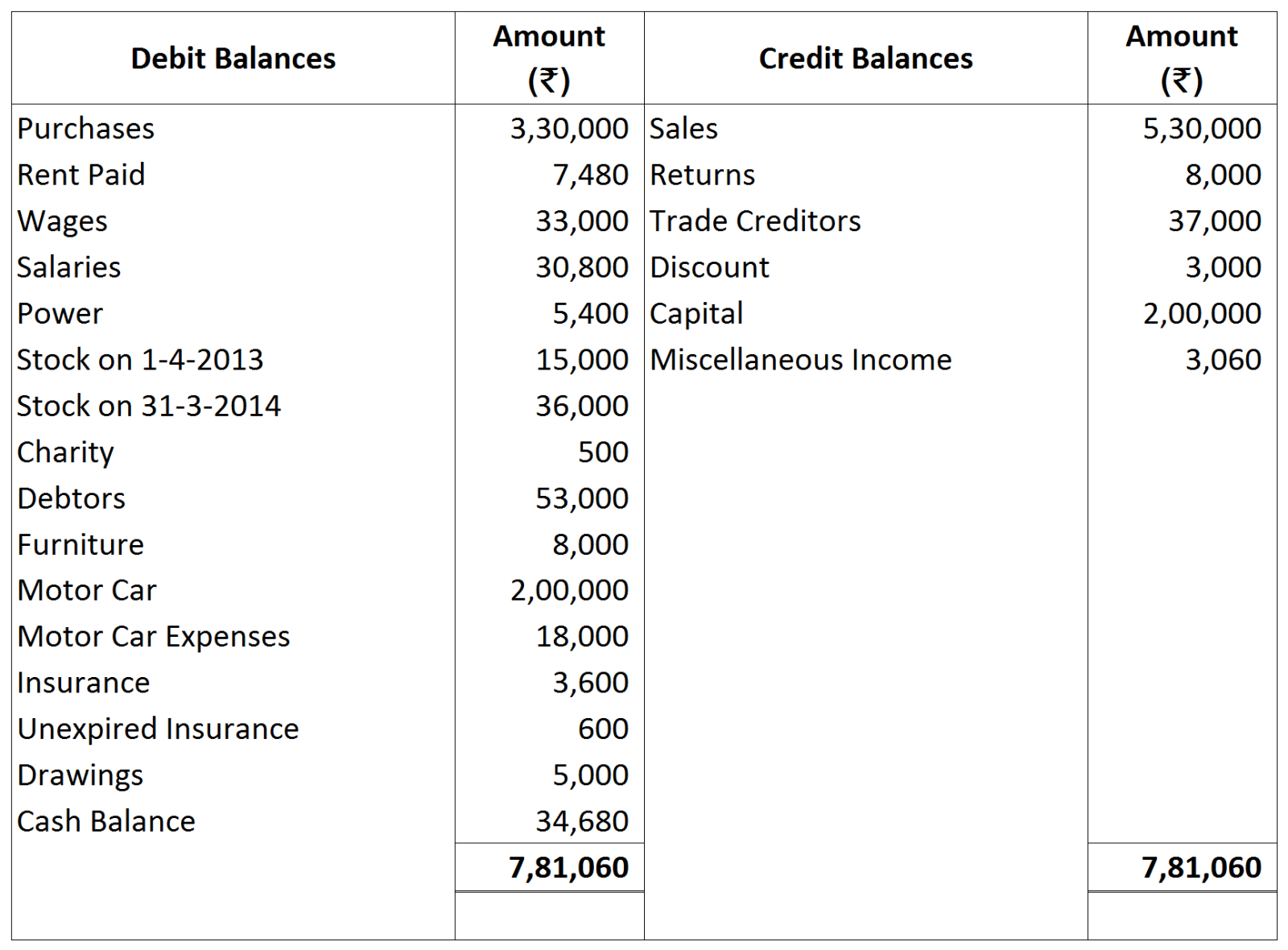
From the following Trial Balance extracted from the books of Mr. Karuna Sagar, prepare a Trading and Profit & Loss A/c for the year ended 31st March, 2019 and a Balance Sheet as at that date:

Informations:
  1. Goods Costing ₹ 2,000 were taken away by the proprietor for his personal use and goods costing ₹ 1,500 were given away as charity.
  2. Expenses for wages, rent and salaries are uniform throughout the year and those for March have not been paid.
  3. Provide 10% depreciation on Furniture and 20% on Motor Car.
  4. Provide for Manager's Commission at 10% on Net Profit after charging such Commission.
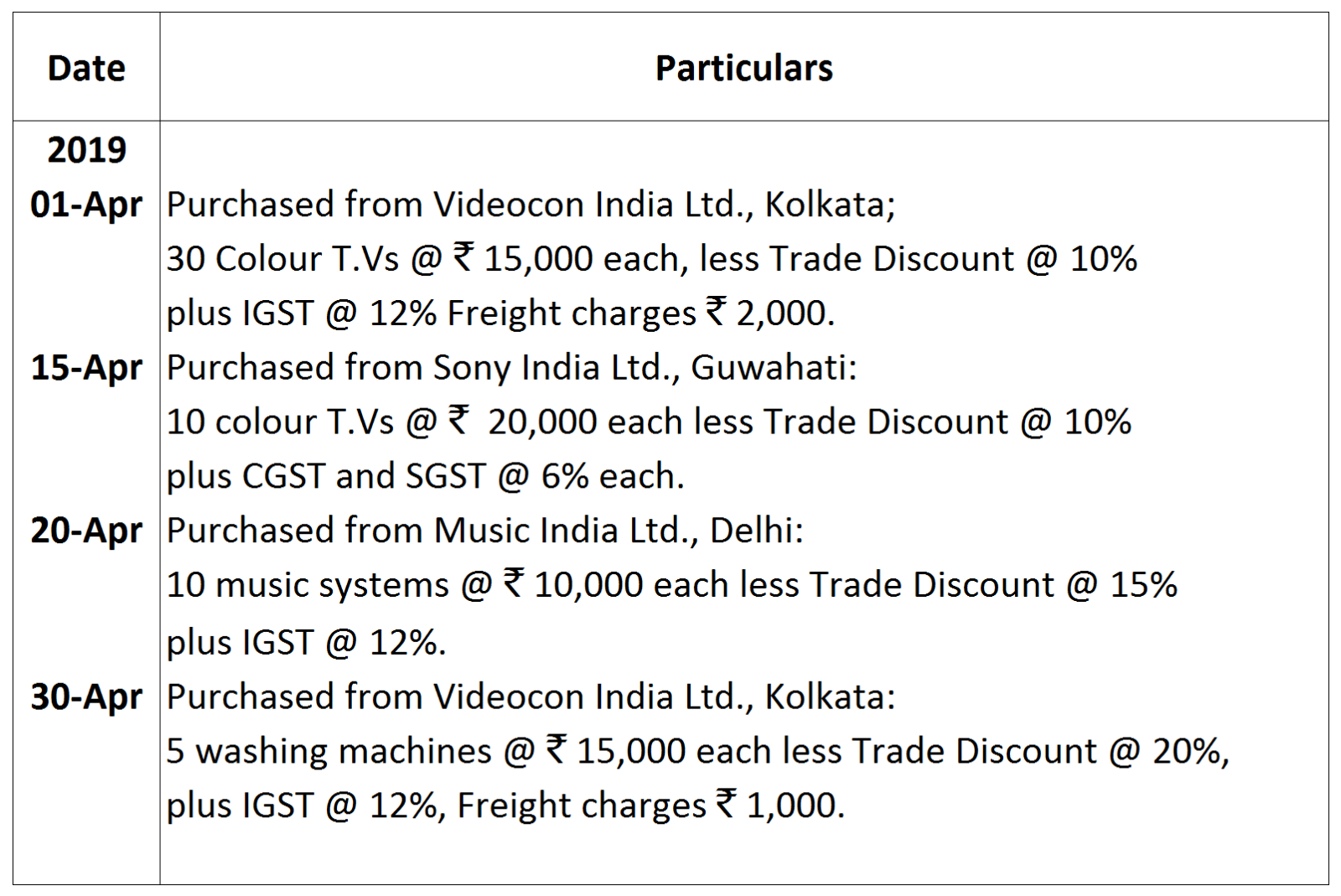
From the following transactions of Kamal, Guwahati, prepare Purchases Book and post into Ledger:
Explain briefly any five advantages of computerised accounting system over the manual system.
Explain the data base design for Model-I for producing the receipts the series of SQL statements for producing the payment side of cash book for Model-II.