Question
What are intrinsic semiconductor and extrinsic semiconductor ? Explain.

Answer

Intrinsic Semiconductor: A pure semiconductor which is free from any impurity is called intrinsic semiconductor. Pure germanium and pure silicon in their natural state are the examples of intrinsic semiconductors. The electronic configuration of these elements is as given below :
Germanium (Ge) : $Z=32$; $1s^{2}, 2s^{2}2p^{6}, 3s^{2}3p^{6} 3d^{10}, 4s^{2}4p^{2}$.
Silicon (Si) : $Z=14$; $1s^{2}, 2s^{2}2p^{6}, 3s^{2}3p^{2}$.
Now it is obvious from this configuration that there are four electrons in outermost orbit of each of these atoms i.e., Ge and Si both have four valence electrons i.e., both are tetravalent.
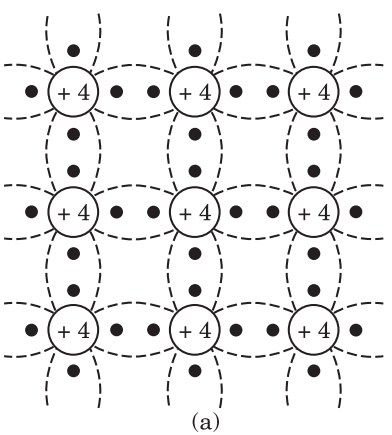
The outermost shell of an atom is of interest in electronics because it contains the loosely bound valence electrons which are easily dislodged to become electric charge carriers. Since germanium has four valence electrons, hence for our purpose the germanium atom may be pictured as containing only these electrons and four protons in the nucleus to keep it electrically neutral. When germanium is in its crystalline form its atoms are arranged in an ordered array in which each atom is situated at a corner of a regular tetrahedron [Fig. (a)].
Image
In this figure, each of the four valence electrons of the atom is shared with the nearest neighbouring electron and forms a covalent bond, shown by shaded curved lines in the figure. In this way in this structure four valency electron pairs are associated with each nucleus.
At temperatures near to absolute zero all valency electrons are bound so strongly with each other and with the nucleus that no free electrons are available to conduct an electric current through the crystal. Thus, at such temperature pure germanium crystal i.e., intrinsic semiconductor seems to be a non-conductor of electricity.
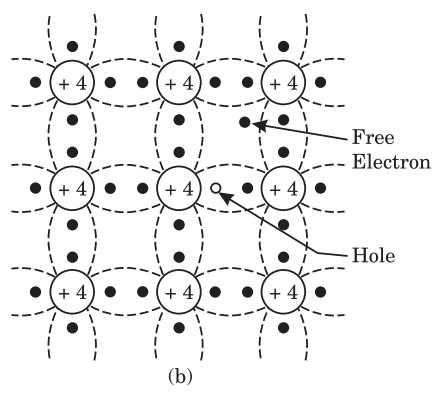
At room temperature due to thermal agitation in the crystal a few covalent bonds are broken liberating some free electrons as charge carriers. An electron disloged from a covalent bond leaves behind a vacancy in the covalent band which is named as hole. Since a hole represents the deficiency of an electron in the band, hence it behaves as a positive charge which is equal in magnitude to be charge of an electron.
Image
Because the liberation of one free electron by thermal agitation creates one hole, hence in intrinsic semiconductors, the number of free electrons is equal to the number of holes.
Now, when a hole is created in some covalent bond an electron from the neighbouring covalent bond may jump into it creating a new hole in that bond. Thus, hole has moved from one place to another. In this way the actual motion of the electron from one covalent bond to another give $\Delta$ rise to the apparent motion of hole from one atom to another. Here it should be noted that thermally generated free electron does not take part in the process of apparent motion of the hole.
Now, when a potential difference is applied across the ends of an intrinsic semiconductor an electric field is established inside it. Hence thermally generated free electrons move in the direction opposite to that of the field and constitute an electric current $I_e$ known as electron current. Along with it under the action of the electric field developed in the semiconductor jumping of bound electrons into the hole takes place from one atom to another in the opposite direction of the field with the corresponding creation of the holes in the direction of the field. Thus, it can be said that holes move in the direction of field and so they act as positive charge carriers giving rise to an electric current Ih known as hole current.
Thus, the total current in the intrinsic semiconductor is equal to the sum of electron current and hole current i.e., $I = I _e+ I _h$.
Extrinsic Semiconductor : The conductivity of an intrinsic semiconductor is very poor unless the temperature is very high. At room temperature, only one atom out of $10^9$ contributes to conduction. The intrinsic semiconductor is thus of no practical use. In order to make the intrinsic semiconductors of practical use, small amount of some suitable impurity atoms is added to them. The resulting semiconductors are called extrinsic semiconductors. The process of adding impurity atoms to the intrinsic semiconductors is known as dopping. The impurity that is added to the intrinsic semiconductors is called dopant. The amount of impurity added is extremely small i.e., generally about 1 part of 108 of intrinsic semiconductor atoms. Extrinsic semiconductor is called doped semiconductor.
The purpose of adding impurity intrinsic semiconductor is to increase its electrical conductivity by increasing either the number of free electrons or holes in the semiconductor. Usually the impurity atoms are taken either from group V having 5 valence electrons or from group III elements having 3 valence electrons. Since the percentage of impurity atoms (dopants) is very small in extrinsic semiconductor hence it does not change either the crystal structure or the chemical properties of the original semiconductor.
On the basis of the type of dopant used extrinsic semiconductors are of two types as given below :
(i) $p$-type extrinsic semiconductor, (ii) $n$-type extrinsic semiconductor.
On dopping pure germanium with trivalent impurity $p$-type extrinsic semiconductor is obtained and on dopping pure germanium semiconductor with pentavalent impurity. $n$-type extrinsic semiconductor is obtained.

Need a full question paper?

Generate a complete, print-ready paper with questions like this in minutes — across 16+ boards, with answer keys.
Start Generating Free

Similar questions

Two friends $A$ and $B \ ($each weighing $40\ kg)$ are sitting on a frictionless platform some distance $d$ apart. A rolls a ball of mass $4\ kg$ on the platform towards $B$ which $B$ catches. Then $B$ rolls the ball towards $A$ and $A$ catches it. The ball keeps on moving back and forth between $A$ and $B$. The ball has a fixed speed of $5m/s$ on the platform.
  1. Find the speed of $A$ after he rolls the ball for the first time.
  2. Find the speed of $A$ after he catches the ball for the first time.
  3. Find the speeds of $A$ and $B$ after the ball has made $5$ round trips and is held by $A$.
  4. How many times can $A$ roll the ball?
  5. Where is the centre of mass of the system $''A + B \ +$ ball'' at the end of the $n^{th}$ trip?
Show that the first few frequencies of light that is emitted when electrons fall to the $n^{th}$ level from levels higher than $n,$ are approximate harmonics $($i.e. in the ratio $1 : 2: 3...)$ when $n > > 1$.
The difference in the frequencies of series limit of Lyman series and Balmer series is equal to the frequency of the first line of the Lyman series. Explain.
An electron is emitted with negligible speed from the negative plate of a parallel$-$plate capacitor charged to a potential difference $V.$ The separation between the plates is $d$ and $a$ magnetic field Bexists in the space, as shown in the figure. Show that the electron will fail to strike the upper plates if $\text{d}>\Big(\frac{2\text{m}_\text{e}\text{v}}{\text{eB}^2}\Big)^{\frac{1}{2}}.$
By explaining magnetic field lines, write their characteristics.
Neglect the effect of rotation of the earth. Suppose the earth suddenly stops attracting objects placed near its surface. A person standing on the surface of the earth will:
  1. Fly up.
  2. Slip along the surface.
  3. Fly along a tangent to the earth's surface.
  4. Remain standing.
Answer the following Questions.
  1. Find expressions for the force and torque on an electric dipole kept in a uniform electric field.
OR
An electric dipole is held in a uniform electric field. (i) Using suitable diagram show that it does not undergo any translatory motion, and (ii) derive an expression for torque acting on it and specify its direction.
  1. Derive an expression for the work done in rotating a dipole from the angle $\theta_0$ to $\theta_1$ in a uniform electric field E.
​​​​​​​OR
  1. Define torque acting on a dipole of dipole moment $\vec{\text{p}}$ placed in a uniform electric field $\vec{\text{E}}.$ Express it in the vector form and point out the direction along which it acts.
  2. What happens if the field is non-uniform?
  3. What would happen if the external field $\vec{\text{E}}$ is increasing (i) parallel to $\vec{\text{p}}$ and (ii) anti-parallel to $\vec{\text{p}}?$
A block of mass M is kept on a rough horizontal surface. The coefficient of static friction between the block and the surface is $\mu.$ The block is to be pulled by applying a force to it. What minimum force is needed to slide the block? In which direction should this force act?
  1. With the help of the circuit diagram explain the working principle of a transistor amplifier as an oscillator.
  2. Distinguish between a conductor, a semiconductor and an insulator on the basis of energy band diagrams.
A copper wire of radius 0.1mm and resistance $1\text{k}\Omega$ is connected across a power supply of 20V.
(a) How many electrons are transferred per second between the supply and the wire at one end? (b) Write down the current density in the wire.