Question
What are the reactions involved for ozone layer depletion in the stratosphere?

Answer


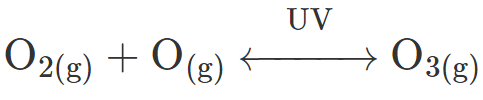
In the stratosphere, ozone is a product of the action of UV radiations on dioxygen as:
  1.  
  1.  

eaction (ii) indicates the dynamic equilibrium existing between the production and decomposition of ozone molecules. Any factor that disturbs the equilibrium may cause depletion of ozone layer by its decomposition. One such factor is the release of chlorofluorocarbon compounds (CFCs). These are non-reactive, non-flammable molecules that are used in refrigerators, air conditioners, plastics, and electronic industries. Once released CFCs mix with atmospheric gases and reach the stratosphere, where they are decomposed by UV radiations.
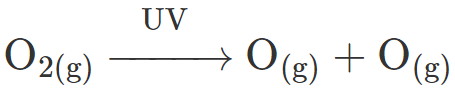
  1. $\text{CF}_2\text{Cl}_{2(\text{g})}\xrightarrow{ \ \ \ \text{UV} \ \ \ \ }\dot{\text{Cl}}_{(\text{g})}+\dot{\text{CF}}_2\text{Cl}_{\text{(g)}}$
The chlorine free radical produced in reaction (iii) reacts with ozone as:
  1. $\dot{\text{Cl}}_{(\text{g})}+\text{O}_{3(\text{g})}\xrightarrow{\ \ \\ \ \ \ \ \\ \ \ \\ \ \ \\ }\text{Cl}\dot{\text{O}}_{(\text{g})}+\text{O}_{2(\text{g})}$
The $\dot{\text{Cl}}_{(\text{g})}$ radicals further react with atomic oxygen to produce more chlorine radicals as:
  1. $\text{Cl}\dot{\text{O}}_{(\text{g})}+\text{O}_{(\text{g})}\xrightarrow{\ \ \\\ \\\ \ \ \ \ \ }\dot{\text{Cl}}_{(\text{g})}+\text{O}_{2(\text{g})}$
The regeneration of $\dot{\text{Cl}}_{(\text{g})}$ causes a continuous breakdown of ozone present in the stratosphere, damaging the ozone layer.

Need a full question paper?

Generate a complete, print-ready paper with questions like this in minutes — across 16+ boards, with answer keys.

Start Generating Free

Similar questions

The work function for caesium atom is $1.9eV$. Calculate,
  1. The threshold wavelength.
  2. The threshold frequency of the radiation.
If the caesium element is irradiated with a wavelength $500nm$, calculate the kinetic energy and the velocity of the ejected photoelectron.
How is dihydrogen obtained from:
  1. dilute sulphuric acid.
  2. sodium hydroxide and.
  3. water.
Explain by giving equations.
  1. $\text{MnO}_4^{2-}$ undergoes disproportionation reaction in acidic medium but does not, give reason.
  2. Give one example each of the following redox reaction:
  1. Combination reaction.
  2. Decomposition reaction.
  3. Metal displacement reaction.
Three students, Manish, Ramesh and Rajni were determining the extra elements present in an organic compound given by their teacher. They prepared the Lassaigne’s extract (L.E.) independently by the fusion of the compound with sodium metal. Then they added solid $\mathrm{FeSO}_4$ and dilute sulphuric acid to a part of Lassaigne’s extract. Manish and Rajni obtained prussian blue colour but Ramesh got red colour. Ramesh repeated the test with the same Lassaigne’s extract, but again got red colour only. They were surprised and went to their teacher and told him about their observation. Teacher asked them to think over the reason for this. Can you help them by giving the reason for this observation. Also, write the chemical equations to explain the formation of compounds of different colours.
Calculate the pH of the following solutions:
2g of TlOH dissolved in water to give 2litre of solution.
The ratio of mass percent of C and H of an organic compound $\mathrm{C}_{\mathrm{x}} \mathrm{H}_y \mathrm{O}_z$ is $6: 1$. If one molecule of the above compound $\left(\mathrm{C}_x \mathrm{H}_y \mathrm{O}_z\right)$ contains half much oxygen of required to burn one molecule of compound $\mathrm{C}_x \mathrm{H}_y$ completely to $\mathrm{CO}_2$ and $\mathrm{H}_2 \mathrm{O}$. What is empirical formula of $\mathrm{C}_{\mathrm{x}} \mathrm{H}_y \mathrm{O}_z$ ?
For the reaction, 2A(g) + B(g) → 2D(g)$\Delta\text{U}^\ominus=-10.5\text{kJ} \ \text{and} \ \Delta\text{S}^\ominus=-44.1\text{kJ}^{-1}.$
Calculate $\Delta\text{G}^\ominus$ for the reaction, and predict whether the reaction may occur spontaneously.
Account for the following observations:
$\mathrm{PbO}_2$ is a stronger oxidising agent than $\mathrm{SnO}_2$.
1. Suggest a method to purify
i. a liquid which decomposes at its boiling point.
ii. kerosene oil containing water.
iii. camphor containing traces of common salt.
2. Giving justification, categorise the following molecules/ions as nucleophile or electrophile:
$
\begin{aligned}
& HS^{-}, BF_3, C_2 H_5 O^{-},\left(CH_3\right)_3 N:, \\
& C \stackrel{+}{l}, C H_3-\stackrel{+}{C}=O, H_2 N \stackrel{+}{:}, \stackrel{+}{N} O_2
\end{aligned}
$
Calculate the oxidation number of sulphur, chromium and nitrogen in $H_2SO_5$, $\text{Cr}_2\text{O}^{2-}_7$ and $\text{NO}^{-}_3.$ Suggest structure of these compounds. Count for the fallacy.