Question
The work function for caesium atom is $1.9eV$. Calculate,
  1. The threshold wavelength.
  2. The threshold frequency of the radiation.
If the caesium element is irradiated with a wavelength $500nm$, calculate the kinetic energy and the velocity of the ejected photoelectron.

Answer

It is given that the work function $(W_0)$ for caesium atom is $1.9eV$.
  1. From the expression, $\text{W}_0=\frac{\text{hc}}{\lambda_0}$ we get:
$\lambda_0=\frac{\text{hc}}{\text{W}_0}$
Where,
$\lambda_0$ = threshold wavelength
h = Planck’s constant
c = velocity of radiation
Substituting the values in the given expression of $(\lambda_0):$
$\lambda_0=\frac{(6.626\times10^{-34}\text{Js})(3.0\times10^8\text{ms}^{-1})}{1.9\times1.602\times10^{-19}\text{J}}$
$\lambda_0=6.53\times10^{-1}\text{m}$
Hence, the threshold wavelength $\lambda_0$ is 653nm.
  1. From the expression, $\text{W}_0=\text{hv}_0$ we get:
$\text{v}_0=\frac{\text{W}_0}{\text{h}}$
Where,
$ν_0$ = threshold frequency
h = Planck’s constant
Substituting the values in the given expression of $ν_0$:
$\text{v}_0=\frac{1.9\times1.602\times10^{-19}\text{J}}{6.626\times10^{-34}\text{Js}}$
$(1eV = 1.602 \times 10^{–19}J)$
$ν_0 = 4.593 \times 10^{14}s^{–1}$
Hence, the threshold frequency of radiation $(ν_0)$ is $4.593 \times 10^{14}s^{–1}$.
According to the question:
Wavelength used in irradiation (λ) = 500nm
Kinetic energy = $h (ν – ν_0)$
$=\text{hc}\Big(\frac{1}{\lambda}-\frac{1}{\lambda_0}\Big)$
$=(6.626\times10^{-34}\text{Js})(3.0\times10^8\text{ms}^{-1})\Big(\frac{\lambda_0-\lambda}{\lambda\lambda_0}\Big)$
$=(1.9878\times10^{-26}\text{Js})\Big[\frac{(653-500)10^{-9}\text{m}}{(653)(500)10^{-18}\text{m}^2}\Big]$
$=\frac{(1.9878\times10^{-26})(153\times10^{9})}{(653)(500)}\text{J}$
$=9.3149\times10^{-20}\text{J}$
Kinetic energy of the ejected photoelectron $=9.3149\times10^{-20}\text{J}$
Since $\text{K.E}=\frac{1}{2}\text{mv}^2=9.3149\times10^{-20}\text{J}$
$\text{v}=\sqrt{\frac{2(9.3149\times10^{-20}\text{J})}{9.10939\times10^{-31}\text{kg}}}$
$=\sqrt{2.0451\times10^{11}\text{m}^2\text{s}^{-2}}$
$\text{v}=4.52\times10^5\text{ms}^{-1}$
Hence, the velocity of the ejected photoelectron (v) is $\text{v}=4.52\times10^5\text{ms}^{-1}.$

Need a full question paper?

Generate a complete, print-ready paper with questions like this in minutes — across 16+ boards, with answer keys.

Start Generating Free

Similar questions

$50.0g$ of $CaCO_3$ are heated to 1073K in a $5L$ vessel. What per cent of the $CaCO_3$ would decompose at equilibrium? $K_p$ for the reaction.
$\text{CaCO}_3(\text{s})\rightleftharpoons\text{CaO(s)}+\text{CO}_2(\text{g})$ is 1.15a/ m at 1073K.
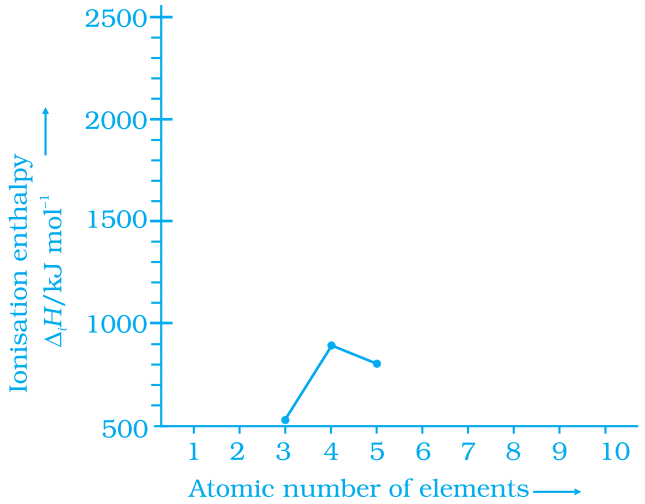
Ionisation enthalpies of elements of second period are given below:
Ionisation enthalpy/ kcal $mol^{-1}, 520, 899, 801, 1086, 1402, 1314, 1681, 2080$.
Match the correct enthalpy with the elements and complete the graph given in also write symbols of elements with their atomic number.
Bromine monochloride, BrCl decomposes into bromine and chlorine and reaches the equilibrium:$2\text{BrCl (g)}\rightleftharpoons\text{Br}_2\text{ (g) + Cl}_2\text{ (g)}$for which $K_c= 32$ at $500K$. If initially pure BrCl is present at a concentration of
$3.3 \times 10^{–3} mol L^{–1}$, what is its molar concentration in the mixture at equilibrium?
Suggest a list of the substances where carbon can exhibit oxidation states from $-4$ to $+4$ and nitrogen from $-3$ to $+5$.
  1. Name the element which forms maximum number of compound.
  2. How is nascent hydrogen prepared?
  3. What is ratio of $\frac{\text{C}_\text{P}}{\text{C}_\text{V}}$ for hydrogen andwhy?
  4. What is half life of tritium? How is it obtained?
  5. If we electrolyse 2000 litres of $H_2O_2$ how much heavy water will be formed?
The ionization constant of benzoic acid is $6.46 \times 10^{-5}$ and $K _{\text {sp }}$ for silver benzoate is $2.5 \times 10^{-13}$. How many times is silver benzoate more soluble in a buffer of pH 3.19 compared to its solubility in pure water?
Discuss the chemistry of Lassaigne's test.
The amount of energy released when one million of atoms of iodine in vapour state are converted to $I^{-}$ions is $4.9 \times$ $10^{-13}$ J according to the reaction:
$\mathrm{I}(\mathrm{~g})+\mathrm{e}^{-} \rightarrow \mathrm{I}^{-}(\mathrm{g})$
Express the electron gain enthalpy of iodine in terms of $\mathrm{kJ} \mathrm{mol}^{-1}$ and $\mathrm{eV}^{-2}$ per atom.
Illustrate by taking examples of transition elements and non-transition elements that oxidation states of elements are largely based on electronic configuration.
Give general characters of elements of s, p, d and f-block.