Concentration of Ore: The process of removal of unwanted impurities like sand, rocky material, earthy particles etc. from the ore is called ore concentration or ore dressing. The finely ground ore is concentrated by any of the following processes:
i. Hydraulic washing: This method depends upon the difference in the densities of the ore particles and the impurities (gangue). The crushed and powdered ore is taken in large wooden tables with small obstacles. A stream of water is passed over the shaking table. The lighter impurities are washed away with the running stream of water while the heavier ore particles are left behind. This method of concentration is usually applicable to oxide ores.
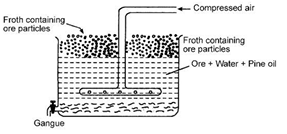
ii. Froth floatation process: This method is used for the extraction of those metals in which the ore particles are preferentially wetted by oil and gangue by water. In this method, the powdered ore is mixed with water containing small quantities of oil (pine oil m eucalyptus oil) in a large tank (Fig.), The water is agitated by blowing air violently when a froth (or foam) is formed. The froth carries the lighter ore particles along with it to the surface. The heavier impurities are left behind in water and these settle to the bottom. Since the ore particles float with the froth at the surface, this process is called froth floatation process. The froth at the surface is transferred into another tank. The froth is broken by adding some acid and ore particles are separated by filtration and dried. For example, the froth floatation process is commonly used for the sulphide ores of copper, zinc, lead et
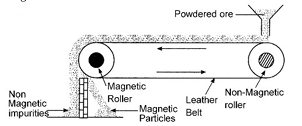
iii. Magnetic separation: The ores which are attracted by a magnet can be separated from the non-magnetic impurities with the help of magnetic separation method. For example, this method is used for the concentration of haematite, an ore of iron. It consists of a leather belt moving over two rollers, one of which is magnetic in nature. This is shown in the figure. The powdered ore is dropped over the moving belt at one end. At the other end, the magnetic portion of the ore is attracted by the magnetic roller and falls nearer to the roller while the non-magnetic impurities fall farther off