Questions

[3 Mark Questions]

🎯

Test yourself on this topic

8 questions · timed · auto-graded

Question 13 Marks
$a.$ What is the heating effect of electric current?
$b.$ Write an expression for the amount of heat produced in a resistor when an electric current is passed through it stating the meanings of the symbols used.
$c.$ Name two appliances based on heating effect of electric current.
Answer
$a.$ When an electric current passes through a conductor $($like a high resistance wire$)$ the conductor becomes hot after some time and produces heat. This is called heating effect of Electric Current.
Ex: A bulb becomes hot after its use for some time. This is because of heating effect of electric current.
$b.$ We Know that
$ H = P \times t$
$H =\frac{\text { Energy }}{\text { Time }} \times t$
$\because$ Energy $= V . Q$
$H =\frac{V \cdot Q . t}{t}$
$H = Vit$
$\because V = IR$
$H = I ^2 Rt$
Other form 
$H =V\left[\frac{V}{R}\right] t$
Where
$I =$ Current 
$R =$ Resistance 
$t =$ Time 
$c.$ Two devices which work on the heating effect of electric current are:
$i.$ Electric heater
$ii.$ Electric iron
View full question & answer
Question 23 Marks
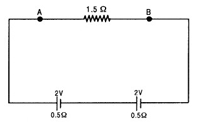
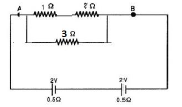
Given in fig. is the circuit diagram in which three resistors of 12, 22 and 32 are connected to cell of e.m.f. 2V and internal resistance 0.5 Ω.
i. Calculate the total resistance of the circuit.
ii. What is the reading of ammeter and What will be ammeter reading if an exactly similar cell is connected in series with the given cell?
Image
Answer
Resistance, 1Ω and 2Ω are in series and combined resistance i.e. 1 + 2 = 3Ω in parallel with 3Ω.
Hence total resistance of the combination is $\frac{1}{R}=\frac{1}{3}+\frac{1}{3}=\frac{2}{3}$ or $R=\frac{3}{2}=1.5 \Omega$
i. Total resistance of the circuit R + r = 1.5 + 0.5 = 2Ω
ii. Total current through ammeter $=\frac{E}{R+r}=\frac{2}{2}=1 A$
iii. In second case total e.m.f.= 2 + 2 = 4V
Total resistance =1.5 + 0.5+0.5 = 2.5Ω
Current through circuit in second case $=\frac{4}{25}=\frac{20}{25}=\frac{8}{5}=1.6 A$
Image
View full question & answer
Question 33 Marks
Distinguish between real image and virtual image.
Answer
Real ImageVirtual Image
1. It is formed by the actual meeting of reflected (or refracted) ray.1. It is formed when reflected (or refracted) rays appear to meet when produced backward
2.It can be obtained on the screen.2.It cannot be obtained on the screen.
3.It is always inverted.3.It is always erect.
4.It is formed by concave mirror or convex lens.4.It is formed by concave, convex and plane mirror(or concave and convex lens.)
View full question & answer
Question 43 Marks
i. In humans, if gene B gives brown eyes and gene b gives blue eyes, what will be the colour of eyes of the persons having the following combination of genes? (a) Bb (b) bb (c) BB
ii. What do you class this trait of eye colour in human? Explain.
Answer
i. Bb will have brown eyes.
bb will have blue eyes.
BB will have brown eyes.
ii. Eye colour in humans is an inherited trait. These are traits that are present in the DNA of an organism and are passed on to their progeny.
View full question & answer
Question 53 Marks
Define nutrition. What are the different modes of nutrition?
Answer
Nutrition: The sum total of processes by which living organisms obtain food materials and prepare them for use in the growth, repair and providing energy is termed nutrition.
Nutrition is of two types $: 1)$ Autotrophic nutrition$, 2)$ Heterotrophic nutrition.
$1)$ Autotrophic nutrition : The mode of nutrition in which an organism prepares its own food is called autotrophic nutrition.
Mostly green plants have the ability to manufacture their own organic food due to the presence of chlorophyll. They take up $CO_2$ and $H_2O$ and manufacture carbohydrates in the presence of sunlight process called as photosynthesis. Such organisms are called autotrophs and their mode of nutrition is called autotrophic.
$2)$ Heterotrophic nutrition : The mode of nutrition in which an organism takes food from another organism is called heterotrophic nutrition. In this type of nutrition, the animals derive organic food materials by consuming bodies or products of other living or dead plants or animals.
View full question & answer
Question 63 Marks
What are the various methods used for concentration of ore/Ore dressing?
Answer
Concentration of Ore: The process of removal of unwanted impurities like sand, rocky material, earthy particles etc. from the ore is called ore concentration or ore dressing. The finely ground ore is concentrated by any of the following processes:
i. Hydraulic washing: This method depends upon the difference in the densities of the ore particles and the impurities (gangue). The crushed and powdered ore is taken in large wooden tables with small obstacles. A stream of water is passed over the shaking table. The lighter impurities are washed away with the running stream of water while the heavier ore particles are left behind. This method of concentration is usually applicable to oxide ores.
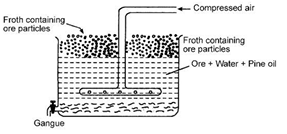
ii. Froth floatation process: This method is used for the extraction of those metals in which the ore particles are preferentially wetted by oil and gangue by water. In this method, the powdered ore is mixed with water containing small quantities of oil (pine oil m eucalyptus oil) in a large tank (Fig.), The water is agitated by blowing air violently when a froth (or foam) is formed. The froth carries the lighter ore particles along with it to the surface. The heavier impurities are left behind in water and these settle to the bottom. Since the ore particles float with the froth at the surface, this process is called froth floatation process. The froth at the surface is transferred into another tank. The froth is broken by adding some acid and ore particles are separated by filtration and dried. For example, the froth floatation process is commonly used for the sulphide ores of copper, zinc, lead et
Image

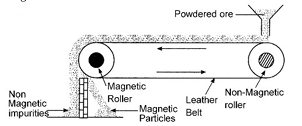
iii. Magnetic separation: The ores which are attracted by a magnet can be separated from the non-magnetic impurities with the help of magnetic separation method. For example, this method is used for the concentration of haematite, an ore of iron. It consists of a leather belt moving over two rollers, one of which is magnetic in nature. This is shown in the figure. The powdered ore is dropped over the moving belt at one end. At the other end, the magnetic portion of the ore is attracted by the magnetic roller and falls nearer to the roller while the non-magnetic impurities fall farther off
Image
View full question & answer
Question 73 Marks
Carbon cannot reduce the oxides of sodium, magnesium, and aluminium to their respective metals. Why? Where are these metals placed in the reactivity series? How are these metals obtained from their ores? Take an example to explain the process of extraction along with chemical equations.
Answer
Oxides of sodium, magnesium and aluminium are very strong oxides as these metals are very reactive metals, but carbon is not a strong reducing agent and hence carbon cannot reduce the oxide of sodium, magnesium and aluminium to their respective metal. In the reactivity series, sodium, magnesium and aluminium are placed in the upper portion and they are very reactive in nature and carbon is less reactive.
K > Na > Ca > Mg Al > C > Zn > Fe
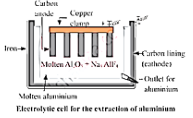
Oxides of reactive metals are directly put into the electrolytic reduction process to obtain the pure metal. For the oxide of a reactive metal like aluminium oxide, as the metal is already in its oxide state so, it is directly put for the electrolytic reduction process. In this process, graphite electrodes are used as anode and cathode in the electrolytic chamber. Pure aluminium is attracted to the cathode, which is a lining of graphite. The oxygen is attracted to the anode and bubbles through the
solution.
Cathode reaction: At the cathode reduction of aluminium takes place and aluminium is discharged
$Al ^{3+}+3 e ^{-} \rightarrow Al$
Anode reaction: At the anode oxidation takes place and oxygen gas is evolved.
$2 O ^{2 *} \rightarrow O _2+4 e ^{-}$
Image
View full question & answer
Question 83 Marks
$i.$ Which types of metals can be obtained in their pure form by just heating their oxides in air? Give one example.
$ii.$ Consider the reaction given below used to obtain Manganese metal in pure form:
$3 MnO _2(s)+4 Al ( s ) \longrightarrow 3 Mn ( l )+2 Al _2 O _3(s)+$ Heat
$a.$ What type of reaction is it?
$b.$ What is the role of aluminium in this reaction?
Answer
$i.$ Metals low in activity series can be reduced to pure metals just by heating their oxides in presence of air, example mercury $(Hg):$
$\underset{\text { Mercurous oxide }}{2 HgO ( s )} \xrightarrow{ Heat } \underset{\text { Mercury }}{2 Hg ( l )}+ O _2$ (g)
$ii. a.$ The given reaction is a displacement reaction.
$b.$ Aluminium is more reactive than manganese used as a reducing agent, as $Al$ is capable of replacing Mn from $MnO_2.$
View full question & answer
[3 Mark Questions] - Science STD 10 Questions - Vidyadip