MCQ
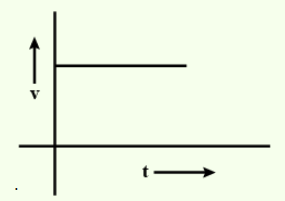
What can you say about the motion of an object if its speed-time graph is a straight line parallel to the time axis?
- AObject is moving with uniform acceleration
- ✓Object is moving with uniform speed
- CObject is moving at rest
- DNone
Generate a complete, print-ready paper with questions like this in minutes — across 16+ boards, with answer keys.
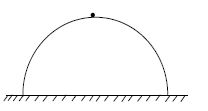
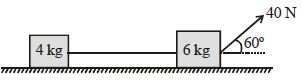
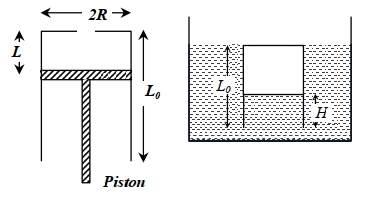
$1.$ The piston is now pulled out slowly and held at a distance $2 \mathrm{~L}$ from the top. The pressure in the cylinder between its top and the piston will then be
$(A)$ $\mathrm{P}_0$ $(B)$ $\frac{\mathrm{P}_0}{2}$ $(C)$ $\frac{P_0}{2}+\frac{M g}{\pi R^2}$ $(D)$ $\frac{\mathrm{P}_0}{2}-\frac{\mathrm{Mg}}{\pi \mathrm{R}^2}$
$2.$ While the piston is at a distance $2 \mathrm{~L}$ from the top, the hole at the top is sealed. The piston is then released, to a position where it can stay in equilibrium. In this condition, the distance of the piston from the top is
$(A)$ $\left(\frac{2 \mathrm{P}_0 \pi \mathrm{R}^2}{\pi \mathrm{R}^2 \mathrm{P}_0+\mathrm{Mg}}\right)(2 \mathrm{~L})$ $(B)$ $\left(\frac{\mathrm{P}_0 \pi R^2-\mathrm{Mg}}{\pi R^2 \mathrm{P}_0}\right)(2 \mathrm{~L})$
$(C)$ $\left(\frac{\mathrm{P}_0 \pi \mathrm{R}^2+\mathrm{Mg}}{\pi \mathrm{R}^2 \mathrm{P}_0}\right)(2 \mathrm{~L})$ $(D)$ $\left(\frac{\mathrm{P}_0 \pi \mathrm{R}^2}{\pi \mathrm{R}^2 \mathrm{P}_0-\mathrm{Mg}}\right)(2 \mathrm{~L})$
$3.$ The piston is taken completely out of the cylinder. The hole at the top is sealed. A water tank is brought below the cylinder and put in a position so that the water surface in the tank is at the same level as the top of the cylinder as shown in the figure. The density of the water is $\rho$. In equilibrium, the height $\mathrm{H}$ of the water column in the cylinder satisfies
$(A)$ $\rho g\left(\mathrm{~L}_0-\mathrm{H}\right)^2+\mathrm{P}_0\left(\mathrm{~L}_0-\mathrm{H}\right)+\mathrm{L}_0 \mathrm{P}_0=0$
$(B)$ $\rho \mathrm{g}\left(\mathrm{L}_0-\mathrm{H}\right)^2-\mathrm{P}_0\left(\mathrm{~L}_0-\mathrm{H}\right)-\mathrm{L}_0 \mathrm{P}_0=0$
$(C)$ $\rho g\left(\mathrm{~L}_0-\mathrm{H}\right)^2+\mathrm{P}_0\left(\mathrm{~L}_0-\mathrm{H}\right)-\mathrm{L}_0 \mathrm{P}_0=0$
$(D)$ $\rho \mathrm{g}\left(\mathrm{L}_0-\mathrm{H}\right)^2-\mathrm{P}_0\left(\mathrm{~L}_0-\mathrm{H}\right)+\mathrm{L}_0 \mathrm{P}_0=0$
Give the answer question $1,2$ and $3.$