Question
What causes variation in velocity of a particle?

Answer

The velocity of a particle changes due to either of the following three causes :
  1. Change in magnitude of velocity.
  2. Change in direction of motion only.
  3. Change in magnitude as well as direction of the motion.

Need a full question paper?

Generate a complete, print-ready paper with questions like this in minutes — across 16+ boards, with answer keys.

Start Generating Free

Similar questions

A metal sphere of radius $R$ is charged to a potential $V:$
  1. Find the electrostatic energy stored in the electric field within a concentric sphere of radius $2R.$
  2. Show that the electrostatic field energy stored outside the sphere of radius $2R$ equals that stored within it.
In Searle's experiment, the diameter of the wire as measured by a screw guage of least count 0.001cm is 0.500cm. The length, measured by a scale of least count 0.1cm is 110.0cm. When a weight of 40N is suspended from the wire, its extension is measured to be 0.125cm by a micrometer of least count 0.001cm. Find the Young's modulus of the material of the wire from this data.
Though India now has a large base in science and technology, which is fast expanding, it is still a long way from realising its potential of becoming a world leader in science. Name some important factors, which in your view have hindered the advancement of science in India.
To what depth must a rubber ball be taken in deep sea so that its volume is decreased by $0.1\%$.
(The bulk modulus of rubber is $9.8 \times 10^8N m^{-2}$, and the density of sea water is $10^3kg m^{-3}$.)
Consider a sample of oxygen at 300K. Find the average time taken by a molecule to travel a distance equal to the diameter of the earth.
Two charged particles, having equal charges of $2.0 \times 10^{-5}C$ each, are brought from infinity to within a separation of 10cm. Find the increase in the electric potential energy during the process.
Two thermometers are constructed in the same way except that one has a spherical bulb and the other has an elongated cylindrical bulb. Which one will respond quickly to the temperature changes? Why?
Calculate the ratio of the angular momentum of the earth about its axis due to its spinning motion to that about the sun due to its orbital motion. Radius of the earth = 6400km and radius of the orbit of the earth about the sun = $1.5 \times 10^8km$.
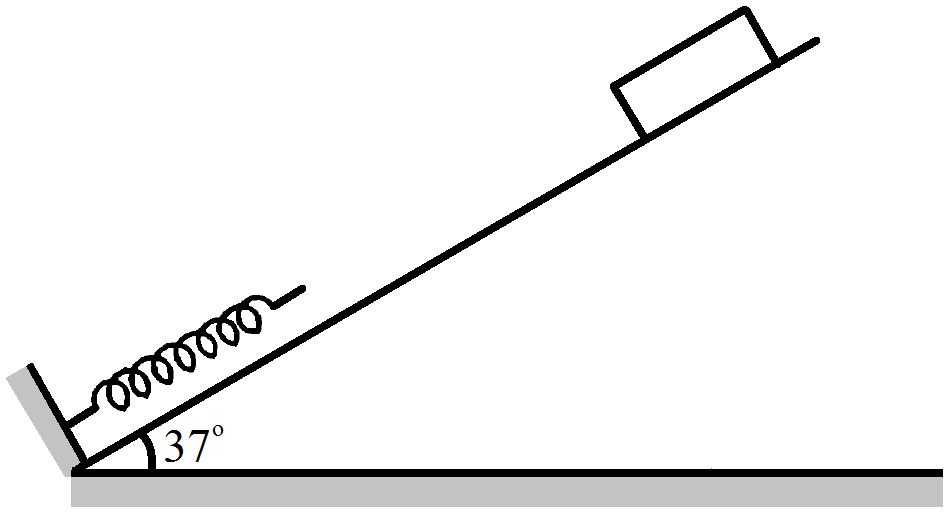
Figure shows a spring fixed at the bottom end of an incline of inclination $37^\circ $. A small block of mass $2\ kg$ starts slipping down the incline from a point $4.8m$ away from the spring. The block compresses the spring by $20\ cm$, stops momentarily and then rebounds through a distance of $1m$ up the incline. Find.
  1. The friction coefficient between the plane and the block.
  2. The spring constant of the spring. Take $g = 10m/s^2$​​​​​​​.
State first law of thermodynamics. What are its limitations? Why $C_p > C_v$?