Question
What do you know about complex tissue Classify and explain its different types in plants with suitable diagrams.

Answer

The complex tissue consists of more than one type of cells having a common origin. They are of two types:
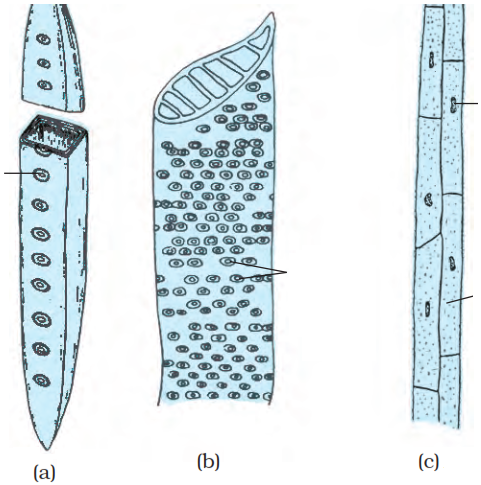
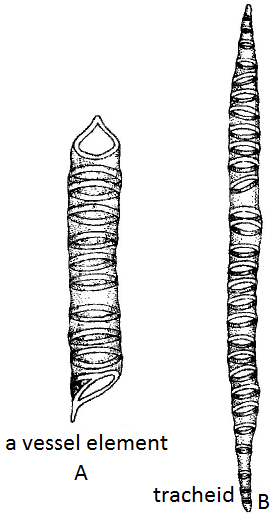
  1. Xylem: Xylem is a vascular and mechanical tissue which conducts water. Xylem is composed of cells of four different types:
  1. Tracheids.
  2. Vessels or tracheae.
  3. Xylem parenchyma.
  4. Xylem Sclerenchyma.
Except xylem parenchyma, all other xylem elements are dead and bounded by thick lignified walls. Vessels are shorter and wider than tracheids. Vessels are very long tube-like structures formed by a row of cells placed end to end. Tracheids are elongated cells with tapering ends. They also conduct water.
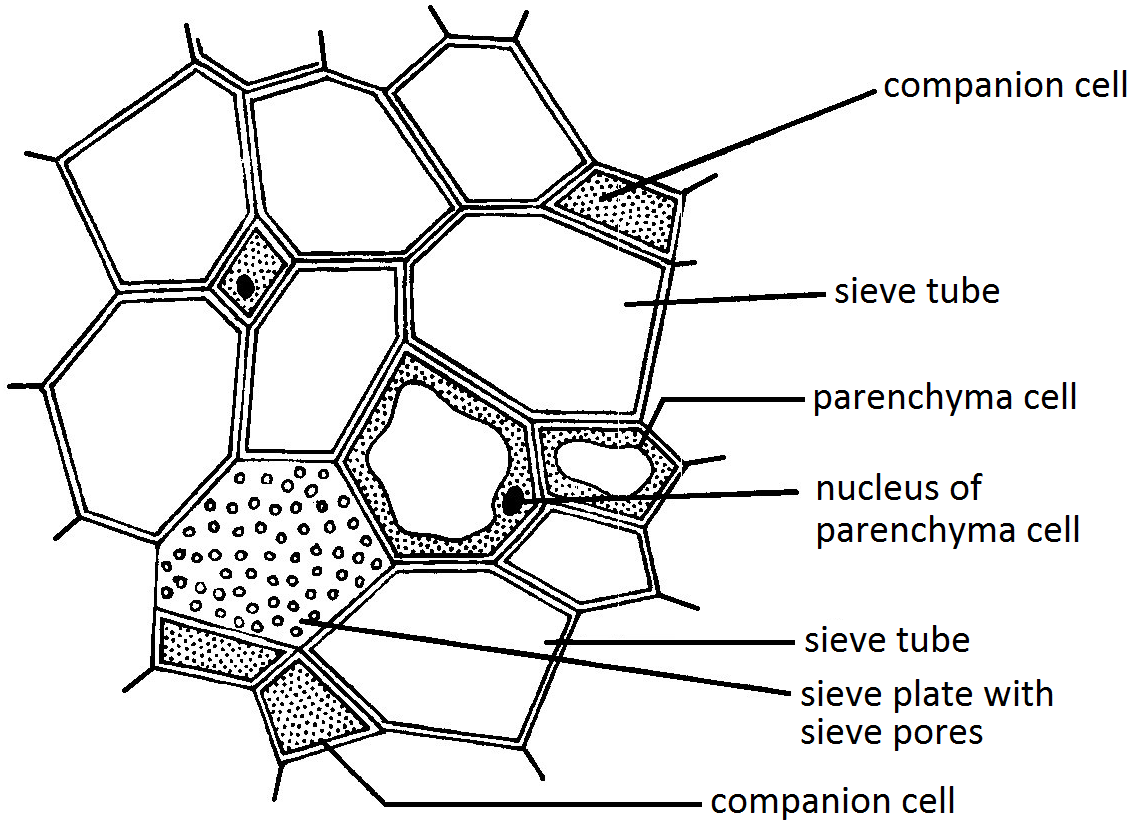
  1. Phloem: Phloem is also a vascular tissue which transports food from the leaves to the various parts of the plant. It is composed of:
  1. Sieve tubes: Sieve tubes are slender, tube-like structures composed of elongated thin-walled cells, placed end to end. Their end walls are perforated by numerous pores and are called sieve plates.
  2. Companion Cells: It is a small thin-walled cell containing dense and very active cytoplasm and large elongated nucleus.
  3. Phloem parenchyma: These are thin-walled, living cells of parenchyma of phloem. They have two functions, storage and slow lateral conduction of food.
  4. Phloem Fibres: These are thick-walled, elongated spindled shaped dead cells which posses narrow lumen. They provide mechanical strength to the tissue.

Need a full question paper?

Generate a complete, print-ready paper with questions like this in minutes — across 16+ boards, with answer keys.
Start Generating Free

Similar questions

How does the force of attraction between the two bodies depend upon their masses and distance between them?
An atom of an element $X$ may be written as $^{9}_4\text{X} $
  1. What does the figure $9$ indicate?
  2. What does the figure $4$ indicate?
  3. What is the number of protons in atom $X$?
  4. What is the number of neutrons in atom $X$?
  5. What is the number of electrons in atom $X$?
  6. How many electrons are there in the outermost shell of an atom of element $X$?
  7. Write the symbol of ion formed by an element $Z$ is $2, 8, 8.$
  1. Identify the structures marked below as A, B and C.
  2. Complete the labeling of each structure.
  3. Write the function of each structure.
What is a soundboard? Explain the working of a soundboard with the help of a labelled diagram.
Suggest some preventive measures for the diseases of poultry birds.
Write the modes by which insects affect the crop yield.
State the law of constant proportions. Give one example to illustrate this law.
Write an activity to show that water can be made to boil even at a temperate below its normal boiling point $(100^\circ C)$.
One of the forms of a naturally occurring solid compound $P$ is usually used for making the floors of houses. On adding a few drops of dilute hydrochloric acid to $P,$ brisk effervescence are produced. When $50g$ of reactant $P$ was heated strongly, than $22g$ of a gas $Q$ and $28g$ of a solid $R$ were produced as products. Gas $Q$ is the same which produced brisk effervescence on adding dilute $\text{HCl}$ to$ P.$ Gas $Q$ is said to cause global warming whereas solid $R$ is used for white$-$washing.
  1. What is $(i)$ solid $P (ii)$ gas $Q,$ and $(iii)$ solid $R.$
  2. What is the total mass of $Q$ and $R$ obtained from $50g$ of $P$?
  3. How does the total mass of $Q$ and $R$ formed compare with the mass of $P$ taken?
  4. What conclusion do you get from the comparison of masses of products and reactant?
  5. Which law of chemical combination is illustrated by the example given in this problem?
Differentiate between sclerenchyma and parenchyma tissue. Draw well labelled diagram.