Question
What do you mean by elevation of boiling point and molal elevation constant? Give the formula or equation to determine the molar mass from elevation of boiling point.
Answer

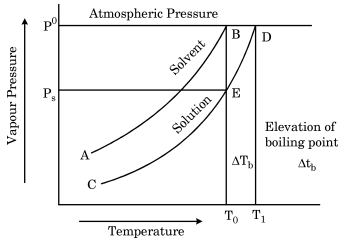
Boiling point of a liquid, is characteristic temperature at which its vapour pressure becomes equal to the atmospheric pressure. The boiling of a liquid depends on the atmospheric pressure. A liquid, therefore, boils at relatively lower temperature. Also liquid boils at relatively higher temperature at places where pressure is relatively higher. As the vapour pressure of a solution containing a non-volatile solute is lower than that of the solvent, its boiling point is higher than that of the solvent. The increase in boiling point is known as elevation in boiling point.
Image
$ \Delta T_{b} = T_{1} - T_{0} $
Since for a solution, decrease in vapour pressure $ \propto $ m (molality) of solution. Thus, $ \Delta T_{b} \propto m $
and $ \Delta T_{b} = K_{b} \times m = \frac{K_{b} \times w_{2} \times 1000}{M_{2} \times w_{1}} $
To find molecular mass of solute
$ M_{2} = \frac{K_{b} \cdot w_{2} \cdot 1000}{\Delta T_{b} \cdot w_{1}} $
where $ K_{b} $ is molal elevation constant or ebullioscopic constant. $ K_{b} $ has units of K/m or K kg $ mol^{-1} $. For water $ K_{b} = 0.52~kg~mol^{-1} $.

Need a full question paper?

Generate a complete, print-ready paper with questions like this in minutes — across 16+ boards, with answer keys.
Start Generating Free

Similar questions

What is the relationship between Gibbs free energy of the cell reaction in a galvanic cell and the emf of the cell? When will the maximum work be obtained from a galvanic cell?
The rate constant for the first order decomposition of $\ce{H_2O_2}$ is given by the following equation:
$\log k = 14.34 – 1.25 \times 10^4K/T$
Calculate $E_a$ for this reaction and at what temperature will its half$-$period be $256$ minutes?
i. How will you convert:
a. Nitrobenzene to phenol,
b. Aniline to chlorobenzene
  1. What are essential and non-essential amino acids? Give two examples of each.
  2. What are the two types of photosynthesis in green plants? Give the basic equations of photosynthesis.
  3. Mention the two products of glycolysis.
Write a detailed note on enzymes.
Cyclobutyl bromide on treatment with magnesium in dry ether forms an organometallic A. The organometallic reacts with ethanol to give an alcohol B after mild acidification. Prolonged treatment of alcohol B with an equivalent of HBr gives 1-bromo-1-methyl cyclopentane $C$. Write the structures of $A, B$ and explain how the $C$ is obtained from B?
Write the principle of manufacture of ammonia by Haber's process. How does it react with $ CuSO_{4} $ solution?
(a) What is van't Hoff factor? Explain.
(b) Write the equation of molecular number properties including van't Hoff factor.
Explain Kohlrausch's law of independent migration of ions. Mention the application of Kohlrausch's law.
(a) Draw the structure of a galvanic cell and also describe the reaction taking place in it.
(b) What happens when opposite external potential is applied in the galvanic cell system? Explain.