Question
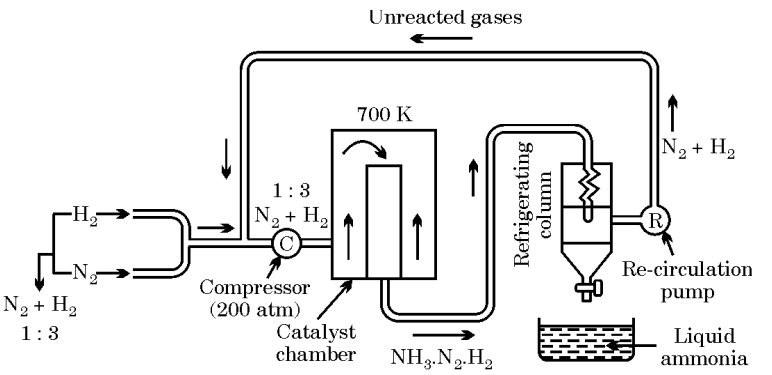
Write the principle of manufacture of ammonia by Haber's process. How does it react with $ CuSO_{4} $ solution?

Answer

Need a full question paper?

Generate a complete, print-ready paper with questions like this in minutes — across 16+ boards, with answer keys.

Start Generating Free

Similar questions

$FeSO_4$ solution mixed with $\left( NH _4\right)_2 SO _4$ solution in $1:1$ molar ratio gives the test of $Fe ^{2+}$ ion but $CuSO _4$ solution mixed with aqueous ammonia in $1: 4$ molar ratio does not give the test of $Cu ^{2+}$ ion. Explain why?
Write equations of the following reactions :
(i) Friedel Crafts reaction-alkylation of anisole.
(ii) Nitration of anisole.
(iii) Bromination of anisole in ethanoic acid medium.
(iv) Friedel Crafts acetylation of anisole.
The experimental data for decomposition of N2O5
$\left[2 N_2 O _5 \rightarrow 4 NO _2+ O _2\right]$
in gas phase at 318 K are given below :
t/s$10^{-2} \times\left[ N _2 O _5\right] / mol L ^{-1}$
01.63
4001.36
8001.14
12000.93
16000.78
20000.64
24000.53
28000.43
32000.35

(i) Plot [N2O5] against t.
(ii) Find the half-life period for the reaction.
(iii) Draw a graph between log[N2O5] and t.
(iv) What is the rate law?
(v) Calculate the rate constant.
(iv) Calculate the half-life period from k and compare it with (ii).
I. Show how p-aminoazobenzene can be obtained from aniline.
II. Write structures for the following compounds:
   a. Benzene diazonium chloride
   b. p-Nitrotoluene
   c. Sulphanilic acid
  1. Define the following terms:
  1. Co-enzymes.
  2. Mutation in biomolecules.
  3. Nucleotides.
  1. List four main functions of carbohydrates in organisms.
Match the terms given in Column I with the units given in Column II.
 
Column I   Column II
i. $\text{K}$ a. $\text{I}\times\text{t}$
ii. $\wedge_{\text{m}}$ b. $\frac{\wedge_{\text{m}}}{\wedge^\circ_\text{m}}$
iii. $\alpha$ c. $\frac{\text{k}}{\text{c}}$
iv. $\text{Q}$ d. $\frac{\text{G}^*}{\text{R}}$
Calculate the depression in the freezing point of water when 10 g of
CH3CH2CHClCOOH is added to 250 g of water. Ka = 1.4 × 10⁻³, Kf = 1.86 K kg mol-1.
$\ce{COSO_4Cl._5NH_3}$ exists in two isomeric forms $'A\ '$ and $'B\ '.$ Isomer $'A\ '$ reacts with $AgNO_3$ to give white precipitate but does not react with $BaCl_2.$ Isomer $'B\ '$ gives a white precipitate with $BaCl_2$ but does not react with $AgNO_3.$ Answer the following questions.
i. Identify $'A\ '$ and $'B\ '$ and write their structural formulas.
ii. Name the type of isomerism involved.
iii. Give the $\text{IUPAC}$ name of $'A\ '$ and $'B\ '.$
Indicate the types of isomerism exhibited by the following complexes and draw the structures for these isomers:
i. $\ce{k \left[ Cr \left( H _2 O \right)_2\left( C _2 O _4\right)_2\right]}$
ii. $\ce{\left[ Co ( en )_3\right] Cl _3}$
iii. $\ce{\left[ Co \left( NH _3\right)_5\left( NO _2\right)\left( NO _3\right)_2\right]}$
iv. $\ce{ \left [ Pt ( NH _3) ( H _2 O ) Cl _2\right].}$
Which of the following compounds would undergo aldol condensation, which the Cannizzaro reaction and which neither? Write the structures of the expected products of aldol condensation and Cannizzaro reaction.
  1. Methanal
  2. 2-Methylpentanal
  3. Benzaldehyde
  4. Benzophenone
  5. Cyclohexanone
  6. 1-Phenylpropanone
  7. Phenylacetaldehyde
  8. Butan-1-ol
  9. 2,2-Dimethylbutanal.