Question
Explain the divisions of the nervous system.

Answer

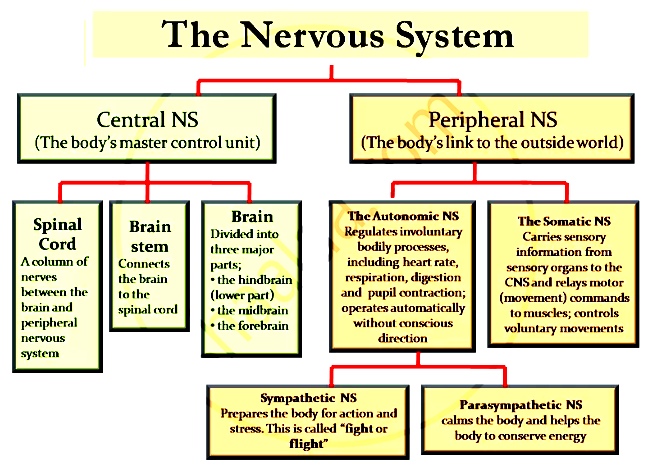
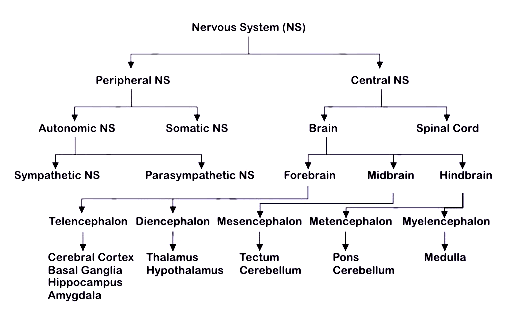
The nervous system is divisible into three regions:
(i) Central nervous system: Includes brain and spinal cord.
(ii) Peripheral nervous system: Includes spinal and cranial nerves.
(iii) Autonomic nervous system: Includes the sympathetic and parasympathetic nerves.

Need a full question paper?

Generate a complete, print-ready paper with questions like this in minutes — across 16+ boards, with answer keys.

Start Generating Free

Similar questions

Given below is the diagram of the human ear. Study the diagram and then answer the questions that follow:
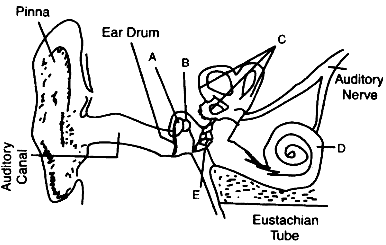
(i) What role does the eardrum play in hearing?
(ii) What common term is given to the parts labeled A, B, and E?
(iii) Would there be any difference if these three parts mentioned in (ii) above were replaced by one by one? Why?
(iv) Give the biological term for the parts labeled C and D.
(v) Name the fluid which fills the parts mentioned in (iv) above.
(vi) State the functions of the ear.
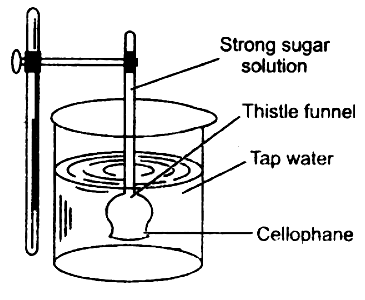
The diagram below represents an experimental set up to demonstrate a vital process. Study the same and then answer the questions that follow:


(i) Name the process.
(ii) Define the above named process.
(iii) What would you observe in the experimental setup after an hour or so?
(iv) What control experiment can be set up for the above experiment?
(v) Keeping in mind the root hair cell and its surrounding name the part that corresponds to (1) Concentrated sugar solution, (2) Parchment paper, (3) Water in the beaker.
(vi) Name any other substance that can be used instead of parchment paper in the above experiment.
(vii) Mention two advantages of this process to the plant.
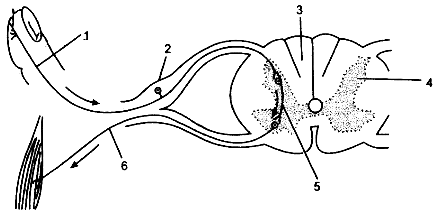
The diagram given below is a representation of a certain phenomenon pertaining to the nervous system. Study the diagram and answer the following questions:

(i) Name the phenomenon which is being depicted.
(ii) Give the technical term for the point of contact between the two nerve cells.
(iii) Name the parts 1, 2, 3, and 4.
(iv) Write the functions of parts 5 and 6
(v) How does the arrangement of neurons in the spinal cord differ from that of the brain?
Briefly discuss Lamarckian Theory of Inheritance citing an appropriate example.
Describe an experiment to prove that transpiration occurs more from the lower surface of a leaf.
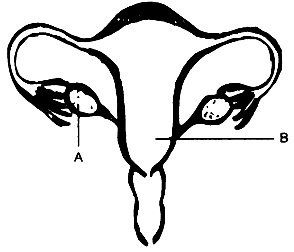
Study the diagram given below and then answer the questions that follow:

(i) Name the part labeled A. Name any two hormones produced by the part labeled A.
(ii) What happens to the part labeled B.
(1) if fertilization takes place?
(2) If fertilization does not take place?
(iii) Where does fertilization occur?
(iv) Draw a neat diagram of the human sperm as seen under high magnification and label the following parts.
(1) Acrosome
(2) Mitochondria
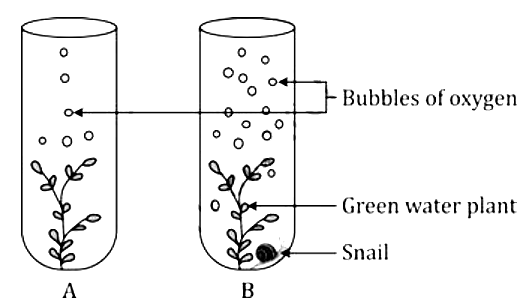
The diagram below shows two test-tubes A and B. Test-tube A contains a green water plant. Test-tube B contains both a green water plant and a snail. Both test-tubes are kept in sunlight. Answer the questions that follow:

(a) Name the physiological process that releases the bubbles of oxygen.
(b) Explain the physiological process as mentioned above in (a).
(c) What is the purpose of keeping a snail in test-tube B?
(d) Why does test-tube B have more bubbles of oxygen?
(e) Give an example of a water plant that can be used in the above experiment.
(f) Write the overall chemical equation for the above process.
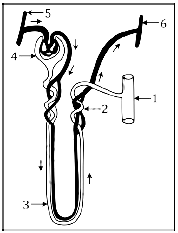
The given diagram represents a nephron and its blood supply. Study the diagram and answer the following questions:
(i) Label parts 1, 2, 3 and 4.
(ii) State the reason for the high hydrostatic pressure in the glomerulus.
(iii) Name the blood vessel which contains the least amount of urea in this diagram.
(iv) Name the two main stages of urine formation.
(v) Name the part of the nephron which lies in the renal medulla.
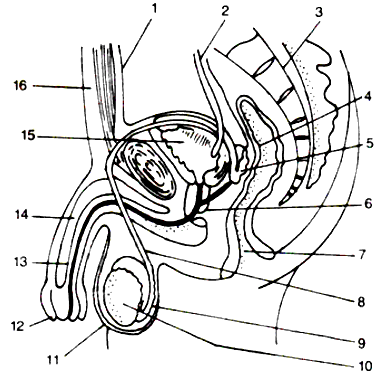
Given on the right is a diagram which represents the reproductive organs of a man:
(i) Write the names of the parts numbered 1 to 16.
(ii) Give two functions of the part 6.
(iii) Name three components of the fluid which may be found in the tube labeled 2.
(iv) What is the main function of the part labelled 3?
With well labelled diagrams explain meiosis.