Questions

5 Marks Questions

🎯

Test yourself on this topic

4 questions · timed · auto-graded

Question 15 Marks
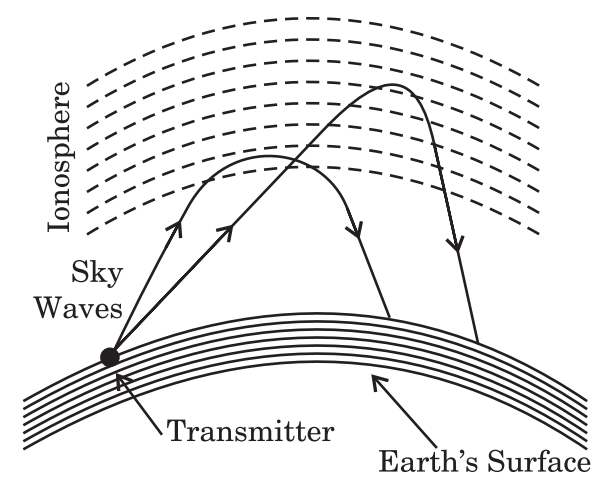
(i) Which mode of propagation is used by short wave broadcast services having frequency range from a few MHz to 30 MHz? Explain diagrammatically how long distance communication can be achieved by this mode.
(ii) Why is there an upper limit to frequency of waves used in this mode ?
Answer
(i) Sky wave propagation is used by short wave broadcast services having frequency range from few MHz to 30 MHz.
Long Distance Communication by Sky Wave Propagation : The radio waves which travel from the transmitting to the receiving antenna after being reflected from the ionosphere are called 'sky waves' and the phenomenon is known as 'sky-wave propagation'. In this mode of transmission radio waves can travel through very large distances and can even travel around the earth.
Mechanism of reflection of Sky Waves from the ionosphere : The reflection of e.m. waves from the ionosphere is caused by the oscillating electric field of e.m. waves (say of frequency $\omega$) that changes the velocity of electrons in the ionosphere. It changes the effective dielectric constant $\in^{\prime}$ and also the refractive index $n^{\prime}$ as compared to free space with value of the above quantities as $\omega_0$ and $n_{0}$, respectively. These quantities are related as follows :
$n^{\prime}=\sqrt{\varepsilon^{\prime} \mu_0}$
$=\sqrt{\varepsilon_0 \mu_0\left[1-\left( N e^2 \varepsilon_0 m \omega^2\right)\right]}$
or $n^{\prime}=n_0\left[1-\left(N e^2 / \varepsilon_0 m \omega^2\right)\right]^{1 / 2}$ ...(1)
Image
where $e$ is the electronic charge, $m$ is the mass of electron and $n$ is the density of electrons in ionosphere. The ionosphere behaves as a rarer medium because its refractive index is less than its free space value of no. Therefore, the wave turns away from the normal when it enters the ionosphere. As we go deep into the ionosphere (the density of electrons, N is large), the refractive index keeps on decreasing. The bending of the beam will continue till it reaches the critical angle after which it is reflected back. It is seen from equation (1) that different frequencies (ω) will be reflected from different regions of the ionosphere having different values of N. Therefore, different points on earth receive signals reflected from different depths of the ionosphere. In case, the frequency is too high, then after a certain value the electron density N may never be so high as to produce enough bending for attaining critical angle. This is called critical frequency. If the maximum electron density of the ionosphere is Nmax per m³, then the critical frequency $f_c$ is approximately calculated by :
$f_c=9\left(N_{\max }\right)^{1 / 2}$
The $f_c$ ranges approximately from 5 to 10 MHz . If the frequencies are higher than this range, they cross the ionosphere and do not come back to the earth.
(ii) There is an upper limit because for frequencies above 30 MHz radiowaves penetrate through ionosphere and escape i.e. never come back to earth.

View full question & answer
Question 25 Marks
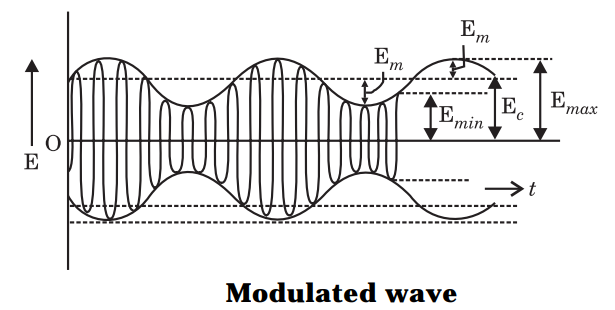
What do you mean by modulation ? Define modulation index. For an amplitude modulated wave the maximum and minimum amplitude is ' $a$ ' and ' $b$ '. Calculate modulation index for it.
View full question & answer
Question 35 Marks
Write the need of modulation in communication system.
Answer
Need of Modulation : Modulation is necessary due to the following three reasons:
(i) Size of the antenna: For transmitting a signal, we need an antenna. This antenna should have a size comparable to the wavelength $\lambda$ of the signal (at least $\lambda/4$ in dimension) so that the antenna properly senses the time variation of the signal. For an electromagnetic wave of frequency 20 kHz the wavelength is 15 km. Obviously, such a long antenna is not possible to construct and operate. Hence direct transmission of such base band signals is not practical. We can obtain transmission with reasonable antenna lengths if transmission frequency is high (for example, if $v$ is 1 MHz, then $\lambda$ is 300 m). Therefore, there is a need of translating the information contained in our original low frequency base band signal into high or radio frequencies before transmission.
(ii) Effective power radiated by an antenna : A theoretical study of radiation from a linear antenna (length $l$) shows that the power radiated is proportional to $(l/\lambda)^{2}$ or directly proportional to the $v^{2}$. This implies that for the same antenna length, the power radiated increases with decreasing $\lambda$, i.e., increasing frequency. Hence, the effective power radiated by a long wavelength baseband signal would be small. For a good transmission, we need high powers and hence this also points out to the need of using high frequency transmission.
(iii) Mixing up of signal : If a number of transmitters are transmitting base band signals simultaneously, then all these signals cover the same frequency range (20 Hz to 20 kHz) and will get mixed up. If transmission is being done at a high frequency, different users may use adequate band width for that given high frequency.

View full question & answer
Question 45 Marks
(A) Explain the follwing :
(i) E-mail, (ii) File transfer, (iii) WWW, (iv) Fax, (v) E-commerce, (vi) Instant Relay Chat (IRC).
(B) What is co-axial cable ? State its uses.
Answer
(A) (i) E-mail (Electronic Mail) : It is a system of creating, sending and storing textual message (with or without multimedia attachments) in a digital form over the internet. To use an E-mail service one needs to have an E-mail account (E-mail ID) with any free mail service like E-mail, Yahoo mail, hot mail, etc. or with a paid E-mail provider like Fast mail. Paid E-mail.com America online. Apple, Netzero etc. free E-mail services are generally provided by an Internet Service Provider (ISP) for personal E-mail account. For sending bulk business mails, one needs to have a paid E-mail account.
E-mails are easy to use, reliable and cost effective. Using e-mail attachments you can send text audio, video and other types of files to the mail recipients.
E-mail address has two components a Username and a Domain name for Host server. Theses two parts are separated by the symbol @.
The domain name, which comes after the symbol @ may also include an extension other than which can stands for commercial business. It may be on educational institution (edu) or organisation (org) or government departments (gov.) Countries have fixed domain name, for example the domain name of the United Kingdom is 'uk' for India is in 'in'.
Thus for example for a person named U.K. Mishra working in a Regional Engineering College located in State Odisha in India, his e-mail address can be written as follows : uk-mishra@rec.orinic.in
Using SMPT (Simple Mail Transfer Protocol) e-mail is sent over the Interest to the server (i.e., the network that provide the service) with the correct domain name where it remains in the recipients mail till it is read.
(ii) File Transfer : If one wants to copy files from one computer to another that is halfway around the world he would probably use his internet connection. File transfers over the internet use special techniques of which one of the oldest and most widely used is F.T.P. which is the short form of File Transfer Protocol. It can transfer files between any computers that have an internet connection and also work between computer D using totally different operating system.
F.T.P. is an application protocol that uses the internet's (TCP/IP) protocol to transfer webpage from a client computer to a web server.
Transferring files from a client computer to a server computer is called uploading and transferring them from a server to a client is called downloading. Once a file gets uploaded on the internet any one can view it. F.T.P is also commonly used to download programs and other files to the computer from the web servers. Each file on an F.T.P. server is given an address (URL) so that other computers connected to the internet may find it. Users can then either use an F.T.P. client or a web browser to either download the files or upload them to the server.
(iii) World Wide Web (WWW) : On Internet information is provided/available through webpages that may contain text, images, videos etc. One can move from one webpage of an internet to another through a system called interlinked hypertext ducuments.
This way of accessing information on Internet through interlinking of webpage is called www or world wide web. Any one can provide specific information on Internet by making a couple of webpages containing that information. Such a set of webpages together constitute Website. One can design a website of own organization containing information about its different aspect and its activities.
The term webpage refers to an electronic page of information designed to be distributed over the world wide web. Webpages can have a mix of text grapics and multimedia. A website is a collection of webpages that are under one domain.
Moving on Internet from one webpage/website to another is called Internet surfing. It is an interesting way of searching and viewing information on any topic of interest.
WWW is a system of interest servers that support hypertext to access serveral internet protocols on a single interface. It is the most widely used service which is accessed through a software called the web browser.
The internet explorer, Mozilla, Fire Fox, Google Chrome etc. are some web browsers by using which you can access this huge digital library with innumerable articles, journals, e-books, views and tutorials stored in the form of webpages on many computers around the world, called web servers. Thousands of new webpages/ websites are added to the www every hour.
(iv) Fax : In addition to the transmission of speech music or coded data many times one may want to transmit a document or a photograph. This can be done by fascimile commonly known as fax transmission. Fascimile means exact copy of documant or photograph. This electronic reproduction of a document or photograph at a distant place is called fascimile telegraphy i.e. FAX. The different parts of a document or photograph are first scanned by a light source and optical signals carrying the information regarding the patterns, writings, signatures etc. The optical signals are converted into electrical signals by photo-detector. These signals are coded and transmitted by a suitable communication method.
(v) E-commerce (Electronic Commerce) : The term E-commerce encompasses all business related activities via., the internet. It provides a wider choice of goods and great convenience to the customers. It allows them to buy goods, pay bills, at the click of the mouse without having to move out of their home or office. It is called E-shopping also. Various Malls are available on Internet where one can view and order to purchase various products. Buying products through product selling websites is called e-shopping. These websites provide the buyer pay cash on delivery or making online payments (using e-banking or credit cards) options. Similarly, there are websites on which one can upload (put) photographs of products, which you want to sell. Thus, this trading of products using Internet along with many other market related activities is called e-commerce.
(vi) Internet Relay Chat (IRC) : Internet Relay Chat commonly termed as chatting is a multi-user, multi channel chatting system. It is a free service using which we can communicate with people all over the world. Using this we can type and read each other's messages through our computers over the internet all in no time. It is called social networking also.
It is a service providing a platform to the people having same interests to build a social network. It is a web-based service which allows an individual to create his own profile, list of users, with whom he wants to make contact. This service allows the user to share their ideas, pictures, events, activities etc., with their group.
Some examples of instant relay chat are AOL Instant Messenger i.e., AIM, Yahoo Messenger, MSN Messenger, ICQ, Facebook, Twitter, Google etc.
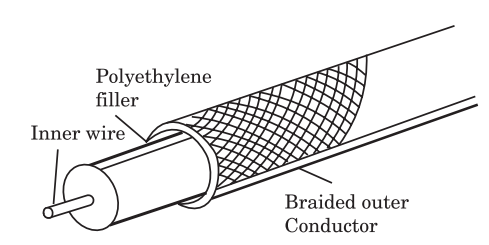
(B) Co-axial cable : The twisted wire transmission line is highly prone to electromagnetic interference. Many types of interference can be acoided by using the shielded co-axial cable. A co-axial cable consists of two conductors- one is the inner conductor which is a signal wire made of copper covered by a P.V.C. insulation and the other is the braided outer conductor. Both of these are separated by an insulator (polyethylene filler). The outer conductor acts as a shield and minimises interference. The outer conductor is normally earthed. Thus it provides an electrical sheilding to the signals carried by the inner conductor.
Image
These are extensively used in long distance telephone lines and as cables for closed circuit TV.
Such cables are normally operated below 18 GHz. and offer a bandwidth of 750 MHz per signal.
Coaxial cable is used in many applications, including :
(i) Cable television : Coaxial cables are used to distribute cable television signals.
Internet connections: Coaxial cables are used to connect cable lines to modems for high-speed broadband internet.
(ii) Audio connections : Coaxial cables are used for digital audio, such as S/PDIF.
(iii) Security cameras : Coaxial cables are used in security camera installations.
(iv) Medical imaging equipment : Coaxial cables are used in medical imaging equipment.
(v) Military and aerospace applications : Coaxial cables are used in military and aerospace applications.
(vi) Connecting to antennas : Coaxial cables are used to connect televisions, home video equipment, and radios to antennas, satellites, and related receivers.
(vii) Amplifying cell phone signals: Coaxial cables can be used to amplify cell phone signals for better reception indoors.
(viii) Amateur radio equipment : Coaxial cables are used for amateur radio equipment.
(ix) Measuring devices : Coaxial cables are used for measuring devices.

View full question & answer