16 questions · timed · auto-graded


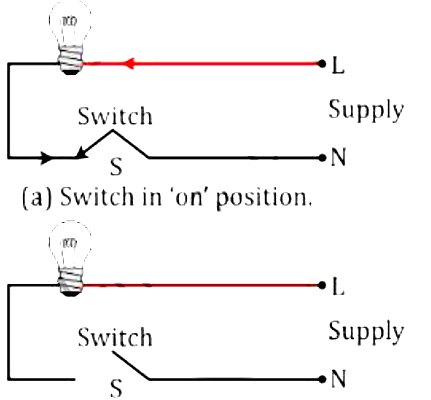
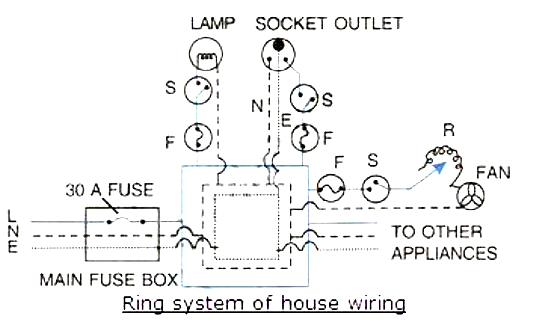
In case of excessive current, it is dangerous to connect the switch in the neutral wire.
Even if the fuse blows off due to excessive current and the current in the circuit would no longer be conducted, the appliance will still remain connected to the live wire of a very high potential.
In such a case, if a person touches the body of that appliance, he/she may suffer a fatal electric shock.
That is why it is highly dangerous to connect the switch with the neutral wire.


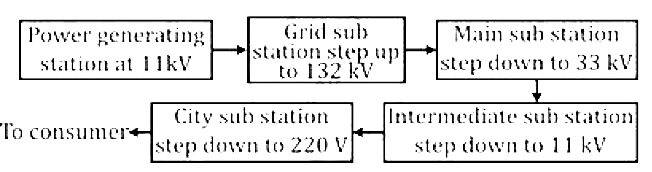
This power from the generating stations is to be transmitted across far away distances.
While transmitting the 11kV power, a lot of energy is lost in the form of heat in the transmission line wires.
Therefore, the voltage of power generated at the stations is raised or stepped up from 11kV to 132kV using the step-up transformer.
As direct current cannot be raised, this process is applicable only for alternating current.
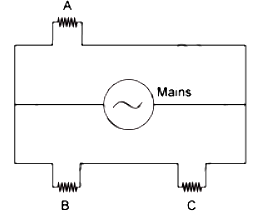
In following figure shows three bulbs A, B and C each of rating 100 W, 220 V connected to the mains of 220 V. Answer the following:
(a) How is the bulb A connected with the mains? At what voltage does it glow?(b) How are the bulbs B and C connected with the mains? At what the bulb A connected with the mains?(c) How is the glow of bulbs A and C affected if bulb B gets fused?(d) How is the glow of bulbs B and C affected if bulb A gets fused?
(a) Bulb A is connected in a parallel connection with the mains.
It will glow when the voltage applied across the bulb is 220 V.
(b) Bulbs B and C are connected in series with the mains. Because of this series connection with the mains, the voltage at which they glow will be divided by two from the main's supply voltage. So, bulb B will glow at 110V.
(c) If bulb B gets fused, bulb C which was connected in series with it will not glow. This will not affect the glow of bulb A, because it is connected parallel with the mains.
(d) If bulb A gets fused, the glow of bulbs B and C will not be affected.