What do you observe in the china dish during crystallization?
Download our app for free and get started
Crystallisation is the process of slow precipitation of solid crystals of a substance from a concentrated homogeneous solution. It is basically a separation method in which a substance is transferred from the liquid (i.e. solution) phase to the solid state. Thus during crystallisation, the substance is obtained in pure crystalline form in china dish which has no impurity. When formation of crystals take place in china dish, we observe that all crystals of different compounds looks different. Some crystals are needle shaped, some are cube shaped and some are hair like which are extremely fine. There are many different forms of crystals. You will learn about them in higher grades.

Download our appand get started for free
Experience the future of education. Simply download our apps or reach out to us for more information. Let's shape the future of learning together!No signup needed.*
Similar Questions
- 1View SolutionWhat is the major difference between a solution and an ordinary mixture?
- 2Which of the tubes in $(a)$ and $(b)$ will be more effective as a condenser in the distillation apparatus?View Solution
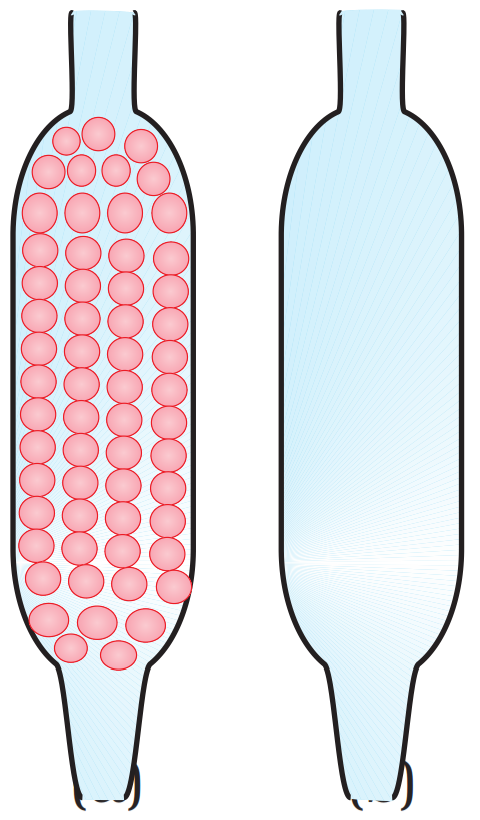
- 3Calculate the mass of potassium sulphate required to prepare its $10 \%$ solution in $100\ g$ of water.View Solution
- 4View SolutionHow will you test whether a given solution is a colloidal solution?
- 5View SolutionWrite two applications of centrifugation techniques.
- 6The teacher instructed three students $‘A’, ‘B’$ and $‘C’$ respectively to prepare a $50 \%$ (mass by volume) solution of sodium hydroxide $(NaOH)$. $‘A’$ dissolved $50g$ of $NaOH$ in $100\ mL$ of water, $‘B’$ dissolved $50\ g$ of $NaOH$ in $100\ g$ of water while $‘C’$ dissolved $50\ g$ of $NaOH$ in water to make $100\ mL$ of solution. Which one of them has made the desired solution and why?View Solution
- 7View SolutionWhich of the following are chemical changes?
- Growth of a plant.
- Rusting of iron.
- Mixing of iron filings and sand.
- Cooking of food.
- Digestion of food.
- Freezing of water.
- Burning of a candle.
- 8View SolutionWhat are the three groups into which all the elements can be divided? Name two elements belonging to each group.
- 9View SolutionDifferentiate between physical and chemical change.
- 10View SolutionName two solid, two liquids and two gaseous elements at the room temperature.