Question
What do you understand by controlled and uncontrolled chain reactions?

Answer

Controlled chain reaction : If the chain reaction of fission can be controlled in such a way that it neither increases nor decreases, that is, such a level of reaction is maintained such that the energy released per second always remains less than the limit of explosion. This is called controlled chain reaction. This type of reaction is used in the production of electrical energy. Controlled chain reaction is the fundamental basis of 'nuclear reactor'.
Uncontrolled chain reaction : In this reaction, on average, more than one neutron takes part in the process of fission out of the neutrons obtained from each fission. Here $K >1$. Due to this, the rate of fission of nuclei increases rapidly and within a few moments tremendous energy is released and causes a massive explosion. This reaction takes place in the atomic bomb.

Need a full question paper?

Generate a complete, print-ready paper with questions like this in minutes — across 16+ boards, with answer keys.
Start Generating Free

Similar questions

  1. At what distance should the lens be held from the figure in Exercise 9.29 in order to view the squares distinctly with the maximum possible magnifying power?
  2. What is the magnification in this case?What is the magnification in this case?
  3. Is the magnification equal to the magnifying power in this case? Explain.
Suppose A and B in the previous problem change their positions in such a way that the line joining them becomes perpendicular to the direction of wind while maintaining the separation x. What will be the time lag B finds between seeing and hearing the drum beating by A?
Write any three characteristics of nuclear force.
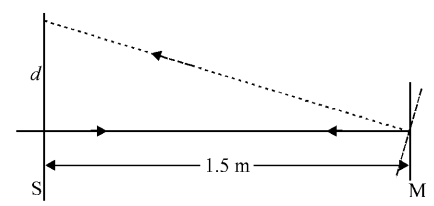
Light incident normally on a plane mirror attached to a galvanometer coil retrace backwards (as shown in Fig.). A current in the coil produces a deflection of 3.5° of the mirror. What is the displacement of the reflected spot of light on a screen placed 1.5 m away? Image
Which waves are electromagnetic waves?Which factors are responsible for their production?
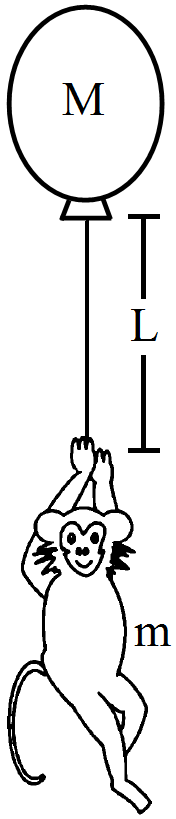
The balloon, the light rope and the monkey shown in figure are at rest in the air. If the monkey reaches the top of the rope, by what distance does the balloon descend ? Mass of the balloon = M, mass of the monkey = m and the length of the rope ascended by the monkey = L.
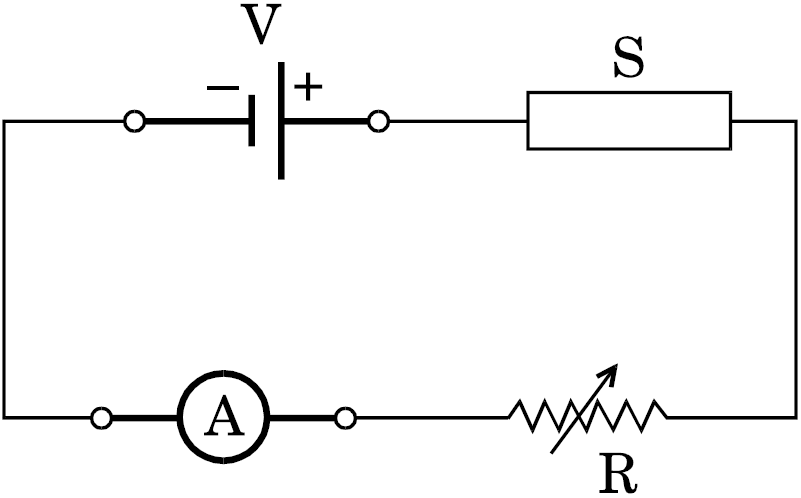
  1. In the following diagram ‘S’ is a semiconductor. Would you increase or decrease the value of R to keep the reading of the ammeter A constant when S is heated? Give reason for your answer.
  1. Draw the circuit diagram of a photodiode and explain its working. Draw its I - V characteristics.
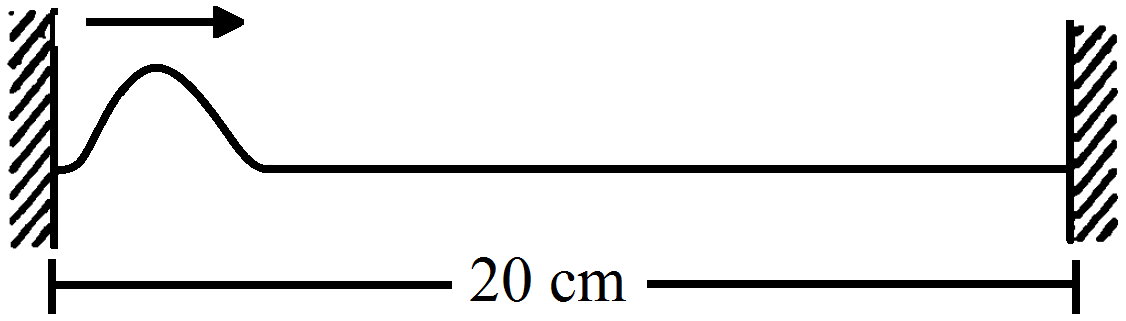
A string of length 20cm and linear mass density 0.40g/cm is fixed at both ends and is kept under a tension of 16N. A wave pulse is produced at t = 0 near an end as shown in figure, which travels towards the other end.
  1. When will the string have the shape shown in the figureagain
  2. Sketch the shape of the string at a time half of that found in part (a).
An electric toaster uses nichrome for its heating element. When a negligibly small current passes through it, its resistance at room temperature $\left(27.0^{\circ} C \right)$ is found to be $75.3 \Omega$. When the toaster is connected to a $230 V$ supply, the current settles, after a few seconds, to a steady value of $2.68 A$. What is the steady temperature of the nichrome element? The temperature coefficient of resistance of nichrome averaged over the temperature range involved, is $1.70 \times 10^{-4}{ }^{\circ} C ^{-1}$.
Distinguish between isotopes and isobars. Give one example for each of the species.