Question
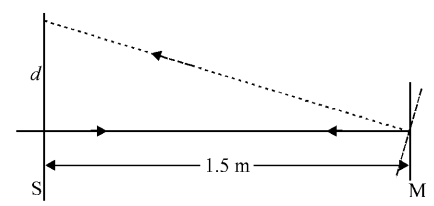
Light incident normally on a plane mirror attached to a galvanometer coil retrace backwards (as shown in Fig.). A current in the coil produces a deflection of 3.5° of the mirror. What is the displacement of the reflected spot of light on a screen placed 1.5 m away? Image
Answer

Here we know that the reflected rays are deflected at an angle twice to the angle of rotation of the mirror. From the figure we see that when the mirror is turned from M to M'position by an angle theta = 3.5 deg The reflected ray OB is bent as:
Image
$\angle 2 \theta=2 \times 3.5^{\circ}=7^{\circ}=\angle AOB$.
In right triangle $AOB , \tan 2 \theta=\frac{ AB }{ AO }$
or $\tan 7^{\circ}=\frac{d}{1.5}$
$\begin{aligned} d & =1.5 \times \tan 7^{\circ} \\ & =1.5 \times 0.1228 \\ & =0.1842 m \\ & =18.42 cm .\end{aligned}$

Need a full question paper?

Generate a complete, print-ready paper with questions like this in minutes — across 16+ boards, with answer keys.

Start Generating Free

Similar questions

State the underlying principle of a potentiometer. Write two factors by which current sensitivity of a potentiometer can be increased. Why is a potentiometer preferred over a voltmeter for measuring the emf of a cell?
  1. Explain briefly the process of emission of light by a Light Emitting Diode (LED).
  2. Which semiconductors are preferred to make LEDs and why?
  3. Give two advantages of using LEDs over conventional incandescent lamps.
An $\alpha -$ particle collides with nucleus after passing through the potential $V$ volt. Prove that distance of closest approach of particle of atomic number $Z$ to the nucleus will be $14.4( Z / V ) \ \mathring A $.
$($Given that : $1 / 4 \pi \varepsilon_0=9.0 \times 10^9$ Newton $-$ meter $^2 /$ Coulomb $^2$ and $e=1.6 \times 10^{-19}$ Coulomb$)$
Why are alloys used for making standard resistance coils?
Two neutral particles are kept 1m apart. Suppose by some mechanism some charge is transferred from one particle to the other and the electric potential energy lost is completely converted into a photon. Calculate the longest and the next smaller wavelength of the photon possible.
How does the resolving power of a compound microscope get affected on:
  1. Decreasing the diameter of its objective?
  2. Increasing the focal length of its objective?
Explain barrier potential of $p-n$ junction.
Figure shows a conducting disc rotating about its axis in a perpendicular magnetic field B. A resistor of resistance R is connected between the centre and the rim. Calculate the current in the resistor. Does it enter the disc or leave it at the centre? The radius of the disc is 5.0cm, angular speed $\omega=10 \ \text{rad/s}, \ \text{B}=0.40\text{T}$ and $\text{R}=10\Omega.$
Draw a plot of potential energy of a pair of nucleons as a function of their separations. Mark the regions where the nuclear force is (i) attractive and (ii) repulsive. Write any two characteristic features of nuclear forces.
Area of a parallel plate capacitor is A and distance between them is $d$. It is charged with a constant current of I. An element of area $\frac{A}{2}$ is kept in the middle of the plates, parallel to the plates. What is the current flowing through this area?