Questions

3 Marks Question

Take a timed test

13 questions · self-marked practice — reveal the answer and mark yourself.

Question 13 Marks
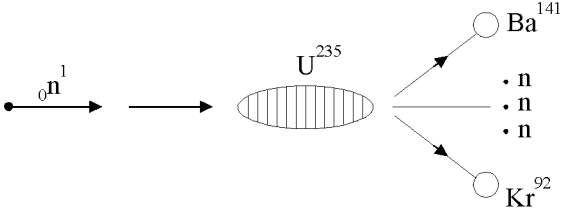
Define nuclear fission reaction.
View full question & answer
Question 23 Marks
What is meant by nuclear fusion? What happens in this reaction?
Answer
Nuclear fusion : When two light nuclei join together to form a heavy nucleus, this process is called nuclear fusion. The mass of the nucleus obtained from fusion is less than the sum of the masses of the original nuclei that did the fusion. This loss in mass is obtained in the form of excessive heat according to Einstein's mass-energy equation. For nuclear fusion to occur, the following processes are necessary :
(i) There should be very high temperature $\left(10^7-10^8 K\right)$.
(ii) Where nuclear fusion process takes place, there should be abundance of reacting molecules.
The process of nuclear fusion is the source of energy in the Sun and other stars like the Sun. Scientist Beithe proposed that solar energy is produced by nuclear fusion in which protons are continuously transformed into He nuclei by fusion.
View full question & answer
Question 33 Marks
What is meant by nuclear mass defect?
Answer
Nuclear Mass Defect :
The difference between the total mass of protons and neutrons present in the nucleus and the actual mass of the nucleus is called mass defect.
Mass defect $=$ Mass of the nucleus obtained by
calculation $-$ Actual mass of the nucleus
$\Delta m=m_c-m_a$
Here, the calculated mass is abbreviated as $m _{c}$ and the actual mass is shown as $m_a$.
Therefore, $ \Delta m=[$ Mass of protons $+$ Mass of neutrons$] -$ Actual mass of nucleus
or $\quad$
$\Delta m=\left[ Z \cdot m_p+(A-Z) m_n\right]-m$
where$, Z$ is the atomic number of the atom$, A$ is the mass number, $m_p$ is the mass of the proton, $m_n$ is the mass of the neutron and $m$ is the actual mass of the nucleus.
View full question & answer
Question 43 Marks
Write any three characteristics of nuclear force.
Answer
(i) The nature of nuclear force is attractive.
(ii) Nuclear force is a short-range force. This force becomes negligible when the distance between nucleons is more than $1 \times 10^{-14}$ meters. This force remains effective only at distances less than this. Therefore it is called short range force.
(iii) Nuclear force is very strong. At a distance of $2 \times 10^{-15}$ meters the nuclear force is about 100 times the electric force.
(iv) The nature of nuclear force becomes repulsive at a distance of $0.5 \times 10^{-15}$ metres.
(v) Nuclear force does not depend on charge. Therefore, it occurs equally between proton-neutron or proton-proton or neutron-neutron. Due to this nature of nuclear force, the question of the stability of the nucleus is solved.
View full question & answer
Question 53 Marks
What is nuclear binding energy?
Answer
Nuclear binding energy : When nuclear particles interact under nuclear forces, then work is done by the system through strong nuclear interaction and the system attains a bound state.
The energy that is released in this process to achieve this bound state is obtained through mass defect.
This is nuclear binding energy.
The total binding energy of any nucleus depends on the number of nucleons present and the value of per $-$ nucleon binding energy $\left(\frac{\Delta E }{ A }\right)$ represents the stability of the nucleus.
Therefore, Per nucleon binding energy
$=\frac{\text { Binding energy }}{\text { Mass number }}$
$=\frac{\Delta E}{A}=\frac{(\Delta m) c^2}{A} \text { joule }$
If mass is expressed as $\text{a.m.u}$. then binding energy
$=(\Delta m) \times 931 MeV$
Per nucleon binding energy
$=(\Delta m) \times 931 MeV$
Per nucleon binding energy
$=\frac{(\Delta m) \times 931}{A} MeV $ nucleon 
View full question & answer
Question 63 Marks
Prove that the structure of helium and oxygen nuclei is more stable than that of deuterium nuclei.
Answer
The total binding energy of any nucleus depends on the number of nucleons present and the value of binding energy per nucleon $\frac{\Delta E }{ A }$ represents the stability of the nucleus.
Per nucleon binding energy for oxygen
$\overline{ B }=\frac{\Delta E }{ A } \approx \frac{127}{16} \approx 7.93 \approx 8 MeV$
Per nucleon binding energy for helium
$\overline{ B }=\frac{\Delta E }{ A } \approx \frac{27.9}{4} \approx 7.0 MeV$
Per nucleon binding energy for deuterium
$\overline{ B }=\frac{\Delta E }{ A } \approx \frac{2.23}{2} \approx 1.1 MeV$
This proves that compared to the deuterium nucleus, the structure of helium and oxygen nuclei is more stable.
View full question & answer
Question 73 Marks
The binding energy of ${ }_4 Be ^9$ nucleus is $5 8 . 0 MeV$ and that of ${ }_2 He ^4$ is $28.3 Me$V . Which of these is more stable and why?
Answer
Total binding energy of ${ }_4 Be ^9= E _b$
$=58.0 MeV$
and for this $A =9$
Therefore, Its binding energy per nucleon is $E _b^{\prime}$
$=E_b / 9$
$=\frac{58.0 MeV}{9}$
$=6.44 MeV$
Total binding energy of ${ }_2 He ^4, E _b=28.3 MeV$
and $ A=4$
Hence, Its binding energy per nucleon is
$E _b^{\prime}= E _b / 4$
$=\frac{28.3 MeV }{4}$
$=7.07 MeV $
Since, the value of $E _b^{\prime}$ for ${ }_2 He ^4$ is greater than the value of $E _b^{\prime}$ for ${ }_4 Be ^9$.
Hence, ${ }_2 He ^4$ is more stable.
View full question & answer
Question 83 Marks
Define radioactivity.
Answer
Radioactivity : The phenomenon of spontaneous disintegration of atoms is called radioactivity. In 1896 AD , French scientist Becquerel discovered that some invisible rays automatically emitted from uranium and its salts, which have the ability to penetrate opaque materials and affect the photographic plate. These rays are called radioactive rays. The phenomenon of a substance emitting rays spontaneously is called 'radioactivity' and such a substance is called 'radioactive substance'. After the discovery of the property of radioactivity in uranium, it became known that not only uranium but other elements like thorium, polodium, actinium etc. are also radioactive.
View full question & answer
Question 93 Marks
Define atomic mass unit.
Answer
Atomic Mass Unit : The mass of nuclear particle proton, neutron is so low that when expressed in kilogram units, they are of the order $10^{-27} kg$. It is not very convenient to use such small quantities. Therefore the masses of nuclei are expressed in a smaller unit. It is called atomic mass unit (a.m.u.). Considering the mass of ${ }_6 C ^{12}$ as standard, its 12 th part is equal to 1 a.m.u.
$\begin{aligned}
\text { That is, } 1 \text { a.m.u. } & =\frac{\text { Mass of } C^{12} \text { atom }}{12} \\
& =1.660565 \times 10^{-27} kg
\end{aligned}$
View full question & answer
Question 103 Marks
What do you understand by controlled and uncontrolled chain reactions?
Answer
Controlled chain reaction : If the chain reaction of fission can be controlled in such a way that it neither increases nor decreases, that is, such a level of reaction is maintained such that the energy released per second always remains less than the limit of explosion. This is called controlled chain reaction. This type of reaction is used in the production of electrical energy. Controlled chain reaction is the fundamental basis of 'nuclear reactor'.
Uncontrolled chain reaction : In this reaction, on average, more than one neutron takes part in the process of fission out of the neutrons obtained from each fission. Here $K >1$. Due to this, the rate of fission of nuclei increases rapidly and within a few moments tremendous energy is released and causes a massive explosion. This reaction takes place in the atomic bomb.
View full question & answer
Question 113 Marks
The Q-value of a nuclear reaction A + b → C + d is defined by
$Q =\left[m_{ A }+m_b-m_{ C }-m_d\right] c^2$
where the masses refer to the respective nuclei. Determine from the given data the Q-value of the following reactions and state whether the reactions are exothermic or endothermic :
(i) ${ }_1^1 H +{ }_1^3 H \rightarrow{ }_1^2 H +{ }_1^2 H$
(ii) ${ }_6^{12} C +{ }_6^{12} C \rightarrow{ }_{10}^{20} Ne +{ }_2^4 He$
Atomic masses are given to be
$\begin{array}{l} m \left({ }_1^2 H \right)=2.014102 u \\ m\left({ }_1^3 H \right)=3.016049 u \\ m\left({ }_6^{12} C \right)=12.000000 u \\ m\left({ }_{10}^{20} Ne \right)=19.992439 u \end{array}$
Answer
(i) Q value of reaction
$Q =\left[ m \left({ }_1^1 H \right)+ m \left({ }_1^3 H \right)-2 m\left({ }_1^2 H \right)\right] c^2$
$Q =(1.007825+3.016049-2 \times 2.014102) u c^2$
$=(4.023874-4.028204) u c^2$
$=(-0.004330) u c^2$
$=-0.00433 \times 931.5 MeV$
$=-4.03 MeV$
Since Q is negative, hence reaction is endothermic.
(ii) $Q =\left[2 m\left({ }_6^{12} C \right)-m\left({ }_{10}^{20} Ne \right)-m\left({ }_2^4 He \right)\right] c ^2$
$\begin{aligned}=(2 \times 12.000000-19.992439 \\ -4.002603) u c^2\end{aligned}$
$=(24.000000-23.995042) u c^2$
$=(0.0049584) u c^2$
$=0.0049584 \times 931.5 MeV$
$=4.6175 MeV \simeq 4.62 MeV$
Since Q is positive, hence reaction is exothermic.
View full question & answer
Question 123 Marks
Obtain approximately the ratio of the nuclear radii of the gold isotope ${ }_{79}^{197} Au$ and the silver isotope ${ }_{47}^{107} Ag$.
Answer
We know, for a spherical nucleus $R=R_o A^{1 / 3}$
where, $A =$ mass number of the nucleus,
$R _{ O }=$ experimental constant.
Let the mass number of ${ }_{79} Au ^{197}$ and its radius be $A _1, R _1$.
And here we have also assumed that the mass number and radius of ${ }_{47} Ag ^{107}$ isotope is $A _2, R _2$, then
$R _1= A _0(197)^{1 / 3}$$\quad$.....(1)
Similarly, $\quad R _2= A _0(107)^{1 / 3}$$\quad$.....(2)
From equation (1) and (2)
$\frac{R_1}{R_2}=\frac{A_0(197)^{1 / 3}}{A_0(107)^{1 / 3}}$
$\frac{ R _1}{ R _2}=\left(\frac{197}{107}\right)^{1 / 3}=(1.841)^{1 / 3}$
$\frac{ R _1}{ R _2}=1.23$
View full question & answer
Question 133 Marks
From the erelation $R=R_0 A^{1 / 3}$, where $R_o$ is a constant and $A$ is the mass number of nucleus, show that the nuclear matter density is nearly constant (i.e. independent of A ).
Answer
The expression for the radius of the nucleus is given by $R=R_0 A^{1 / 3}$$\quad$....(1)
If the volume of the nucleus is V, then
$V =\frac{4}{3} \pi R ^3=\frac{4}{3} \pi\left( R _0 A^{1 / 3}\right)^3$
(Substituting the value from equation 1)
$=\frac{4}{3} \pi R _0^3 A$$\quad$....(2)
If the density of the nucleus is p, then
$\rho=\frac{\text { Mass of the nucleus }}{\text { Volume of the nucleus }}=\frac{ A }{\frac{4}{3} \pi R _0^3 A}$
$\rho=\frac{3 A}{4 \pi R _0^3 A}=\frac{3}{4 \pi R _0^3}=$ constant$\quad$...(3)
Thus from equation (3) we can see that A is independent of the density p. Hence we can conclude that p is approximately constant for all nuclei.
View full question & answer
3 Marks Question - Physics STD 12 Science Questions - Vidyadip