Question
What do you understand by multi-valued attribute? How is it different from complex and composite attribute? Illustrate by giving suitable example.

Answer

Attributes may be defined as characteristics that reflect the features of the entity. In case of a person these characteristics may be height, weight, name, date of birth, etc. and in case of accounts it may be code, type, name, etc. These attributes own a value which is stored in database as data.
Multi-valued attribute is an attribute that has multiple values. For example, flavour of ice-creams. It is a multi-valued attribute as the flavour of an ice-cream can be strawberry, vanilla, butter-scotch, etc. In other words, multi-valued attributes are the different characteristics of a same entity.
Composite attributes are the combination or aggregate of related attributes. These attributes can be further divided into small portions to represent the independent meaning of some basic attributes. For example, contact details which is generally divided into telephone numbers (with STD code), mobile number and e-mail Ids.
Complex attributes are formed by grouping together the attributes of composite and multi-valued attributes. To show the grouping of components of composite attributes, the parenthesis ( ) are used and to show the grouping of components of complex attributes, the brackets { } are used.
Need a full question paper?

Generate a complete, print-ready paper with questions like this in minutes — across 16+ boards, with answer keys.

Start Generating Free

Similar questions

On $1^{st}$ April $2014$, Mr, Ghosh started business with a capital of ₹ $5,00,000$. He kept his books on single entry basis. Soon after he purchased furniture for ₹ $40,000$ and purchased goods for ₹ $3,00,000$. During the year he borrowed ₹ $1,00,000$ from his brother and introduced further capital of his own amounting to ₹ $80,000$.
On $31^{st}$ March, $2015$, there were sundry debtors amounting to ₹ $2,20,000$ and creditors amounted to ₹ $1,40,000$. Stock was valued at ₹ $4,50,000$. Cash in hand ₹ $15,400$ and Bank Overdraft ₹ $40,000$.
During the year Mr. Ghosh withdrew ₹ $2,000$ per week for his family expenses. You are informed that included in sundry debtors is an irrecoverable amount of ₹ $5,000$. He also took goods from the business for his personal use amounting to ₹ $4,000$.
You are required to calculate his profit or loss during the year.
Define a computerised accounting system. Distinguish between a manual and computerised accounting system.
On 31st March, 2019, Pass Book of Shri Bhama Shah shows debit balance of ₹ 10,000. From the following particulars, prepare Bank Reconciliation Statement.
  1. Cheques amounting to ₹ 8,000 drawn on 25th March of which cheques of ₹ 5,000 cashed in April, 2019.
  2. Cheques paid into bank for collection of ₹ 5,000 but cheques of ₹ 2,200 could only be collected in March 2019.
  3. Bank charges ₹ 25 and dividend of ₹ 350 on investment collected by bank could not be shown in the Cash Book.
  4. A cheque of ₹ 600 debited in the Cash Book omitted to be banked.
  5. Bill of ₹ 5,000 discounted with Bank but was not recorded in the Cash Book.
State with reasons whether the following are capital or revenue expenditures:
  1. A new machine is purchased for ₹ 60,000, ₹ 800 were spent on its carriage and ₹1,500 were paid as wages for its installation.
  2. A sum of ₹ 40,000 was spent on painting the new factory.
  3. ₹ 6,000 were paid for annual insurance premium.
  4. ₹ 20,000 were spent on repairs before using a second hand generator purchased recently.
  5. ₹ 5,000 were spent on the repair of a machinery.
  6. ₹ 50,000 were spent for airconditioning of the office of the manager.
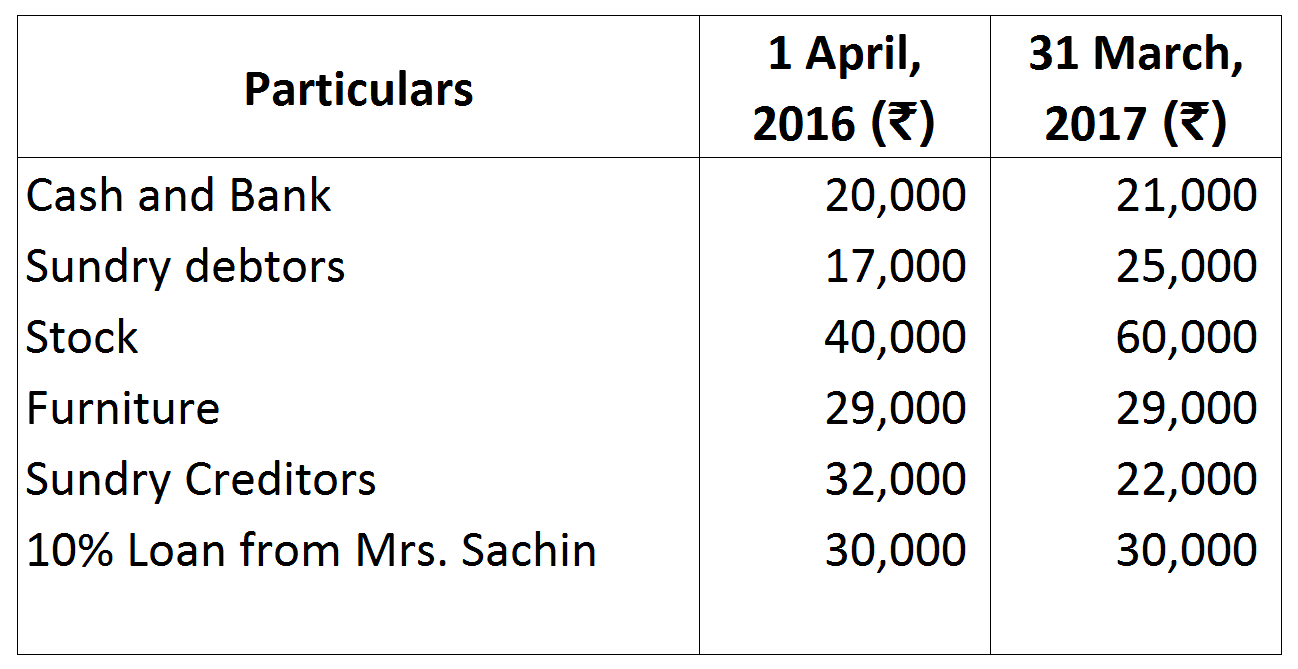
The following information is available from Sachin, who maintains books of accounts on single entry system:
Sachin withdrew $₹\ 5,000$ from the business every month for meeting his household expenses. During the year, he sold investments held by him privately for $₹\ 35,000$ and invested the amount in his business. At the end of the year $2016-17$, it was found that full year's interest on loan from Mrs. Sachin had not been paid. Depreciation $@ 10\%$ per annum was to be provided on furniture for the full year. Shop assistant was to be given a share of $5\%$ on the profits ascertained before charging such share. Calculate profit earned during the year ended $31^{st}$ March, $2017$ by Sachin.
A owed B ₹ 400. A accepted a Bill of Exchange at 3 months for this amount which B discounted for ₹ 380.
Give the necessary Journal entries in the books of A and B if this bill is:
  1. Dishonoured on the due date.
  2. Met at maturity.
  3. Retired under rebate at 6% p.a. 2 months before its maturity.
State main categories of data models.
What do you mean by programmed or casual reports?
What is a Cash Book? What are the types of Cash Book? How is it balanced?
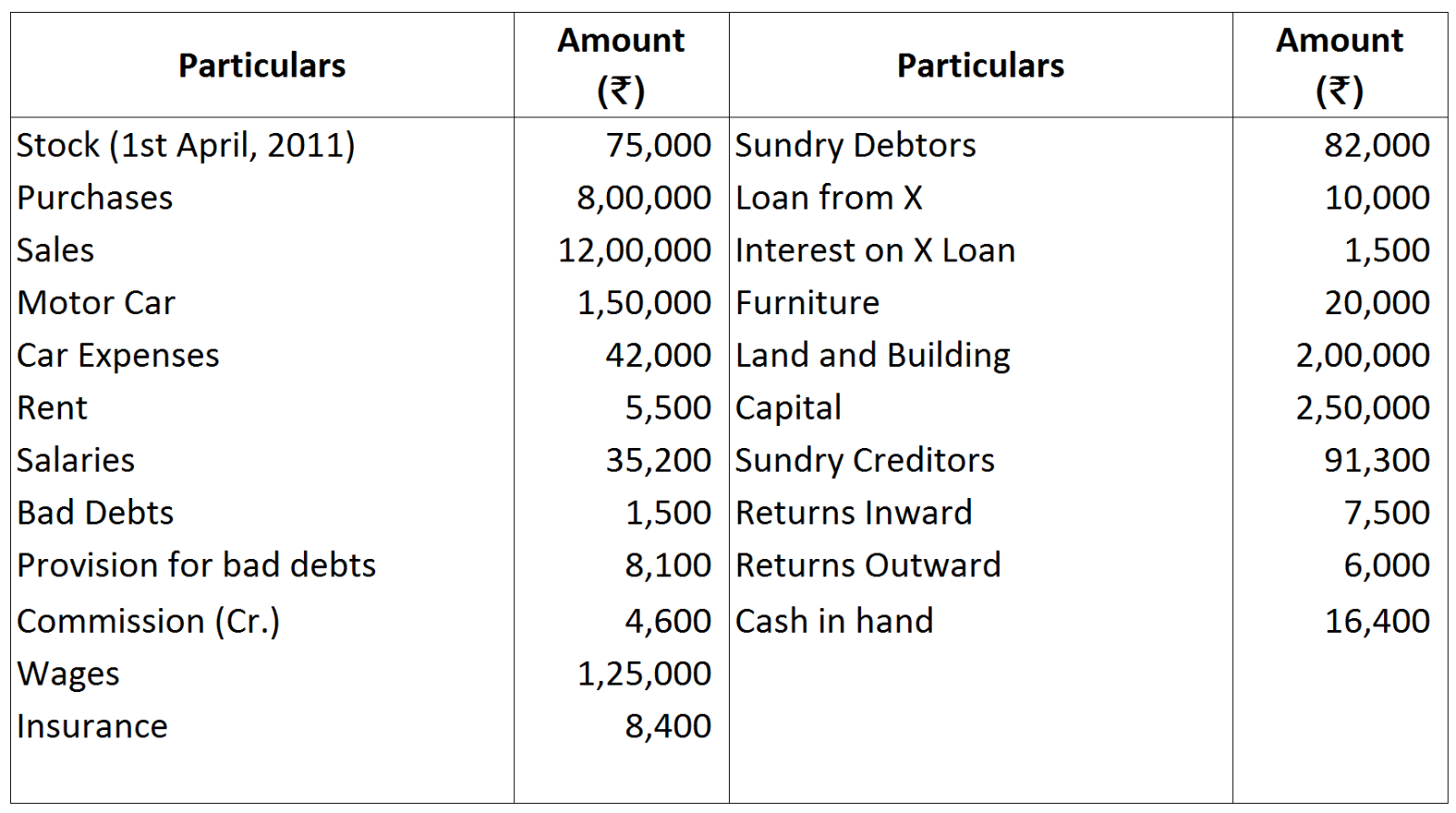
From the following figures prepare the Trading and Profit and Loss Account for the year ended 31st March, 2019 and the Balance Sheet as at that date:

Adjustments:
  1. Commission include ₹ 1,600 being commission received in advance.
  2. Write off ₹ 2,000 as further Bad-debts and maintain Bad-debts provision at 5% on debtors.
  3. Expenses paid in advance are: Wages ₹ 5,000 and Insurance ₹ 1,200.
  4. Rent and Salaries have been paid for 11 months.
  5. Loan from X has been taken at 18% p.a. interest.
  6. Depreciate furniture by 15% p.a. and Motor Car by 20% p.a.
  7. Closing Stock was valued at ₹ 60,000.