Question
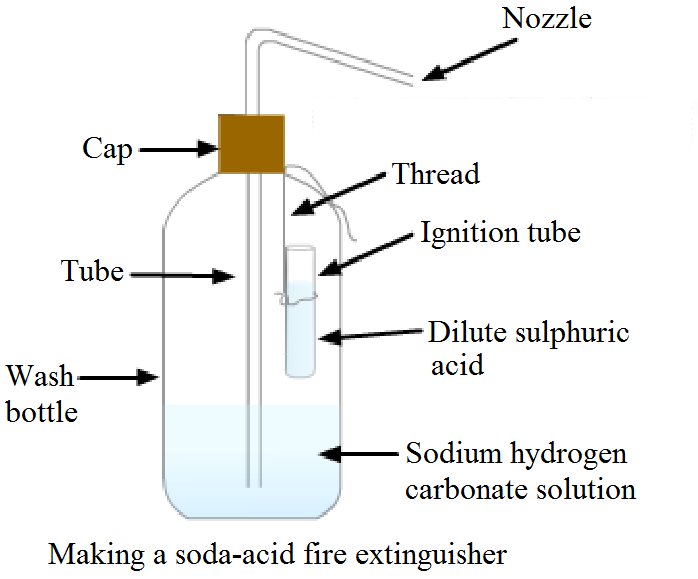
What does a soda-acid type fire extinguisher contain? How does it work?
Explain the working of a soda- acid fire extinguisher with the help of a labelled diagram.
Need a full question paper?

Generate a complete, print-ready paper with questions like this in minutes — across 16+ boards, with answer keys.

Start Generating Free

Similar questions

What is meant by ‘rusting of iron’? With the help of labelled diagrams, describe an activity to find out the conditions under which iron rusts.
What is a functional group? Give examples of four different functional groups.
Explain why, a salt which does not conduct electricity in the solid state becomes a good conductor in molten state.
  1. Given below are the steps for extraction of copper from its ore. Write the reaction involved.
    1. Roasting of copper (1) sulphide.
    2. Reduction of copper (1) oxide with copper (1) sulphide.
    3. Electrolytic refining.
  2. Draw a neat and well labelled diagram for electrolytic refining of copper.
During the reaction of some metals with dilute hydrochloric acid, following observations were made.

  1. Silver metal does not show any change.
  2. The temperature of the reaction mixture rises when aluminium (Al) is added.
  3. The reaction of sodium metal is found to be highly explosive.
  4. Some bubbles of a gas are seen when lead (Pb) is reacted with the acid.

Explain these observations giving suitable reasons.

You are given samples of three metals — sodium, magnesium and copper. Suggest any two activities to arrange them in order of their decreasing reactivities.
Complete the following cross word puzzle (Figure).

Across:

  1. An element with atomic number 12.

  1. Metal used in making cans and member of Group 14.

  2. A lustrous non-metal which has 7 electrons in its outermost shell.

​​​​​​​Down:

  1. Highly reactive and soft metal which imparts yellow colour when subjected to flame and is kept in kerosene.

  1. The first element of second Period.

  2. An element which is used in making fluorescent bulbs and is second member of Group 18 in the Modern Periodic Table.

  3. A radioactive element which is the last member of halogen family.

  4. Metal which is an important constituent of steel and forms rust when exposed to moist air.

  5. The first metalloid in Modern Periodic Table whose fibres are used in making bullet-proof vests.

Properties of the elements are given below. Where would you locate the following elements in the periodic table?
  1. A soft metal stored under kerosene.
  2. An element with variable (more than one) valency stored under water.
  3. An element which is tetravalent and forms the basis of organic chemistry.
  4. An element which is an inert gas with atomic number 2.
  5. An element whose thin oxide layer is used to make other elements corrosion resistant by the process of “anodising”.
State and explain the various methods for preventing or retarding rancidity of food.
The white solid compound A decomposes quite rapidly on heating in the presence of a black substance X to form a solid compound B and a gas C. When an aqueous solution of compound B is reacted with silver nitrate solution, then a white precipitate of silver chloride is obtained along with potassium nitrate solution. Gas C does not burn itself but helps burn other things.
  1. What is compound A?
  2. What is compound B?
  3. What is gas C?
  4. What do you think is the black substance X? What is its function?
  5. What is the general name of substances like X?