Question
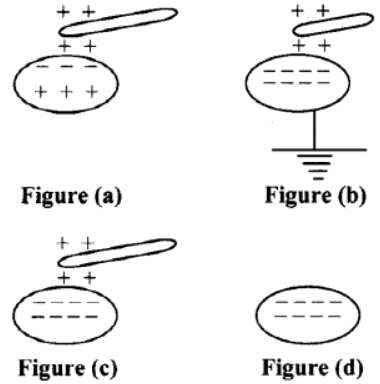
What does the below diagrams show?
Image

Answer

  1. Figure (a) shows insulated conductor.
  2. Figure (b) shows that positive charge is neutralized by electron from Earth.
  3. Figure (c) shows that earthing is removed, negative charge still stays in conductor due to positive charged rod.
  4. Figure (d) shows that when rod is removed, negative charge is distributed over the surface of the conductor.

Need a full question paper?

Generate a complete, print-ready paper with questions like this in minutes — across 16+ boards, with answer keys.
Start Generating Free

Similar questions

What is meant by period of revolution of $\text{U.C.M.}$ Obtain an expression for the period of revolution of a particle performing uniform circular motion.
Distinguish between scalar product (dot product) and vector product (cross product).
A conical pendulum has length $50 \ cm.$ Its bob of mass $100 g$ performs uniform circular motion in horizontal plane, so as to have radius of path $30 \ cm.$ Find
$i)$ The angle made by the string with vertical
$ii)$ The tension in the supporting thread and
$iii)$ The speed of bob.
Define and explain the following terms in case of a bar magnet:
i. Axis
ii. Equator
iii. Magnetic  length
A position dependent force $f = 7 – 2x + 3x^2$ newton acts on a small body of mass $2 \ kg$ and displaces from $x = 0 m$ to $x = 5 m,$ calculate the work done.
From the given data set, determine angular dispersion by the prism and dispersive power of its material for extreme colours. $nR = 1.62 nv = 1.66, δR = 3.1^\circ $
For an $EM$ wave propagating along X direction, the magnetic field oscillates along the $Z-$direction at a frequency of $3 \times 10^{10} Hz$ and has amplitude of $10^{-9} T$.
$i.$ What is the wavelength of the wave?
$ii.$ Write the expression representing the corresponding electric field.
Write down the number of significant figures in the following: $0.003 m^2, 0.1250 gm cm^{-2}, 6.4 \times 10^6 m, 1.6 \times 10^{-19} C, 9.1 \times 10^{-31} kg.$
The distance travelled by an object in time $(100 \pm 1)\ s$ is $(5.2 \pm 0.1)\ m.$ What is the speed and it’s relative error?
$C, Si$ and $Ge$ have same lattice structure. Why is $C$ insulator while $Si$ and $Ge$ intrinsic semiconductors?