MCQ
What force should be applied on the wedge so that block over it does not move? (All surfaces are smooth)
  • A
    $F=(M+m) g \cot \theta$
  • $F=(M+m) g \tan \theta$
  • C
    $F=(M+m) g \sin \theta$
  • D
    $F=(M+m) g \cos \theta$

Answer

Correct option: B.
$F=(M+m) g \tan \theta$
b
(b)

$a =\left(\frac{ F }{ m + M }\right) \ldots \ldots(1)$

$m a \cos \theta=m g \sin \theta$

$a=g \tan \theta$

Put in $(1)$

$F=(M+m) g \tan \theta$

Need a full question paper?

Generate a complete, print-ready paper with questions like this in minutes — across 16+ boards, with answer keys.
Start Generating Free

Similar questions

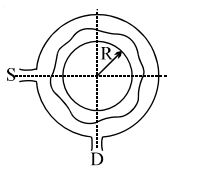
 A narrow tube is bent in the form of a circle of radius $R,$ as shown in the figure. Two small holes $S$ and $D$ are made in the tube at the positions right angle to each other. A source placed at $S$ generated a wave of intensity $I_0$ which is equally divided into two parts : One part travels along the longer path, while the other travels along the shorter path. Both the part waves meet at the point $D$ where a detector is placed  If the minima is formed at the detector then, the magnitude of wavelength $\lambda$ of the wave produced is given by 
Two different magnets are tied together and allowed to vibrate in a horizontal plane. When their like poles are joined, time period of oscillation is $5 \,s$ and with unlike poles joined, time period of oscillation is $15 \,s$. The ratio of their magnetic moments is
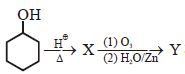
$Y$ is
Spherical wavefronts shown in figure, strike a plane mirror. Reflected wavefront will be as shown in
The $“K_{\alpha} ”$ $X-$ rays emission line of tungsten occurs at $\lambda = 0.021 \,nm.$ The energy difference between $K$ and $L$ levels in this atom is about
A body of mass $\mathrm{m}$ is kept on a rough horizontal surface (coefficient of friction $=\mu$ ) A horizontal force is applied on the body, but it does not move. The resultant of normal reaction and the frictional force acting on the object is given by $\mathrm{F},$ where $\mathrm{F}$ is
A series $LCR$ circuit driven by $300\, {V}$ at a frequency of $50 \,{Hz}$ contains a resistance ${R}=3 \,{k} \Omega$, an inductor of inductive reactance $X_{L}=250 \,\pi \Omega$ and an unknown capacitor. The value of capacitance to maximize the average power should be : (Take $\pi^{2}=10$ ) (in $\mu {F}$)
The de Broglie wavelength of an electron moving with a velocity $1.5 \times 10^8\, m/s$ is equal to that of a photon. The ratio of the kinetic enrgy of the electron to the energy of the photon is
In Bainbridge mass spectrograph a potential difference of $1000 V$ is applied between two plates distant $1$ cm apart and magnetic field in $B = 1T$. The velocity of undeflected positive ions in m/s from the velocity selector is
Assertion : Neutrons penetrate mater more readily as compared to protons.

Reason : Neutrons are slightly more massive than protons.