A body of mass $\mathrm{m}$ is kept on a rough horizontal surface (coefficient of friction $=\mu$ ) A horizontal force is applied on the body, but it does not move. The resultant of normal reaction and the frictional force acting on the object is given by $\mathrm{F},$ where $\mathrm{F}$ is
NEET 2019, Medium


Download our appand get started for free
Experience the future of education. Simply download our apps or reach out to us for more information. Let's shape the future of learning together!No signup needed.*
Similar Questions
- 1A block of mass $m$ is moving with a constant acceleration a on a rough plane. If the coefficient of friction between the block and ground is $\mu $, the power delivered by the external agent after a time $t$ from the beginning is equal toView Solution
- 2View SolutionWhich of the following statements is not true
- 3A girl holds a book of mass $m$ against a vertical wall with a horizontal force $F$ using her finger, so that the book does not move. The frictional force on the book by the wall isView Solution
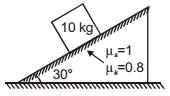
- 4A block of $10 \,kg$ mass is placed on a rough inclined surface as shown in figure. The acceleration of the block will beView Solution
- 5A small object placed on a rotating horizontal turn table just slips when it is placed at a distance $4\, cm$ from the axis of rotation. If the angular velocity of the turn-table is doubled, the object slips when its distance from the axis of rotation isView Solution
- 6A road is $10\, m$ wide. Its radius of curvature is $50\, m$. The outer edge is above the lower edge by a distance of $1.5\, m$. This road is most suited for the velocity .......... $m/\sec$View Solution
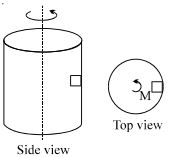
- 7A hollow vertical cylinder of radius $R$ is rotated with angular velocity $\omega$ about an axis through its center. What is the minimum coefficient of static friction necessary to keep the mass $M$ suspended on the inside of the cylinder as it rotates?View Solution
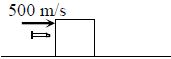
- 8A bullet of mass $20\, g$ travelling horizontally with a speed of $500 \,m/s$ passes through a wooden block of mass $10.0 \,kg$ initially at rest on a surface. The bullet emerges with a speed of $100\, m/s$ and the block slides $20 \,cm$ on the surface before coming to rest, the coefficient of friction between the block and the surface. $(g = 10\, m/s^2)$View Solution
- 9A particle moves in a circular orbit under the action of a central attractive force inversely proportional to the distance $'r'$. The speed of the particle isView Solution
- 10A rope of length $L$ and mass $M$ is being pulled on a rough horizontal floor by a constant horizontal force $F$ = $Mg$ . The force is acting at one end of the rope in the same direction as the length of the rope. The coefficient of kinetic friction between rope and floor is $1/2$ . Then, the tension at the midpoint of the rope isView Solution