MCQ
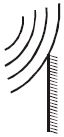
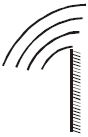
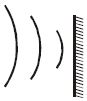
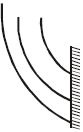
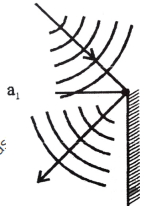
Spherical wavefronts shown in figure, strike a plane mirror. Reflected wavefront will be as shown in
  • A

  • B


  • D

Answer

Correct option: C.

c

Need a full question paper?

Generate a complete, print-ready paper with questions like this in minutes — across 16+ boards, with answer keys.

Start Generating Free

Similar questions

A tuning fork of unknown frequency produoes $4$ beats per second when sounded with another tuning fork of frequency $254 \,Hz$. It gives the same number of beats per second when unknown tuning fork loaded with wax. The unknown frequency before loading with wax is ..........
If the body covers one-third distance at speed $v_1$, next one third at speed $v_2$ and last one third at speed $v_3$, then average speed will be
A body is dropped on ground from a height $h_1$ and after hitting the ground, it rebounds to a height $h _2$ If the ratio of velocities of the body just before and after hitting ground is $4$, then percentage loss in kinetic energy of the body is $\frac{x}{4}$. The value of $x$ is $.......$
An electron moves with speed $2 \times {10^5}\,m/s$ along the positive $x$-direction in the presence of a magnetic induction $B = \hat i + 4\hat j - 3\hat k$ (in $Tesla$) The magnitude of the force experienced by the electron in Newton's is (charge on the electron =$1.6 \times {10^{ - 19}}C)$
The equation of stationary wave along a stretched string is given by $y = 5\sin \frac{{\pi x}}{3}\cos 40\pi t$, where $x $ and $y$ are in $cm$ and $t$ in second. The separation between two adjacent nodes is..... $cm$
If the length of a closed organ pipe is $1m $ and velocity of sound is $330 m/s$, then the frequency for the second note is
Two magnets, each of magnetic moment $‘M’ $ are placed so as to form a cross at right angles to each other. The magnetic moment of the system will be
A system is provided with $200 \,cal$ of heat and the work done by the system on the surrounding is $40 \,J$. Then its internal energy
A transistor is operating in the active mode. $v_1$ is potential barrier across base emitter junction and $v_2$ is potential barrier across collector base junction. $b_1$ is width of depletion layer of base emitter junction and $b_2$ is width of collector base junction.
A diatomic gas $(\gamma=1.4)$ does $200 \mathrm{~J}$ of work when it is expanded isobarically. The heat given to the gas in the process is: