MCQ
What happens when a glass rod is rubbed with silk?
  • Gains protons from silk.
  • B
    Gains electrons from silk.
  • C
    Gives electrons to silk.
  • D
    Gives protons to silk.

Answer

Correct option: A.
Gains protons from silk.

Excess electrons are transferred from glass to silk when a glass rod is rubbed with silk. Hence, the glass rod becomes positive, and silk becomes negative.

Need a full question paper?

Generate a complete, print-ready paper with questions like this in minutes — across 16+ boards, with answer keys.
Start Generating Free

Similar questions

In a series resonant circuit, the $ac$ voltage across resistance $R$, inductance $L$ and capacitance $C$ are $5\, V$, $10\, V$ and $10\, V$ respectively. The $ac$ voltage applied to the circuit will be.....$V$
By a cell a current of 0.9 A flows through 2 ohm resistor and 0.3 A through 7 ohm resistor. The internal resistance of the cell is
Light is incident normally on a diffraction grating through which the first order diffraction is seen at $32^\circ$. The second order diffraction will be seen at
$A$ fish is near the centre of a spherical water filled $( \mu = 4/3)$ fish bowl. $A$ child stands in air at a distance $2R$ ($R$ is the radius of curvature of the sphere) from the centre of the bowl. At what distance from the centre would the child nose appear to the fish situated at the centre :
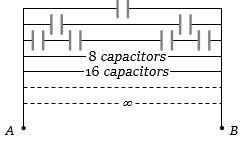
An infinite number of identical capacitors each of capacitance $1\,\mu F$ are connected as in adjoining figure. Then the equivalent capacitance between $A$ and $B$ is......$\mu F$
Which waves are used by artificial satellites for communication?
Three resistances, each of $1\, ohm$, are joined in parallel. Three such combinations are put in series, then the resultant resistance will be ............. $ohm$
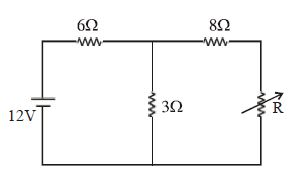
The maximum power delivered to resistance $R$ is  ............... $W$
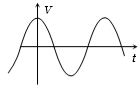
The voltage across a pure inductor is represented by the following diagram. Which one of the following diagrams will represent the current
The energy of a photon of characteristic X-rays from a Coolidge tube comes from