Question
  1. What happens when $H_2O_2$ is passed through alkaline solution of Chromium sulphate? Write the chemical reaction involved.
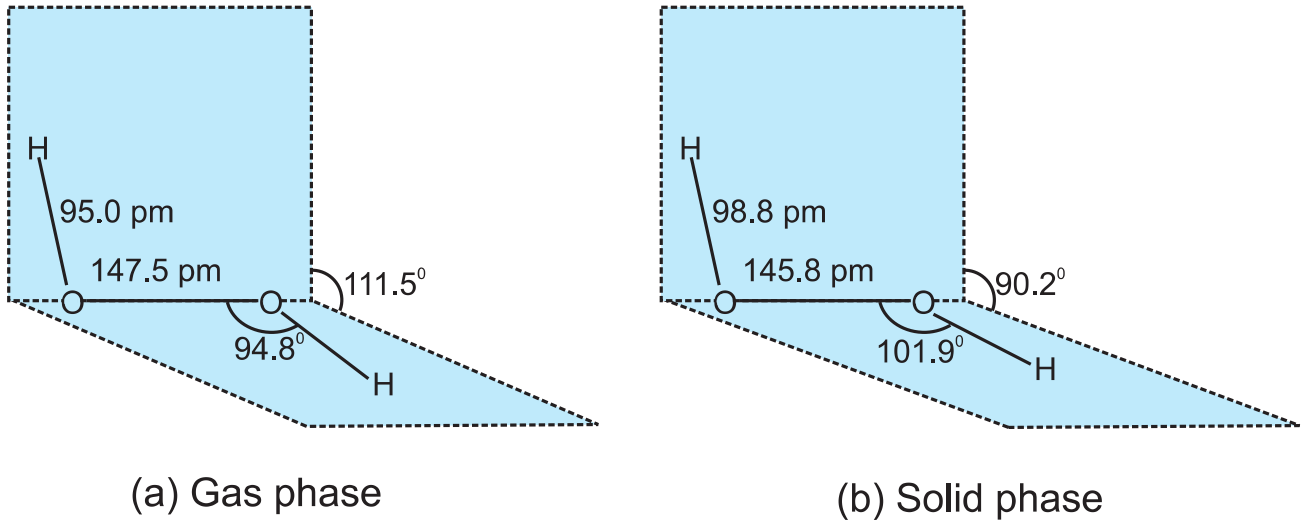
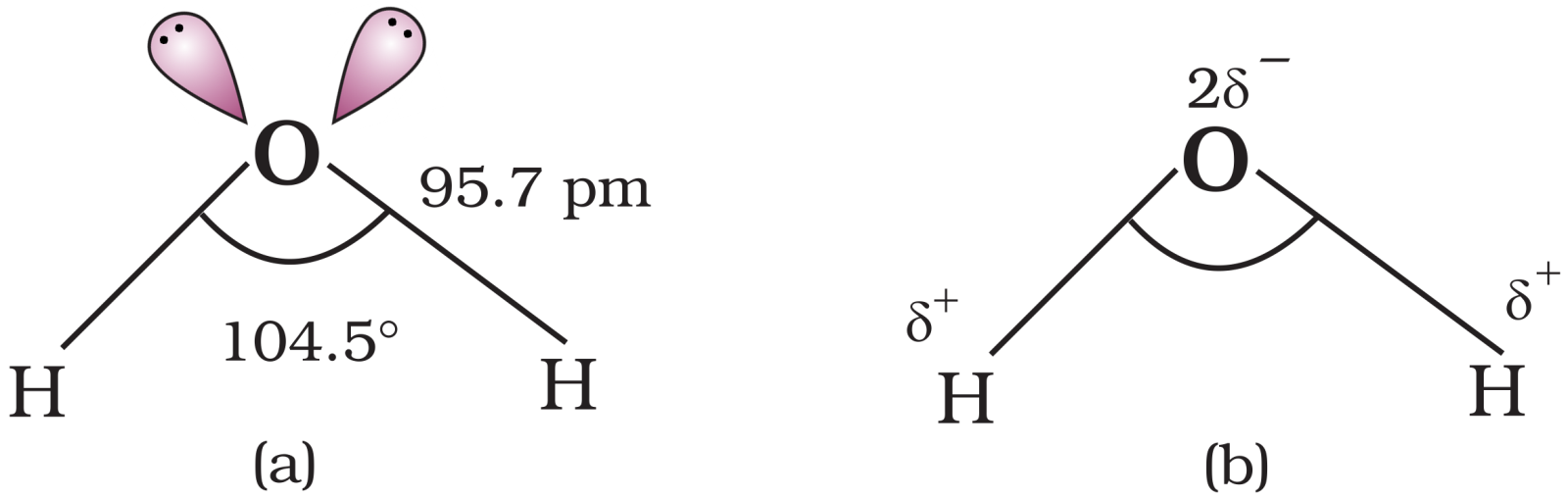
  2. Compare the structures of $H_2O$ and $H_2O_2$.
Answer

  1. The solution will become yellow in colour due to formation of $Na_2CrO_4$.
$\text{Cr}_2(\text{SO}_4)+3\text{H}_2\text{O}_2+10\text{NaOH}\\\xrightarrow{\ \ \ \ \ \ }2\text{Na}\text{}_2\text{CrO}_4+3\text{Na}_2\text{SO}_4+8\text{H}_2\text{O}$

Alternate Answer

$2\text{Cr}^3+3\text{H}_2\text{O}_2+10\text{OH}^-\xrightarrow{\ \ \ \ \ \ \ \ \ }2\text{Cr}\text{O}_4^{2-}+8\text{H}_2\text{O}$
  1. Structure of $H_2O$ and $H_2O_2$:


In $\mathrm{H}_2 \mathrm{O}$, O is $\mathrm{sp}^3$ hybridised but due to lone pair-lone pair repulsion, the HOH bond angle decreases to $104.5^{\circ}$. Hence, water is a bent molecule as shown above.
In $\mathrm{H}_2 \mathrm{O}_2$, the two oxygen atoms are linked to each other by single bond (peroxide) and each oxygen is further linked to H atom by single bond. The two $\mathrm{O}-\mathrm{H}$ bonds are in different plane, giving $\mathrm{H}_2 \mathrm{O}_2$ a non-planar structure as shown above.

Need a full question paper?

Generate a complete, print-ready paper with questions like this in minutes — across 16+ boards, with answer keys.
Start Generating Free

Similar questions

$2\text{NO}(\text{g})+\text{O}_2(\text{g})\rightleftharpoons2\text{NO}_2(\text{g}),\Delta\text{H}=-117\text{J}$
Predict the effect of an increase in concentration of NO on the equilibrium concentration of $\text{NO}_2$.
Predict the effect of pressure decrease as a result of increased volume on the equilibrium concentration of $\text{NO}_2$.
Explain the harmful effects of oxides of sulphur and nitrogen on plants and animals.
The water level in a metric measuring cup is 0.75L before the addition of a pebble weighing 150g. The water level after submerging the pebble is 0.82L. Determine the density of the pebble.
  1. Write IUPAC name of the following:
$\text{CH}_3\text{CHCH}\equiv\text{CH}\\\ \ \ \ \ \ \ \ \ |\\ \ \ \ \ \ \ \ \ \text{CH}=\text{CH}_2$
  1. Draw the structure of Pent-4-en-2-ol.
  2. What is nucleophile? Give one example.
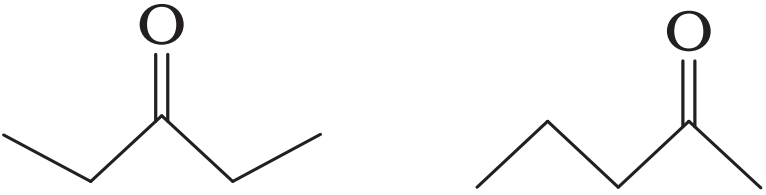
What is the relationship between the members of following pairs of structures? Are they structural or geometrical isomers or resonance contributors?
How many grams of $Cl _2$, are required to completely react with 0.4 g of H, to yield HCl ? Also, calculate the amount of HCl formed.
  1. Account for the following:
  1. Boron halides do not dimerise like $BH_3$.
  2. Carbon shows catenation remarkably.
  3. $PbCl_4$ is a good oxidising agent.
  1. Complete the following reactions:
  1. $\text{Na}_{2}\text{B}_{4}\text{O}_{7} + 2\text{HCl} + \text{5H}_{2}\text{O} \xrightarrow{\ \ \ \ \ \ \ \ }$
  2. $\text{B}_{2}\text{H}_{6} + 6\text{NH}_{3} \xrightarrow[\ \ \ \ \ \ ]{\Delta}$
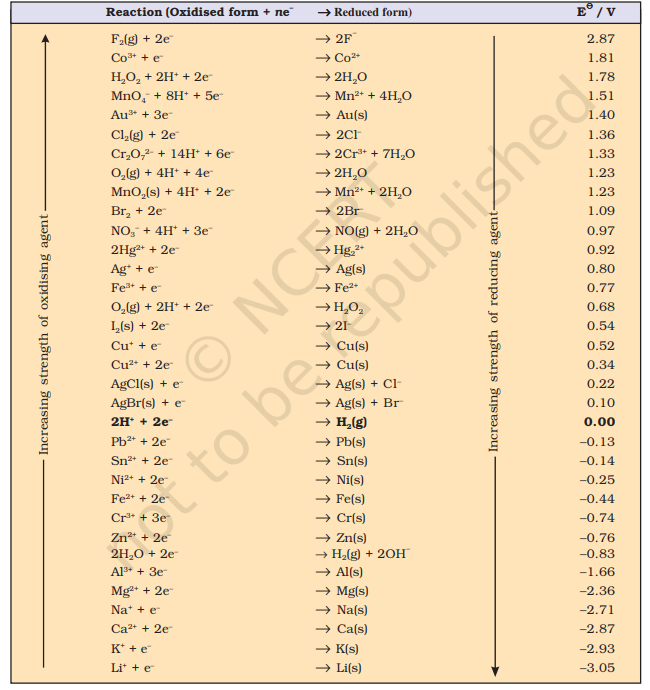
Using the standard electrode potentials given in the Table, predict if the reaction between the following is feasible:

$\mathrm{Fe}^{3+}(\mathrm{aq})$ and $\mathrm{l}^{-}(\mathrm{aq})$.
  1. How does Ionic radii vary with effective nuclear charge? Give example.
  2. An element belongs to 3rd period and group-13 of the periodic table. Identify the element and write two properties of element.
$A 2.0L$ container at $25^\circC$ contain $1.25$ moles of $O_2$ and 3.2 moles of $C.$
  1. What is the initial pressure in the flask?
  2. If the carbon and oxygen react as completely as possible to form $CO$, what will be the final pressure in the container?