Question
What is a centromere? How does the position of centromere form the basis of classification of chromosomes. Support your answer with a diagram showing the position of centromere on different types of chromosomes.
Answer


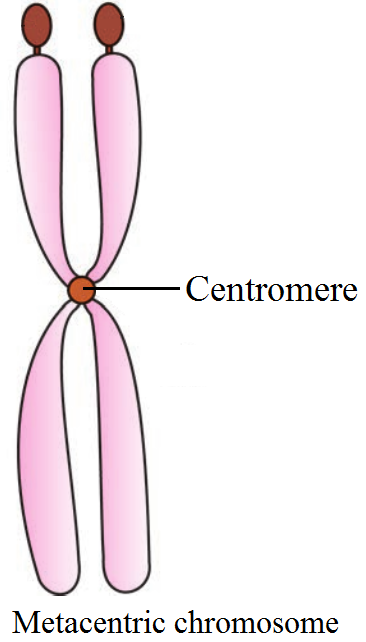
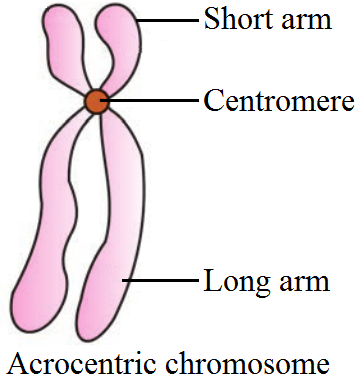
Centromere is a constriction present on the chromosomes where the chromatids are held together. Chromosomes are divided into four types based on the position of the centromere.
  1. Metacentric chromosome
style="margin-left: 40px;">The chromosomes in which the centromere is present in the middle and divides the chromosome into two equal arms is known as a metacentric chromosome.
  • Sub-metacentric chromosome
The chromosome in which the centromere is slightly away from the middle region is known as a sub-metacentric chromosome. In this, one arm is slightly longer than the other.
  1. Acrocentric chromosome
The chromosome in which the centromere is located close to one of the terminal ends is known as an acrocentric chromosome. In this, one arm is extremely long and the other is extremely short.
  1. Telocentric chromosome
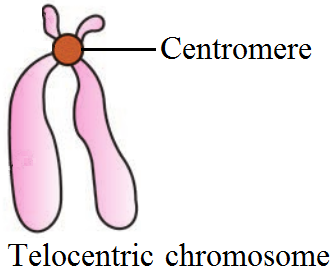
The chromosome in which the centromere is located at one of the terminal ends is known as a telocentric chromosome.

Need a full question paper?

Generate a complete, print-ready paper with questions like this in minutes — across 16+ boards, with answer keys.

Start Generating Free

Similar questions

Match Column I with Column II
 
Column I
 
Column II
a.
Eosinophils
i.
Coagulation
b.
RBC
ii.
Universal Recipient
c.
AB Group
iii.
Resist Infections
d.
Platelets
iv.
Contraction of Heart
e.
Systole
v.
Gas transport
Name the following:
1. Limbless animal
2. Poikilothermic animal
3. Homeothermic animal
4. Animals with two chambered heart
5. Animals with four chambered heart
6. Animal with dry horny skin
  1. Represent schematically the major pathways of anaerobic respiration.
  2. Even though glycolysis yields 8 ATP molecules, only two ATP molecules are the net result in fermentation. Give reason.
What is the significance of atrio-ventricular node and atrio-ventricular bundle in the functioning of heart?
Describe the cross section of an isobilateral leaf by making a labeled diagram.
Mention any three similarities and two differences between facilitated diffusion and active transport of substances in plants. Also draw a neat labelled diagram depicting facilitated diffusion of proteins.
Explain the difference between the following and make a labelled diagram of the parts of a flowering plant.
1. Difference between stipule and bract
2. Phyllotaxy and Venation
  1. Where is sino-atrial node (SAN) located in human heart? Why is SAN called pacemaker of the heart?
  2. What is electrocardiogram? What represents P-wave, QRS complex and T-wave in a standard ECG?
  3. What are the causes of Angina and Coronary Artery Disease?
  1. Where does electron transport system operate in mitochondria? Explain the system, giving the role of oxygen.
  2. What is oxidative phosphorylation?
Explain the regulation of heart function with the help of a diagram.