Question
What is a lever?

Answer

Image
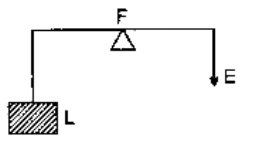
A lever is a special case of the application of the law of moments. It is a rigid bar, straight or bent, which is capable of rotation about a fixed point or a fixed-line, called the axis of rotation. This fixed point or the axis of rotation is called the fulcrum. An effort E is applied at point A of the lever to overcome resistance (or load) at another point B, as shown in the diagram.

Need a full question paper?

Generate a complete, print-ready paper with questions like this in minutes — across 16+ boards, with answer keys.
Start Generating Free

Similar questions

Describe two experiments to illustrate the production of electric current by electromagnetic induction. State the laws which determine the direction and magnitude of the induced current.
Prove that Moment of couple = Force x couple arm.
$(i) (a)$ Define work and state the mathematical expression for work.
$(b)$ State $\text{CGS}$ and $SI$ unit of work.
$(ii)$ An electric pump is $60 \%$ efficient and is rated $2 HP$ . Calculate the maximum amount of water it can lift through a height of $5 m$ in $40 s .\  [$Take $g =10 ms^{-2}$ and $1 HP =750 W$ ]
$(iii)$ In a hydroelectric power station, $1000 \ kg$ water is allowed to drop through a height of $100 m$ in $1s$ . If the conversion of potential energy to electric energy is $60 \%$, calculate the power output in $kW ($take $g =10 m / s ^2).$
Two copper wires are of the same length, but one is thicker than the other.
  1. Which wire will have more resistance?
  2. Which wire will have more specific resistance?
Find the equivalent resistance between points $A$ and $B$
Describe a method to determine the specific heat capacity of a solid, like a piece of copper.
What is nuclear fission? Give one example and write its nuclear reaction.
(i) A copper vessel of mass 100 g contains 150 g of water at $50^{\circ} C$. How much ice is needed to cool it to $5^{\circ} C$ ?
Given : Specific heat capacity of copper $=0.4 J g ^{-1}{ }^{\circ} C ^{-1}$
Specific heat capacity of water $=4.2 Jg ^{-1}{ }^{\circ} C ^{-1}$
Specific latent heat of fusion of ice $=336 Jg ^{-1}$
(ii) A piece of ice of mass 60 g is dropped into 140 g of water at $50^{\circ} C$. Calculate the final temperature of water when all the ice has melted. (Assume no heat is lost to the surrounding)
Specific heat capacity of water $=4.2 Jg ^{-1} K^{-1}$.
Specific latent beat of fusion of ice $=336 Jg ^{-1}$.
(iii) (a) Define specific latent heat of fusion of ice.
(b) What happens to the heat supplied to the substance when the heat supplied causes no change in the temperature of the substance?
Draw neat diagrams for the formation of images in case of concave lens and state their characteristics when the object is:
(a) at infinity,
(b) anywhere between infinity and the optical centre