Question
What is a refrigerator? Draw a schematic representation of a refrigerator.

Answer

A refrigerator or a heat pump is a heat engine working in reverse direction.
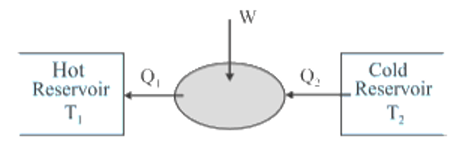
In the refrigerator, we have 2 bodies, lower temperature (cold) body which is freezer and higher temperature (hot) body which is surroundings. It takes heat from the cold reservoir and then some work is done on the refrigerator and then the amount of heat is transferred to the hot reservoir. Let $Q _2$ be the heat takes from the cold reservoir, W is the work done on the system and then releases $Q _1$ amount of heat to the hot reservoir.
Mathematically, $Q _2+ W = Q _1$
The schematic representation of a refrigerator has been shown in the following Figure. Here the refrigerator extracts heat $Q _2$ from a cold reservoir at temperature $T_2$, work $W$ is done on it and finally, it rejects $Q_1\left(=Q_2+W\right)$ heat to surroundings (hot reservoir) maintained at a higher temperature $T _1$.
Image
The efficiency of the refrigerator can be calculated from the coefficient of performance of the refrigerator, $\alpha=\frac{Q_2}{Q_1-Q_2}$

Need a full question paper?

Generate a complete, print-ready paper with questions like this in minutes — across 16+ boards, with answer keys.
Start Generating Free

Similar questions

Water near the bed of a deep river is quiet while that near the surface flows. Give reasons.
In Fizeau method of measuring the speed of light, the toothed wheel is placed in the focal plane of a converging lens. How would the experiment be affected if the wheel is slightly away from the focal plane?
In a glass capillary tube, water rises upto a height of 10.0 cm while mercury fall down by 5.0 cm in the same capillary. If the angles of contact for mercury glass is $60^{\circ}$ and water glass is $0^{\circ}$, then find the ratio of surface tension of mercury and water.
Estimate the total number of air molecules (inclusive of oxygen, nitrogen, water vapour and other constituents) in a room of capacity $25.0m^3$ at a temperature of $27°C$ and $1$ atm pressure.
A police van moving on a highway with a speed of $30 \mathrm{~km} \mathrm{~h}^{-1}$ fires a bullet at a thief's car speeding away in the same direction with a speed of $192 \mathrm{~km} \mathrm{~h}^{-1}$. If the muzzle speed of the bullet is $150 \mathrm{~m} \mathrm{~s}^{-1}$, with what speed does the bullet hit the thief's car? (Note: Obtain that speed which is relevant for damaging the thief's car).
The physicists think at a level far higher than a normal individual. Explain.
An engine is attached to a wagon through a shock absorber of length 1.5 m . The system with a total mass of $50,000 \mathrm{~kg}$ is moving with a speed of $36 \mathrm{~km} \mathrm{~h}^{-1}$ when the brakes are applied to bring it to rest. In the process of the system being brought to rest, the spring of the shock absorber gets compressed by 1.0 m . If $90 \%$ of energy of the wagon is lost due to friction, calculate the spring constant.
An enclosure of volume four litres contains a mixture of $8g$ of oxygen, $14g$ of nitrogen and $22g$ of carbon dioxide. If the temperature of the mixture is $27°C$, find the pressure of the mixture of gases. Given $R = 8.315J-K^{-1}mol^{-1}$.
A small block of mass is pressed against a horizontal spring fixed at one end to compress the spring through 5.0cm. When released the block moves horizontally till it leaves the spring. Where will it hit the ground at a distance 2m below the slab? [k = 100N/ m, m = 100g)
Is it easier to take out a nucleon from carbon or from iron? Fi$-$om iron or from lead?