Question
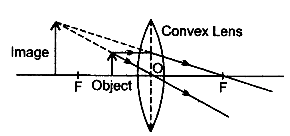
What is a simple microscope or a magnifying glass? Draw a ray diagram to show its function.
Answer


A convex lens works as a simple microscope or a magnifying glass when an object is kept between its optical centre and the focus. The image of the object so obtained is virtual, upright, and magnified.

Need a full question paper?

Generate a complete, print-ready paper with questions like this in minutes — across 16+ boards, with answer keys.
Start Generating Free

Similar questions

Two resistors having $2Ω$ and $3Ω$ resistance are connected—(i) in series, and (ii) in parallel. Find the equivalent resistance in each case.
What type of lever is formed by the human body while raising a load on the palm ?
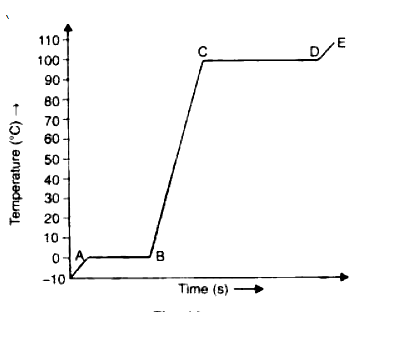
A piece of ice is heated at a constant rate. The variation in temperature with time of heating is shown in the graph (see fig.)
(i) What is represented by AB?
(ii) What does CD represent?
(iii) What conclusion can you draw regarding the nature of ice from the graph below?
Name and define three classes of levens and give two examples for each kind

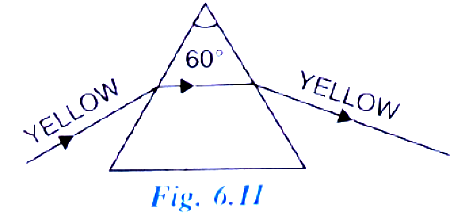
The following diagram shows the path taken by a narrow beam of yellow monochromatic light passing through an equiangular glass prism. Now the yellow light is replaced by a narrow beam of white light incident at the same angle. Draw another diagram to show the passage of white light through the prism and label it to show the effect of prism on the white light.
A parallel oblique beam of light falls on a (i) convex lens, (ii) concave lens. Draw a diagram in each case to show the refraction of light through the lens.
Point out the difference between a convex lens and a concave lens.
A lever of length 9 cm has its load arm 5 cm long and the effort arm is 9 cm long.
Draw diagram of the lever showing the position of fulcrum F and directions of both the load L and effort E.
Water falls from a height of 50 m. Calculate the rise in the temperature of water when it strikes the bottom.
$(g = 10 ms^{-2}$​​​​​​​; Specific heat capacity of water $= 4200 J / kg^\circ C)$
What is the difference between static and dynamic equilibrium?