Question
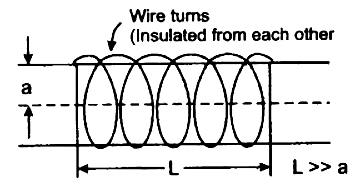
What is a solenoid? Why do we usually keep its diameter small in comparison to its length?

Answer


If a conducting wire (coated with an insulating paint or varnish) is closely wound on a (long) cylindrical core, the resulting coil is referred to as solenoid. It is usual to keep the diameter of the solenoid small compared to its length. This is done to bring about a greater degree of uniformity (and simplicity) in the axial magnetic field of the solenoid.

Need a full question paper?

Generate a complete, print-ready paper with questions like this in minutes — across 16+ boards, with answer keys.
Start Generating Free

Similar questions

200 g of of ice at $0^{\circ} C$ is added to 2 kg of water at $30^{\circ} C$. What is the temperature of the mixture?
Explain, why submarines are able to dive underwater as well as a sail on the surface of the water?
Point out two main disadvantages of ‘Tree System’.
A $10 \ m$ long wire of a particular material is of resistance $5Ω$ What will be the resistance of $10\ m$ long wire of the same material but the double radius.
A bullet fired against a window glass pane makes a hole in it without any cracks while a stone striking the same glass pane smashes it; explain with reason.
A simple machine enables us to lift a load of 10,000 N by the application of an effort of 500 N. However, when the point of application of the effort moves through 2.5 m, the load gets raised through 10 cm only. What are the values of the:
(i) M.A.
(ii) V.R. and
(iii) Efficiency of the machine?
A body of mass $50\ kg$ has a momentum of $3000 kg^{-1} ms$. Calculate:
(j) the kinetic energy of the body.
(ii) the velocity of the body.
A force of 5 kgf is required to cut a metal sheet. A shears used for cutting the metal sheet has its blades 5 cm long, while its handles is 10 cm long. What effort is needed to cut the sheet?
An element P disintegrates by α - -emission and the new element suffers two further disintegrations, both by β -emission, to form an element Q. Explain the fact that P and Q are the isotopes.
Name musical instrument, one in each case, which produces its notes by using the following. In each case state the method used to produce notes of different pitches and loudness.
(a) A vibrating string.
(b) A vibrating column air.
(c) Vibration of any other body.