Question
What is activation energy? Explain with the help of graph by suitable example

Answer

→ Activation energy can be understood clearly using the formation reaction of hydrogen iodide.
→ H2(g) + I2(g) → 2HI(g)
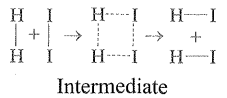
→ According to Arrhenius, this reaction can take place only when a molecule hydrogen and molecule of iodine collide to form an unstable intermediate. It exists for a very short time and then breaks up to form two molecules of hydrogen iodide.
Image
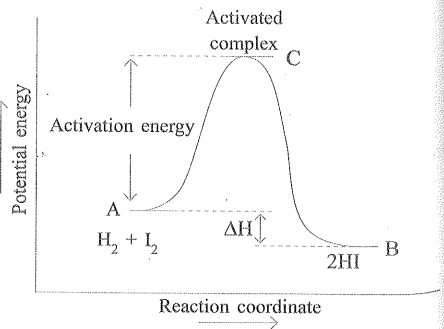
→ The energy required to form this intermediate, called activated complex (C), is known as activation energy (Ea).
→ Below figure is obtained by plotting potential energy VS reaction coordinate. Reaction coordinate represents the profile of energy change when reactant change into products.
Image
→ Some energy is released when the complex decomposes to form products. So, the final enthalpy of the reaction depends upon the nature of reactants and products.

Need a full question paper?

Generate a complete, print-ready paper with questions like this in minutes — across 16+ boards, with answer keys.

Start Generating Free

Similar questions

Write a note on Wurtz reaction and its Limitations.
Write down the IUPAC name for the following complex and indicate the oxidation state, electronic configuration and coordination number. Also give stereochemistry and magnetic moment of the complex:
CrCl3(py)3
  1. Deficiency of which vitamin causes night-blindness?
  2. Name the base that is found in nucleotide of RNA only.
  3. Glucose on reaction with HI gives n-hexane. What does it suggest about the structure of glucose?
An aqueous solution of 2% non-volatile solute exerts a pressure of 1.004 bar at the normal boiling point of the solvent. What is the molar mass of the solute?
(A), (B) and (C) are three non-cyclic functional isomers of a carbonyl compound with molecular formula C4H8O. Isomers (A) and (C) give positive Tollens’ test whereas isomer (B) does not give Tollens’ test but gives positive Iodoform test. Isomers (A) and (B) on reduction with Zn(Hg)/ conc. HCl give the same product (D).
  1. Write the structures of (A), (B), (C) and (D).
  2. Out of (A), (B) and (C) isomers, which one is least reactive towards addition of HCN?
Complte the following reaction :
$CH _3 COOH \frac{\text { (i) } X _2 R e d P }{\text { (iii) } H _2 O }$
Discuss the classification of monohydric alcohols containing Csp3-OH bond.
A special thermometer (Beckmann thermometer) is used to determine molecular weight by freezing point depression method instead of ordinary thermometer. Why?
  1. Calculate $\Delta$rGfor the reaction:

Mg (s)+Cu2+ (aq) $\rightarrow$ Mg2+ (aq) + Cu (s)
Given: Eocell = + 2.71 V, 1 F = 96500 C mol–1

  1. Name the type of cell which was used in Apollo space programme for providing electrical power.
How does acetone reacts with HCN and NaHSO3?