Question 13 Marks
What is half-life of a reaction? Derive formula for half-life of zero and first order reaction.
Answer
View full question & answer→→ Half-life of a reaction: "The time in which the concentration of a reactant is reduced to one half of its initial concentration is called half-life $\left( t _{\frac{1}{2}}\right)$ of a reaction."
Half-life for zero order reaction:
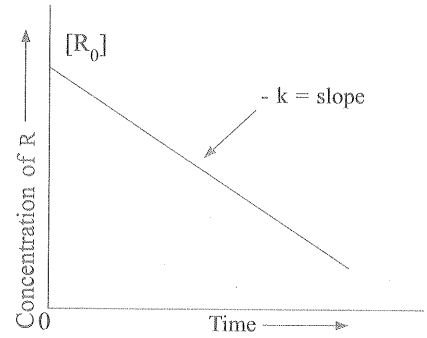
→ For a zero order reaction, rate constant is given by following equation
$
\begin{array}{l}
→ k =\frac{[ R ]_0-[ R ]}{ t } \\
\text { At } t = t _{\frac{1}{2}},[ R ]=\frac{1}{2}[ R ]_0
\end{array}
$
The rate constant at $t _{\frac{1}{2}}$ becomes
$
\begin{aligned}
k & =\frac{[ R ]_0-\frac{1}{2}[ R ]_0}{ t _{\frac{1}{2}}^2} \\
t _{\frac{1}{2}} & =\frac{[ R ]_0}{2 k }
\end{aligned}
$
It is clear that $t_{\frac{1}{2}}$ for a zero order reaction is directly proportional to the initial concentration of the reactants and inversely proportional to the rate constant.
Half-life for first order reactior
→ For the first order reaction,
$
\begin{array}{l}
k =\frac{2.303}{ t } \log \frac{[ R ]_0}{[ R ]} \\
\text { at } t = t _{\frac{1}{2}}[ R ]=\frac{[ R ]_0}{2}
\end{array}
$
→ So, the above equation become
$
\begin{array}{l}
k =\frac{2.303}{ t _{\frac{1}{2}}^2} \log \frac{[ R ]_0}{\frac{\left[ R p _0\right.}{2}} \\
\text { or } t _{\frac{1}{2}}=\frac{2.303}{ k } \log 2 \\
t _{\frac{1}{2}}=\frac{2.303}{ k } \times 0.301 \\
t _{\frac{1}{2}}=\frac{0.693}{ k }
\end{array}
$
→ It can be seen that for a first order reaction, half-life period is constant, i.e. it is independent of initial concentration of the reacting species. The half-life of a first order equation is readily calculated from the rate constant and vice versa. For zero order reaction $t _{\frac{1}{2}} \times[ R ]_0$ for first order reaction $t _{\frac{1}{2}}$ is independent of $[ R ]_0$
Half-life for zero order reaction:
→ For a zero order reaction, rate constant is given by following equation
$
\begin{array}{l}
→ k =\frac{[ R ]_0-[ R ]}{ t } \\
\text { At } t = t _{\frac{1}{2}},[ R ]=\frac{1}{2}[ R ]_0
\end{array}
$
The rate constant at $t _{\frac{1}{2}}$ becomes
$
\begin{aligned}
k & =\frac{[ R ]_0-\frac{1}{2}[ R ]_0}{ t _{\frac{1}{2}}^2} \\
t _{\frac{1}{2}} & =\frac{[ R ]_0}{2 k }
\end{aligned}
$
It is clear that $t_{\frac{1}{2}}$ for a zero order reaction is directly proportional to the initial concentration of the reactants and inversely proportional to the rate constant.
Half-life for first order reactior
→ For the first order reaction,
$
\begin{array}{l}
k =\frac{2.303}{ t } \log \frac{[ R ]_0}{[ R ]} \\
\text { at } t = t _{\frac{1}{2}}[ R ]=\frac{[ R ]_0}{2}
\end{array}
$
→ So, the above equation become
$
\begin{array}{l}
k =\frac{2.303}{ t _{\frac{1}{2}}^2} \log \frac{[ R ]_0}{\frac{\left[ R p _0\right.}{2}} \\
\text { or } t _{\frac{1}{2}}=\frac{2.303}{ k } \log 2 \\
t _{\frac{1}{2}}=\frac{2.303}{ k } \times 0.301 \\
t _{\frac{1}{2}}=\frac{0.693}{ k }
\end{array}
$
→ It can be seen that for a first order reaction, half-life period is constant, i.e. it is independent of initial concentration of the reacting species. The half-life of a first order equation is readily calculated from the rate constant and vice versa. For zero order reaction $t _{\frac{1}{2}} \times[ R ]_0$ for first order reaction $t _{\frac{1}{2}}$ is independent of $[ R ]_0$