Question
What is called equipotential surface? Draw equipotential surfaces for point charges and write their properties.
Answer

SELF

Need a full question paper?

Generate a complete, print-ready paper with questions like this in minutes — across 16+ boards, with answer keys.

Start Generating Free

Similar questions

The electric field E due to a point charge at any point near it is defined as $\text{E} = \DeclareMathOperator*{\median}{\text{lim}} \median_{\text{q}\rightarrow0}\frac{\text{F}}{\text{q}}$ where q is the test charge and F is the force acting on it. What is the physical significance of $\DeclareMathOperator*{\median}{\text{lim}} \median_{\text{q}\rightarrow0}$ in this expression? Draw the electric field lines of a point charge Q when (a) Q>0 and (b) Q<0. 
For a photosensitive surface, threshold wavelength is $\lambda_0.$ Does photoemission occur if the wavelength of radiation is (i) more than $\lambda_0$ and (ii) less than $\lambda_0?$ Justify your answer.
The luminous flux of a monochromatic source of 1W is 450 lumen/ watt. Find the relative luminosity at the wavelength emitted.
The mean speed of the molecules of a hydrogen sample equals the mean speed of the molecules of a helium sample. Calculate the ratio of the temperature of the hydrogen sample to the temperature of the helium sample.
In Ampere's $\oint\overrightarrow{\text{B}}.\text{d}\overrightarrow{\text{l}}=\mu_0\text{i},$ the current outside the curve is not included on the right hand side. Does it mean that the magnetic field B calculated by using Ampere's law, gives the contribution of only the currents crossing the area bounded by the curve?
Can you think of two particles which do not exert gravitational force on each other?
As temperature increases, the viscosity of liquids decreases considerably. Will this decrease the resistance of an electrolyte as the temperature increases?
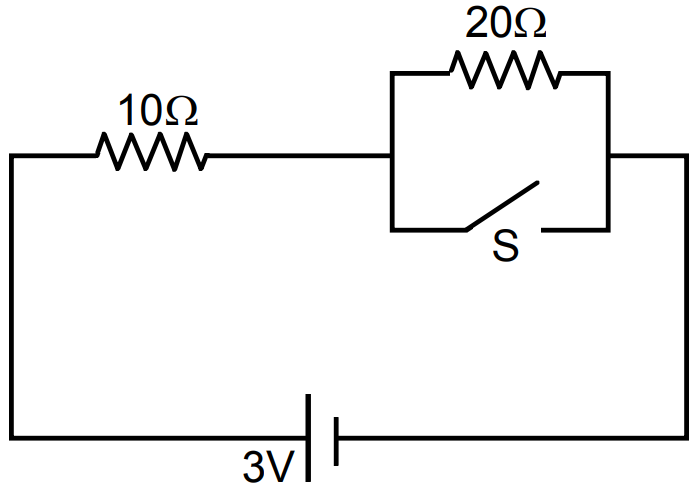
Consider the circuit shown in figure. Find the current through the $10\Omega$ resistor when the switch S is (a) Open (b) Closed.

A tunnel is dug along a diameter of the earth. Find the force on a particle of mass m placed in the tunnel at a distance x from the centre.
A compound microscope forms an inverted image of an object. In which of the following cases it is kely to create difficulties?
  1. Looking at small germs.
  2. Looking at circular spots.
  3. Looking at a vertical tube containing some water.