Question
What is Cash Flow Statement? Discuss its main uses and limitations.

Answer

Cash Flow Statement is a statement that shows inflows (receipts) and outflows (payments) of Cash and Cash Equivalents of an enterprise during a specified period of time.
  1. Short-term Planning: Cash Flow Statement gives information about sources and applications of Cash and Cash Equivalents for a specific period. It helps in planning investments and assessing the financial requirements of the enterprise.
  2. Cash Flow Helps in Assessing Liquidity and Solvency: Solvency is the ability of the enterprise to meet its liabilities on time. Cash Flow Statement helps to assess liquidity.
  3. Efficient Cash Management: Cash Flow Statement gives information relating to surplus or deficit of cash. An enterprise, therefore, can decide about the Short-term Investments of the surplus and can arrange the Short-term Credit in case of deficit.
  4. Comparative Study: A comparison of the actual cash flows with the budgeted cash flows of the year shows the extent to which Cash and Cash Equivalents were generated and applied as per the plan.
  5. Reasons for Cash Position: Cash Flow Statement shows the reasons for lower and higher cash balances with the enterprise. Sometimes, an enterprise has lower cash balance in spite of higher profits or has higher cash balance in spite of lower profits. Reasons for such situations can be analysed with the help of Cash Flow Statement.
The limitations of Cash Flow Statement are:
  • Non-cash Transactions are not Shown: Cash Flow Statement shows only inflows and outflows of cash. It does not show non-cash transactions like the purchase of building by issue of shares or debentures to the vendors or bonus shares.
  • Not a Substitute for an Income Statement: Income Statement shows net income of the enterprise based on accrual basis of accounting whereas Cash Flow Statement shows only cash inflows or outflows which does not represent net profit earned or loss incurred by the enterprise.
  • Not a Substitute for Balance Sheet: It is not a substitute for Balance Sheet (Position Statement) because it does not show the financial position (i.e., Equity, Liabilities and Assets)

Need a full question paper?

Generate a complete, print-ready paper with questions like this in minutes — across 16+ boards, with answer keys.

Start Generating Free

Similar questions

'Sangam Woollens Ltd.', Ludhiana, are the manufacturers and exporters of woollen garments. The company decided to distribute free of cost woollen garments to 10 villages of Lahaul and Spiti District of Himachal Pradesh. The company also decided to employ 50 young persons from these villages in its newly established factory. The company issued 40,000 equity shares of ₹ 10 each and 1,000 9% debentures of ₹ 100 each to the vendors for the purchase of machinery of ₹ 5,00,000.
Pass necessary Journal Entries. Also identify any one value that the company wants to communicate to the society.
What is meant by 'Financial Analysis'? What is the interest of shareholders and prospective investors in such analysis?
How will you show the following items in the Balance Sheet of a Company:
  1. Stores and Spares.
  2. Debentures due for Redemption.
  3. Live Stock.
  4. Intellectual Property Rights.
  5. Advance from Customers.
  6. Advance to Suppliers.
  7. Commission Received in Advance.
On 1st April, 2013, ABC Ltd. issued 10,000, 10% Debentures of ₹ 100 each at a discount of 4% redeemable after 5 years at a premium of 6%.
Pass the necessary journal entries for issue of debentures and writing off Loss on issue of Debentures. Also prepare Loss on issue of Debentures Account.
From the following information, calculate Cash Flow from Investing Activities:
Particulars
31st March, 2018 ₹
31st March, 2017 ₹
Investment in 10% Debentures
Land and Building
10,00,000
15,00,000
5,00,000
9,00,000
Additional Information:
  1. Half of the investments held in the beginning of the year were sold at 10% profit.
  2. Depreciation on Land and Building was ₹ 50,000 for the year.
  3. Interest received on investments ₹ 75,000.
Closing Trade Receivables ₹ 4,00,000; Cash Sales being 25% of Credit Sales; Excess of Closing Trade Receivables over Opening Trade Receivables ₹ 2,00,000; Revenue from Operations, i.e., Net Sales ₹ 15,00,000. Calculate Trade Receivables Turnover Ratio.
Hints:
  1. Net Credit Sales = Total Sales - Cash Sales = ₹ 15,00,000 - 20% of ₹ 15,00,000 = ₹ 12,00,000.
  2. Opening Trade Receivables = Closing Trade Receivables - Excess of Closing Trade Receivables over Opening Trade Receivables.
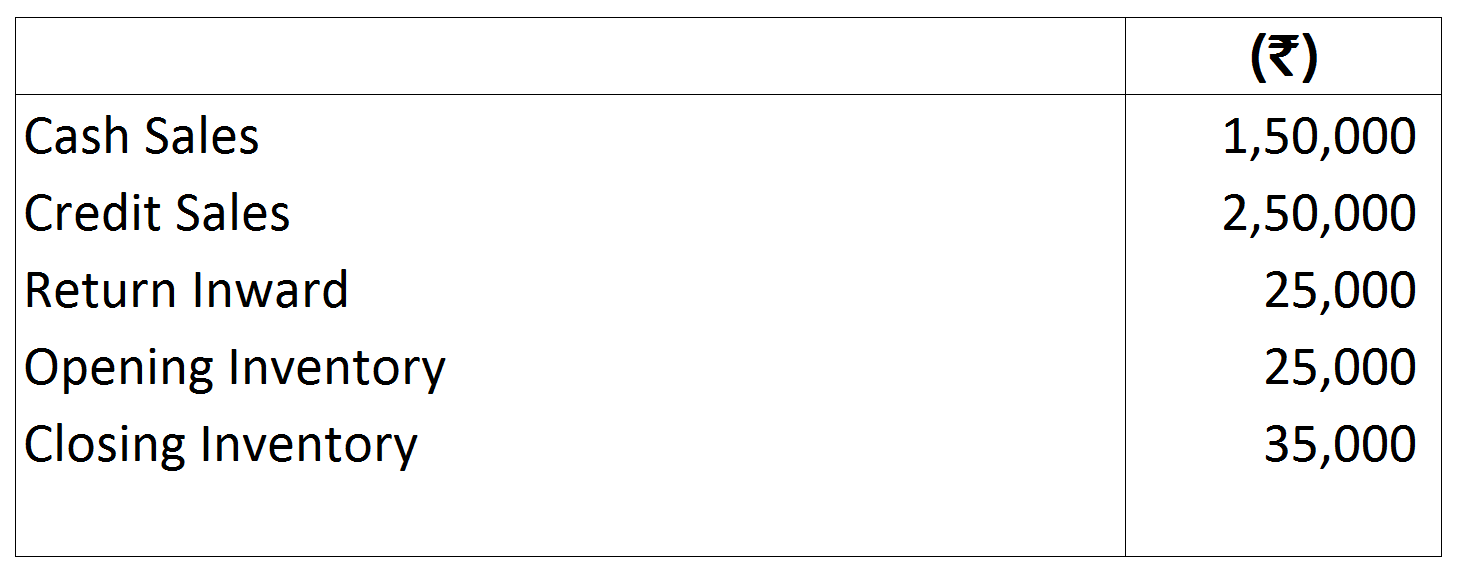
Determine the amount of Revenue from Operations from the following particulars:

You are informed that closing inventory is two times in comparison to opening inventories.
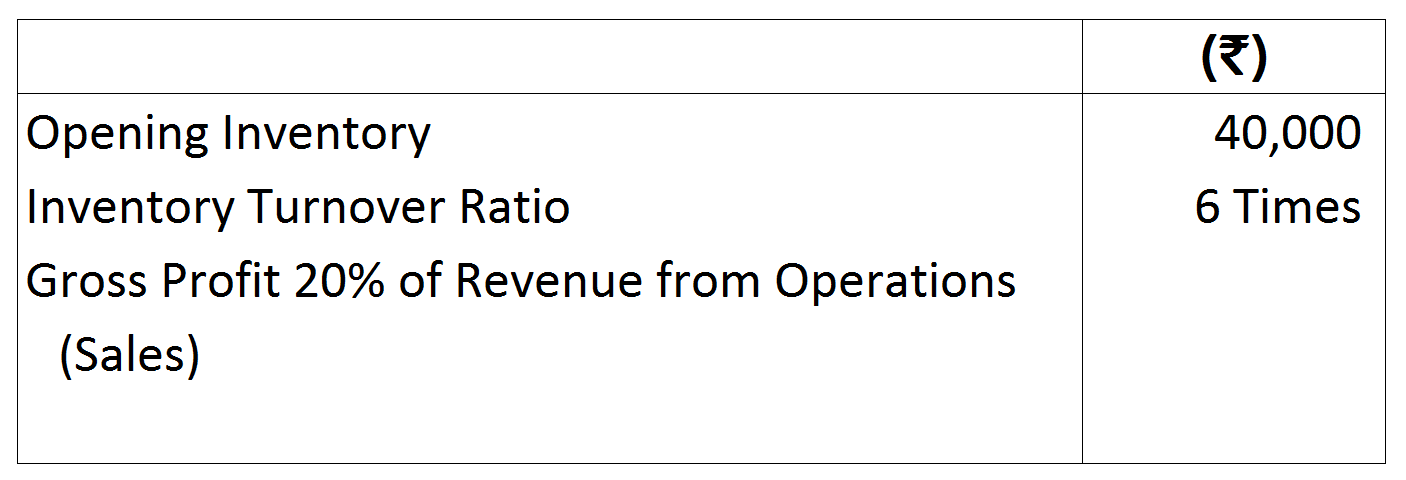
From the following data, calculate 'Inventory Turnover Ratio' when gross profit ratio is given 20%:
From the following information, calculate Cash Flow from Investing Activities:
Particulars
31st March, 2018 ₹
31st March, 2017 ₹
Plant and Machinery
Investment (Long-term)
Land (At cost)
10,00,000
1,00,000
1,00,000
8,50,000
40,000
2,00,000
Additional Information:
  1. Depreciation charged on Plant and Machinery ₹ 50,000.
  2. Plant and Machinery with a Book Value of ₹ 60,000 was sold for ₹ 40,000.
  3. Land was sold at a profit of ₹ 60,000.
  4. No investment was sold during the year.
  1. From the following information compute 'Debt-Equity Ratio'.
 
Long term Borrowings 8,00,000
Long term Provisions 4,00,000
Current Liabilities 2,00,000
Non-current Assets 14,40,000
Current Assets 3,60,000
  1. The Quick Ratio of Z Ltd. is 1 : 1. State with reason which of the following transactions would (i) increase; (ii) decrease or (iii) not change the ratio:
  1. Included in the trade payables was a Bills payable of ₹ 3,000 which was met on maturity.
  2. Debentures of ₹ 50,000 were converted into Equity shares.