MCQ
What is common name of following compound :-

$C{H_3} - \begin{array}{*{20}{c}}
  {\begin{array}{*{20}{c}}
  {C{H_3}} \\ 
  | 
\end{array}} \\ 
  C \\ 
  | \\ 
  {C{H_3}} 
\end{array} - C{H_2} - Cl$

  • Neopentyl chloride
  • B
    Tertiary pentyl chloride
  • C
    Isopentyl chloride
  • D
    None

Answer

Correct option: A.
Neopentyl chloride
a

Need a full question paper?

Generate a complete, print-ready paper with questions like this in minutes — across 16+ boards, with answer keys.

Start Generating Free

Similar questions

$PC{l_5}$ reacts with propanone, to give
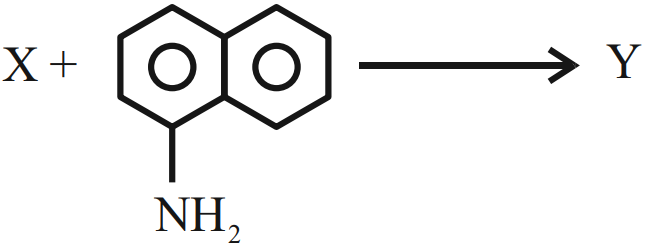
The azo-dye $( Y )$ formed in the following reactions is Sulphanilic acid $+ NaNO _2+ CH _3 COOH \rightarrow X$

Image
In which of the following coordination entities the magnitude of $\Delta _o$ ($CFSE$ in octahedral field) will be maximum ? (At. No. $Co = 27$ )
The difference between $\Delta H$ and $\Delta U$ $(\Delta H - \Delta U),$ when the combustion of one mole of heptane $(I)$ is carried out a temperature $T$ is equal to
$L-$isomer of a compound $'A'$ $\left( C _{4} H _{8} O _{4}\right)$ gives a positive test with $\left[ Ag \left( NH _{3}\right)_{2}\right]^{+}$. Treatment of $'A'$ with acetic anhydride yield triacetate derivative. Compound $'A'$ produces an optically active compound $(B)$ and an optically inactive compound $(C)$ on treatment with bromine water and $HNO _{3}$ respectively, compound $( A )$ is ....
Which of the following reaction is a redox reaction
In the Arrhenius equation, $k = A{e^{ - Ea/RT}}$, the Arrhenius constant $A$ will be equal to the rate constant when

$(A)$ $E_a = 0$

$(B)$ $T$ $=$ $\infty $

$(C)$ $T = 0$

$(D)$ $E_a$ $=$ $\infty $

Identify the major products $P, Q$ and $R$ in the following sequence of reaction

$P\;,\;Q\;,\;R$

If the bond dissociation energies of $XY,\,{X_2}$ and ${Y_2}$ (all diatomic molecules) are in the ratio of $1 : 1 : 0.5 $ and ${\Delta _f}H$ for the formation of $XY$ is $ - 200\,kJ\,mol{e^{ - 1}}$. The bond dissociation energy of ${X_2}$ will be.....$kJ\,mo{l^{ - 1}}$
Identify the correct order of stability of carbocation