MCQ
What is constant in S.H.M.
  • A
    Restoring force
  • B
    Kinetic energy
  • C
    Potential energy
  • Periodic time

Answer

Correct option: D.
Periodic time
(d)

Need a full question paper?

Generate a complete, print-ready paper with questions like this in minutes — across 16+ boards, with answer keys.

Start Generating Free

Similar questions

A particle of mass $\mathrm{m}$ moving with horizontal speed $6 \mathrm{~m} / \mathrm{sec}$ as shown in figure. If $m \ll M$ then for one dimensional elastic collision, the speed of lighter particle after collision will be

Image

When a particle moves in a uniform circular motion. It has
A gas for which $\gamma=1.5$ is suddenly compressed to $\frac{1}{4}$ th of the initial volume. Then the ratio of the final to the initial pressure is
If temperature of a black body increases from $7^{\circ} \mathrm{C}$ to $287^{\circ} \mathrm{C}$, then the rate of energy radiation increases by
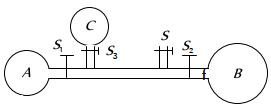
The adjoining diagram shows three soap bubbles $A, B$ and $C$ prepared by blowing the capillary tube fitted with stop cocks, $S, S$ and $S$. With stop cock $S$ closed and stop cocks $S, S$ and $S$ opened
Image
Consider an NPN transistor amplifier in common-emitter configuration. The current gain of the transistor is $100.$ If the collector current changes by $1\ mA$, what will be the change in emitter current
$A$ is singing a note and at the same time $B$ is singing a note with exactly one $-$ eighth the frequency of the note of $A$. The energies of two sounds are equal, the amplitude of the note of $B$ is
The distance between two consecutive crests in a wave train produced in a string is $5 \mathrm{~cm}$. If $2$ complete waves pass through any point per second, the velocity of the wave is
When a metal surface is illuminated by light of wavelengths $400 \mathrm{~nm}$ and $250 \mathrm{~mm}$, the maximum velocities of the photoelectrons ejected are $v$ and $2 v$ respectively. The work function of the metal is $(h=$ Planck's constant, $c=$ velocity of light in air)
$80 \mathrm{gm}$ of water at $30^{\circ} \mathrm{C}$ are poured on a large block of ice at $0^{\circ} \mathrm{C}$. The mass of ice that melts is