Question
What is Double-Entry System? Explain its principles and advantages.

Answer

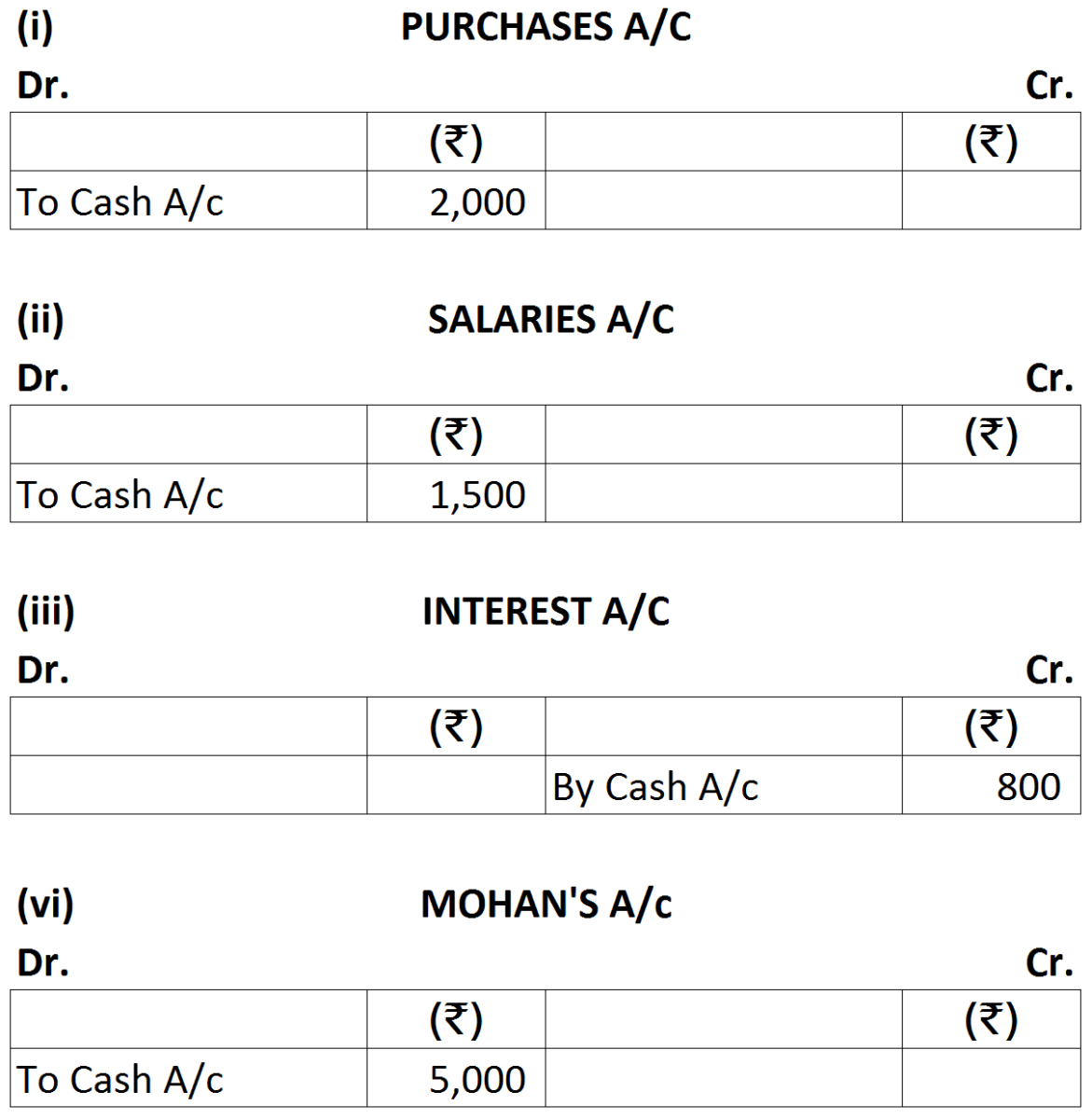
Meaning of Double Entry System: According to this system every business transaction affects at least two accounts in opposite directions. For example, if the furniture is purchased in the business, furniture is increased whereas the cash is decreased. There can be no transaction in the business which affects only one account or which has only one aspect. As such, both the aspects of every transaction are recorded under this system. It may, however, be noted that the double entry does not mean that a transaction is recorded twice. But it means that at least two accounts are affected by a transaction - one account receiving a benefit and the other account yielding a benefit. The person or the account receiving a benefit is debited and the person or the account who gives something to the business is credited. The amount of every transaction is written twice, once as a debit and again as a credit. For example, we received ₹ 25,000 from Mohan. This transaction affects two accounts - Cash Account and the Mohan's Account. Cash account is receiving a benefit (as cash is coming in) and hence Cash account will be debited, whereas Mohan is yielding a benefit and hence his account will be credited.
Principles or Characteristics of Double Entry System: Double Entry System is based upon the principle that “Every debit has a credit and every credit has a debit”. Following are the important features or essentials of the double entry system.
  1. Every bussiness transaction affects two accounts: Every business transaction has a two-fold effect, i.e., it affects two accounts simultaneously. One of them is debited and the other is credited. Certain transactions may affect more than two accounts but the amount of the accounts to be debited and credited will always be equal.
  2. Recording of both personal and impersonal aspects: Both personal and impersonal aspects of a transaction are recorded in Double Entry. It is possible that both the aspects of a transaction may be personal or both may be impersonal or one may be personal and the other may be impersonal.
The advantages of Double Entry System are:
  1. Scientific System: Double Entry System is a scientific system of recording business transactions as compared to other systems of Book Keeping. It helps attain the objectives of accounting.
  2. Complete Record of Transactions: Under the system, both sides of a transaction are recorded. It is a complete record as it results in showing correct income or loss, assets and liabilities.
  3. Arithmetical Accuracy of Accounts is Ensured: By the use of this system, arithmetical accuracy of the accounting work can be established throagh the Trial Balance.
  4. Determining Profit or Loss: Profit earned or loss incurred during a period can be determined by preparing Profit and Loss Account.

Need a full question paper?

Generate a complete, print-ready paper with questions like this in minutes — across 16+ boards, with answer keys.

Start Generating Free

Similar questions

There was a difference of ₹ 430 in a Trial Balance. It was placed on the Debit side of a Suspense A/c. Later on the following errors were discovered. Pass rectifying entries and prepare Suspense A/c.
  1. Purchases book was overcast by ₹ 100.
  2. Sales book was overcast by ₹ 1,000.
  3. Goods for ₹ 800 purchased from Umakant, though entered in the purchase book, has not been posted to his account.
  4. An amount of ₹ 500 has been posted to the credit side of commission account instead of ₹ 570.
  5. Goods sold to Bharti for ₹ 4,400 has been posted to her account as ₹ 4,000.
  6. Goods sold to X for ₹ 750 were recorded in purchase book.
Explain the following:
  1. Dual Aspect Concept.
  2. Accrual Concept.
  3. Going Concern Concept.
  4. Cost Concept.
  5. Accounting Period Concept.
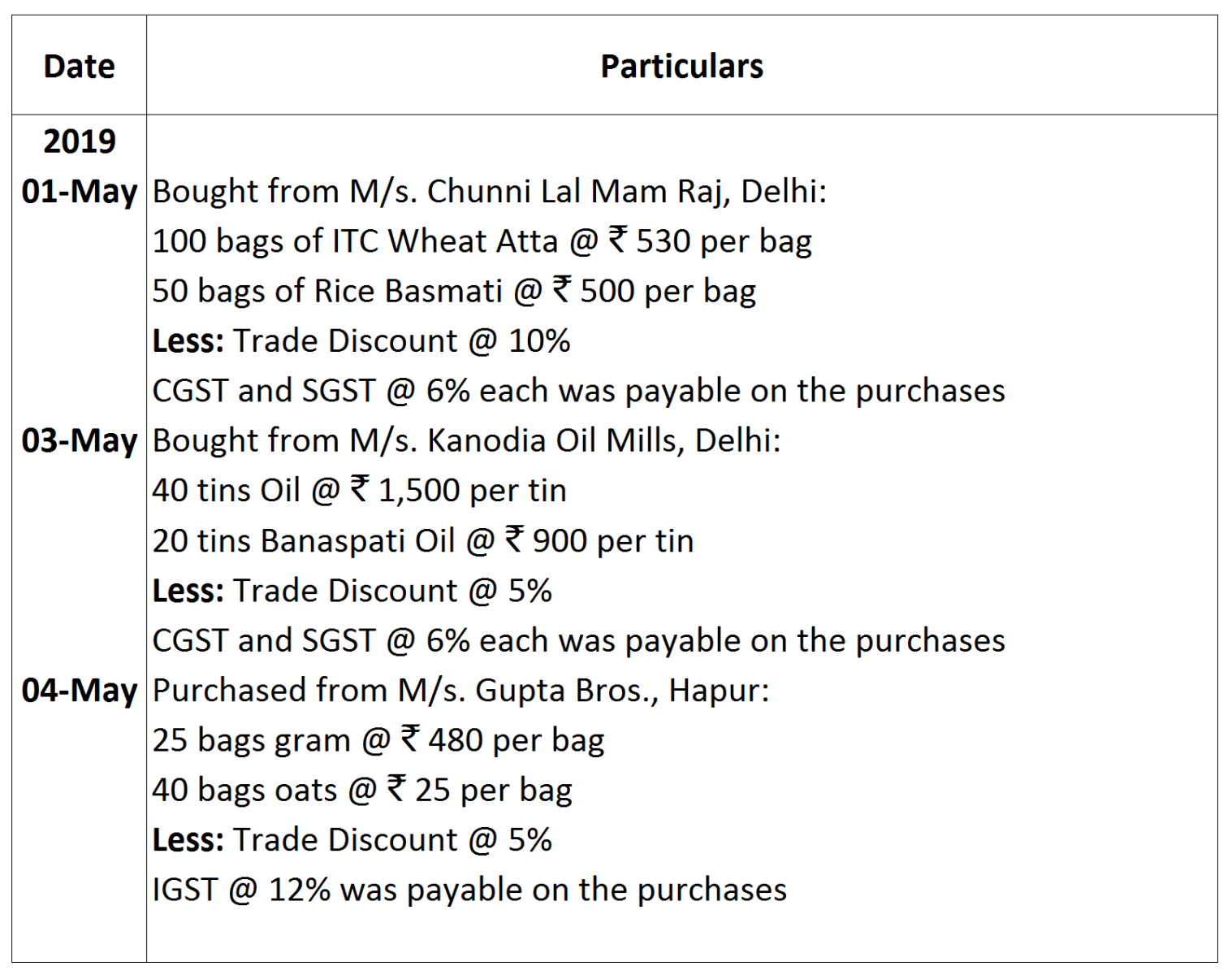
Record the following transactions in the Purchases Book of Subhash General Stores, Delhi:
Prepare journal Entries of the following postings:
Write the process of preparing ledger from a journal.
Journalise the following transactions:
  1. Purchased a Motor Car for 3,00,000 and paid 25,000 for its repair and renewal. Entire payment is made by cheque.
  2. Received Rent 5,000.
  3. Goods worth 20,000 were distributed as free samples.
  4. Charge depreciation on Motor Car 32,500.
  5. Rent due to Landlord 10,000 and Salary due to Clerks 80,000.
  6. Charge interest on Capital 20,000.
  7. 5,000 due from Sanjay Gupta are bad-debts.
  8. Goods worth 50,000 were destroyed by fire.
  9. ash 5,000 and goods worth 20,000 were stolen by an employee.
Prepare bank reconciliation statement of Dinesh on 30th June 2014 with following particulars:
  1. Pass Book showed an overdraft of ₹ 15,000 on 30th June 2014.
  2. A cheque of ₹ 200 was deposited in bank but not recorded in Cash Book.
  3. Cheques of ₹ 17,000 were issued but cheques worth only ₹ 10,000 were presented for payment up to 30th June 2014.
  4. Cheques of ₹ 2,000 were received and recorded in Cash Book but not sent to bank.
  5. Cheques of ₹ 10,000 were sent to bank for collection; out of these cheques of ₹ 2,000 and of ₹ 1,000 were credited respectively on 8th July and 10th July and the remaining cheques were credited before 30th June 2014.
  6. Bank paid ₹ 300 fee of Chamber of Commerce on behalf of Dinesh, which was not recorded in Cash Book.
  7. Bank charged interest on overdraft ₹ 800 which was not recorded in Cash Book.
  8. ₹ 40 for bank charges were recorded two times in Cash Book and bank expenses of ₹ 35 were not at all recorded in Cash Book.
  9. Total of credit side of bank column of Cash Book was undercast by ₹ 1,000 by mistake.
Prepare bank reconciliation statement of Dinesh on 30th June 2014 with following particulars:
  1. Pass Book showed an overdraft of ₹ 15,000 on 30th June 2014.
  2. A cheque of ₹ 200 was deposited in bank but not recorded in Cash Book.
  3. Cheques of ₹ 17,000 were issued but cheques worth only ₹ 10,000 were presented for payment up to 30th June 2014.
  4. Cheques of ₹ 2,000 were received and recorded in Cash Book but not sent to bank.
  5. Cheques of ₹ 10,000 were sent to bank for collection; out of these cheques of ₹ 2,000 and of ₹ 1,000 were credited respectively on 8th July and 10th July and the remaining cheques were credited before 30th June 2014.
  6. Bank paid ₹ 300 fee of Chamber of Commerce on behalf of Dinesh, which was not recorded in Cash Book.
  7. Bank charged interest on overdraft ₹ 800 which was not recorded in Cash Book.
  8. ₹ 40 for bank charges were recorded two times in Cash Book and bank expenses of ₹ 35 were not at all recorded in Cash Book.
  9. Total of credit side of bank column of Cash Book was undercast by ₹ 1,000 by mistake.
On 1st July 2015, ABC Ltd. purchase 4 machines for ₹ 80,000 each. The accounting year of the company ends on 31st March every year. Depreciation is provided at the rate of 15% p.a. on original cost.
On 1st April, 2017 one machine was sold for ₹ 50,000 and on 1st January, 2019 a second machine was sold for ₹ 40,000. Another machine with a higher capacity which cost ₹ 2,00,000 was purchased on 1st January, 2019.
You are required to show: (i) Machinery Account, (ii) Depreciation Account, and (iii) Provision for Depreciation Account for four years ending 31st March, 2019.
On 1st April, 2016, B accepts a bill drawn by A at three months for ₹ 8,000 in payment of debt. On the due date the acceptance is dishonoured and A gets the bill noted paying ₹ 100. On 4th July, 2016 A draws a new bill payable after 73 days provided interest is paid in cash @ 15% p.a. To this B is agreeable. The bill is met on maturity.
Record these transactions in the Journal of both the parties.