Question
What is Electrolytic cell? Explain simplest electrolytic cell in details?

Answer

→ In an electrolytic cell external source of voltage is used to bring about a chemical reaction.
→ The electrochemical processes are of great importance in the laboratory and the chemical industry.
→ One of the simplest electrolytic cell consists of two copper strips dipping in an aqueous solution of copper sulphate.
→ If a DC voltage is applied to the two electrodes, then $Cu ^{+2}$ ions discharged at the cathode (negatively charged) and the following reaction takes place :
$
Cu ^{2+}( aq )+2 e ^{-} \rightarrow Cu ( s )
$
→ Copper metal is deposited on the cathode. At the anode, copper is converted into $Cu ^{+2}$ ions by the reaction :
$
Cu ( s ) \rightarrow Cu ^{2+}( s )+2 e ^{-}
$
→ Thus copper is dissolved (oxidised) at anode and deposited (reduced) at cathode.
→ This is the basis for an industrial process inwhich impure copper is converted in to copper of high purity. The impure copper is made theanode that dissolves on passing current andpure copper is deposited at the cathode.
→ Many metals like Na, Mg, Al, etc. are produced on large scale by electrochemical reduction of their respective cations where no suitable chemical reducing agents are available for this purpose.
→ Sodium and magnesium metals are produced by the electrolysis of their fused chlorides and aluminium is produced by electrolysis of aluminium oxide in presence of cryolite.

Need a full question paper?

Generate a complete, print-ready paper with questions like this in minutes — across 16+ boards, with answer keys.
Start Generating Free

Similar questions

Calculate emf of the following cell at $25^{\circ} \mathrm{C}$ :
$\mathrm{Fe}\left|\mathrm{Fe}^{2+}(0.001 \mathrm{M})\right|\left|\mathrm{H}^{+}(0.01 \mathrm{M})\right| \mathrm{H}_2(\mathrm{~g})(1 \text { bar }) \mid \mathrm{Pt}(\mathrm{~s})$
$\mathrm{E}^{\circ}\left(\mathrm{Fe}^{2+} \mid \mathrm{Fe}\right)=-0.44 \mathrm{VE} \mathrm{E}^{\circ}\left(\mathrm{H}^{+} \mid \mathrm{H}_2\right)=0.00 \mathrm{~V}$
Explain the importance of carbohydrate compounds.
Explain with examples the terms weak and strong electrolytes.
The decomposition of A into product has value of k as $4.5 \times 10^3 s^{-1}$ at $10^{\circ} C$ and energy of activation $60 kJ mol ^{-1}$. At what temperature would k be $1.5 \times 10^4 s^{-1}$ ?
Explain stoichiometry calculation of chemical reaction occurs on the electrode of electrolytic cell and it's formula. $($for numerical$)$
Explain the displacement equation of the diazonium group of benzene diazonium salt by the hydroxyl group as well as by the nitro group.
How would you account for the following?
  1. The lower oxidation state becomes more stable with increasing atomic number in Group $13.$
  2. Hydrogen fluoride is much less volatile than hydrogen chloride,
  3. Interhalogen compounds are strong oxidising agents.
  1. What is the radius of sodium atom if it crystallises in bcc structure with the cell edge of $400$ pm?
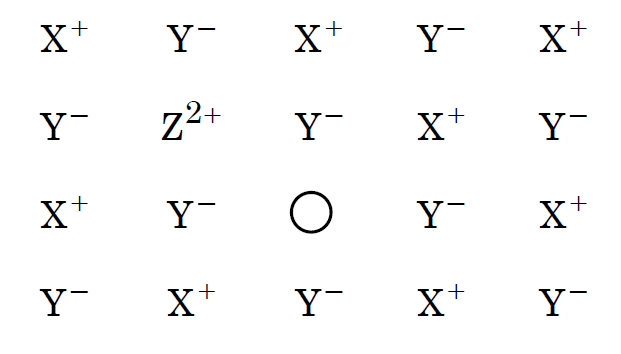
  2. Examine the given defective crystal:
  1. Write the term used for this type of defect.
  2. What is the result when $XY$ crystal is doped with divalent $(Z^{2+})$ impurity$?$
After the ban on plastic bags, students of one school decided to make the people aware of the harmful effects of plastic bags on environment and Yamuna River. To make the awareness more impactful, they organised rally by joining hands with other schools and distributed paper bags to vegetable vendors, shopkeepers and departmental stores. All students pledged not to use polythene bags in future to save Yamuna River.
After reading the above passage, answer the following questions:
  1. What values are shown by the students?
  2. What are biodegradable polymers? Give one example.
  3. Is polythene a condensation or an addition polymer?
Why a compound in which hydroxyl group attached to an aromatic ring is more acidic than the one in which hydroxyl group attached to an alkyl group?