Question
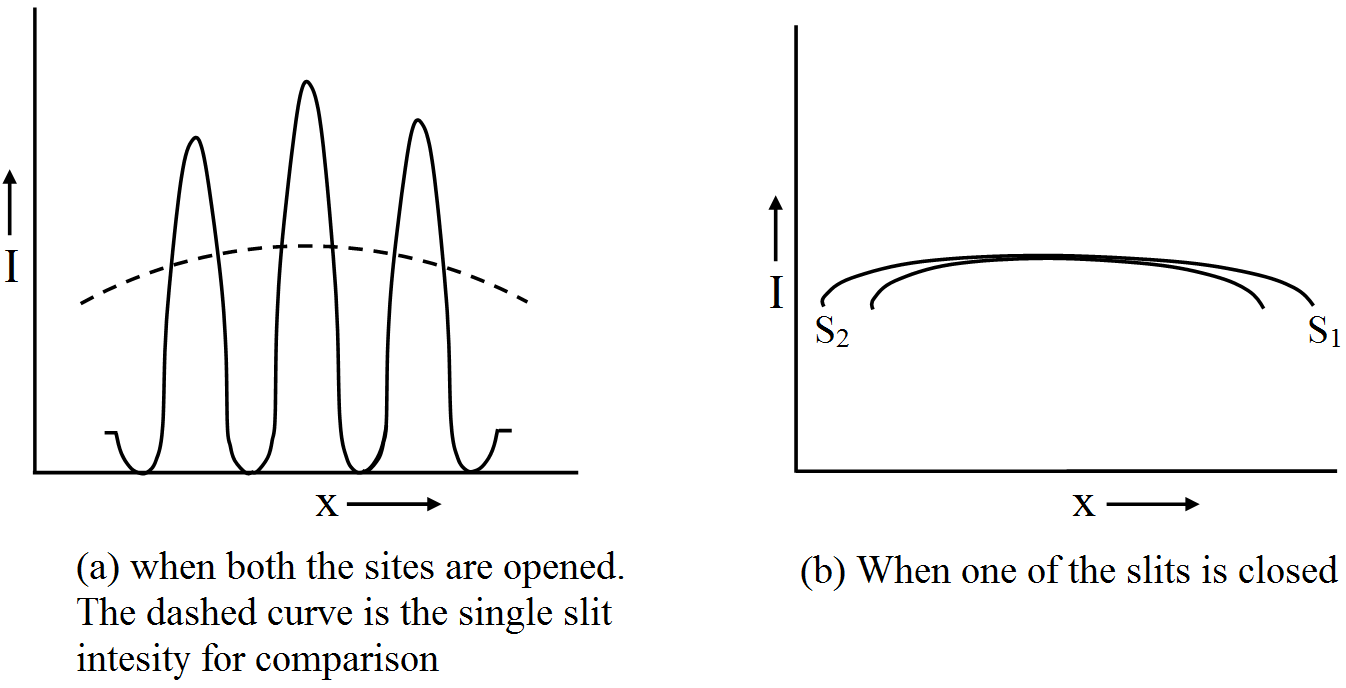
What is interference of light? Write two essential conditions for sustained interference pattern to be produced on the screen. Draw a graph showing the variation of intensity versus the position on the screen in Young’s experiment when (a) both the slits are opened and (b) one of the slits is closed. What is the effect on the interference pattern in Young’s double slit experiment when:
  1. Screen is moved closer to the plane of slits?
  2. Separation between two slits is increased?
Explain your answer in each case.

Answer


Interference of light: When two waves of same frequency and constant initial phase difference travel in the same direction along a straight line simultaneously, they superpose in such a way that the intensity of the resultant wave is maximum at certain points and minimum at certain other points. This phenomenon of redistribution of energy due to superposition of two waves of same frequency and constant initial phase difference is called interference
Conditions for Sustained Interference of Light Waves:
To obtain sustained (well-defined and observable) interference pattern, the intensity must be maximum and zero at points corresponding to constructive and destructive interference. For the purpose following conditions must be fulfilled:
  1. The two interfering sources must be coherent and of same frequency, i.e., the sources should emit light of the same wavelength or frequency and their initial phase should remain constant. If this condition is not satisfied the phase difference between the interfering waves will vary continuously. As a result the resultant intensity at any point will vary with time being alternately maximum and minimum, just like the phenomenon of beats in sound.
  2. The interfering waves must have equal amplitudes. Otherwise the minimum intensity will not be zero and there will be general illumination.

The variation of intensity I versus the position x on the screen in Young’s experiment. Fringe width, $\beta=\frac{\text{D}\lambda}{\text{d}}.$
  1. $\text{B}\alpha\text{D},$ therefore with the decrease of separation between the plane of slits and screen, the fringe width decreases.
  2. On increasing the separation between two slits (d), the fringe separation decreases as β is inversely proportional to d $(\text{i.e.,}\beta\alpha\frac{1}{\text{d}}.)$

Need a full question paper?

Generate a complete, print-ready paper with questions like this in minutes — across 16+ boards, with answer keys.

Start Generating Free

Similar questions

A tightly-wound, long solenoid is kept with its axis parallel to a large metal sheet carrying a surface current. The surface current through a width dl of the sheet is Kdl and the number of turns per unit length of the solenoid is n. The magnetic field near the centre of the solenoid is found to be zero.
  1. Find the current in the solenoid.
  2. If the solenoid is rotated to make its axis perpendicular to the metal sheet, what would be the magnitude of the magnetic field near its centre ?
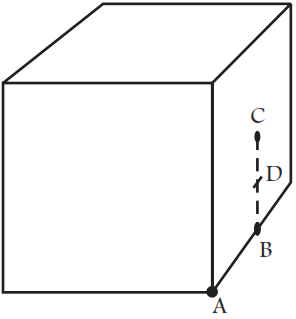
What will be the total flux through the faces of the cube (Fig.) with side of length a if a charge q is placed at:
  1. A: a corner of the cube.
  2. B: mid-point of an edge of the cube.
  3. C: centre of a face of the cube.
  4. D: mid-point of B and C.
Two convex lenses, each of focal length 10cm, are placed at a separation of 15cm with their principal axes coinciding,
  1. Show that a light beam coming parallel to the principal axis diverges as it comes out of the lens system.
  2. Find the location of the virtual image formed by the lens system of an object placed far away.
  3. Find the focal length of the equivalent lens.
(Note that the sign of the focal length is positive although the lens system actually diverges a parallel beam incident on it).
Two particles A and B having charges q and 2q respectively are placed on a smooth table with a separation d. A third particle C is to be clamped on the table in such a way that the particles A and B remain at rest on the table under electrical forces. What should be the charge on C and where should it be clamped?
A uniform field of $2.0NC^{-1}$ exists in space in x-direction.
  1. Taking the potential at the origin to be zero, write an expression for the potential at a general point (x, y, z).
  2. At which points, the potential is 25V?
  3. If the potential at the origin is taken to be 100V, what will be the expression for the potential at a general point?
  4. What will be the potential at the origin if the potential at infinity is taken to be zero? Is it practical to choose the potential at infinity to be zero?
Write the properties of charge. What is meant by charge conservation? Explain with example. What do you understand by charge quantization?
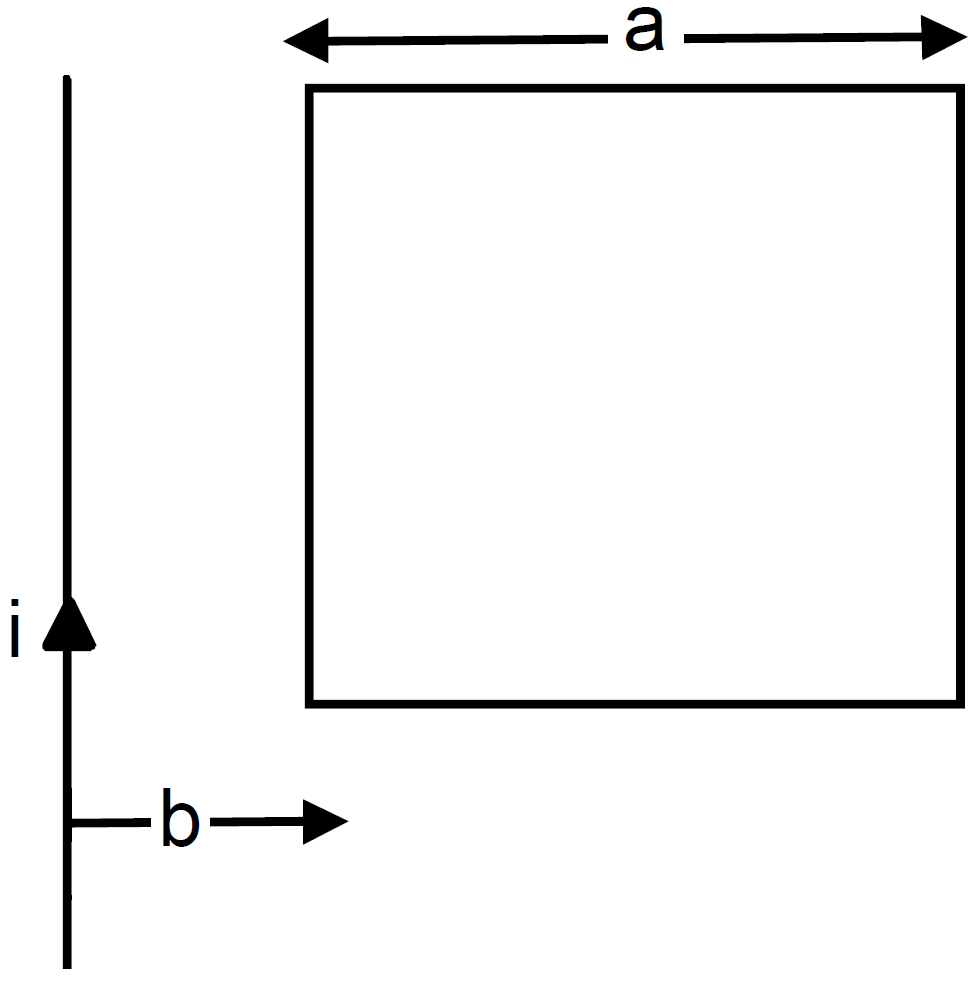
Figure shows a square frame of wire having a total resistance r placed coplanarly with a long, straight wire. The wire carries a current i given by $\text{i}=\text{i}_0\sin\omega\text{t}.$ Find
  1. The flux of the magnetic field through the square frame.
  2. The emf induced in the frame.
  3. The heat developed in the frame in the time interval 0 to $\frac{20\pi}{\omega}.$
Hari is a student of Class X in a school near his village. His uncle gifted him a bicycle with a dynamo fitted in it. He was thrilled to find that while cycling during night, he could light the bulb and see the objects on the road clearly. He, however, did not know how this device works. He asked this question to his teacher. The teacher considered it an opportunity and explained the working of a dynamo to the whole class.
Answer the following questions:
  1. State the principle and working of a dynamo.
  2. Write two values each displayed by Hari and his Science teacher.
With the help of a neat and labelled diagram, explain the underlying principle and working of a moving coil galvanometer. What is the function of:
  1. Uniform radial field.
  2. Soft iron core in.
In such a device?
A magnetic field set up using Helmholtz coils (described in Exercise 4.16) is uniform in a small region and has a magnitude of 0.75 T. In the same region, a uniform electrostatic field is maintained in a direction normal to the common axis of the coils. A narrow beam of (single species) charged particles all accelerated through 15 kV enters this region in a direction perpendicular to both the axis of the coils and the electrostatic field. If the beam remains undeflected when the electrostatic field is $9.0 \times 10^{–5} V m^{–1}$, make a simple guess as to what the beam contains. Why is the answer not unique?