Question
What is limiting molar conductivity ? Explain relation between molar conductivity and concentration of solution with strong electrolyte.
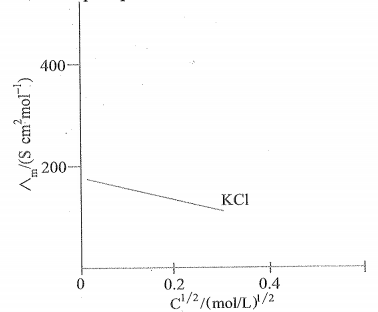
Answer

→ "When the concentration of solution approaches zero, the molar conductivity is known as limiting molar conductivity and is represented by the symbol $\wedge_m^0$
→ Electrolytes which is completely ionize is known as strong electrolyte.
e.g. $KCl , NaCl , MgCl _2, CaCl _2, NaNO _3, KNO _3$ etc.
→ For strong electrolytes, $\wedge_{ m }$increases slowly with dilution and can be represented by the equation : $
\wedge_{ m }=\Lambda^0{ }_{ m }- Ac ^{\frac{1}{2}}
$
→ It can be seen that if we plot $\wedge_{ m }$ against $c ^{\frac{1}{2}}$, we obtain a straight line with intercept equal to $\wedge^0{ }_{ m }$ and slope equal to - A .
Image
→ The value of the constant A for a given solvent and temperature depends on the type of electrolyte.
→ Thus, $NaCl , CaCl _2, MgSO _4$ are known as 1-1, 2-1 and 2-2 electrolytes respectively. Al electrolytes of a particular type have the same value for 'A'.

Need a full question paper?

Generate a complete, print-ready paper with questions like this in minutes — across 16+ boards, with answer keys.
Start Generating Free

Similar questions

Write a note on chemical composition of nucleic acid compounds.
Describe the following$:$
$i.$ Acetylation
$ii.$ Cannizzaro reaction
$iii.$ Cross aldol condensation
$iv.$ Decarboxylation
How do you convert:
  1. Chlorobenzene to biphenyl.
  2. Propene to I-iodopropane.
  3. 2-bromobutane to but-2-ene.
(a) How will you prepare phenol from benzenediazonium chloride?
(b) How will you convert salicylic acid into phenol?
A violet compound of manganese (A) decomposes on heating to liberate oxygen and compounds (B) and (C) of manganese are formed. Compound (C) reacts with $KOH$ in the presence of potassium nitrate to give compound (B). On heating compound (C) with conc. $H_2SO_4$ and $NaCl$, chlorine gas is liberated and a compound (D) of manganese along with other products is formed. Identify compounds A to D and also explain the reactions involved.
$a.$ Write down the reaction occurring on two inert electrodes when electrolysis of copper chloride is done. What will happen if a concentrated solution of copper sulphate is replaced with copper chloride?
$b.$ Write an expression for the molar conductivity of aluminium sulphate at infinite dilution according to Kohlrausch law.
In the following cases rearrange the compounds as directed:
  1. In an increasing order of basic strength:
$C_6H_5NH_2, C_6H_5N(CH_3)_2, (C_2H_5)_6NH$ and $CH_3NH_2$.
  1. In a decreasing order of basic strength:
Aniline, p-nitroaniline and p-toluidine.
  1. In an increasing order of $pK_b$ values:
$C_2H_5NH_2, C_6H_5 NHCH_3, (C_2H_5)_2NH and C_6H_5NH_2$.
How do you convert the following:
  1. Prop-1-ene to Propan-2-ol
  2. Bromobenzene to 2-bromoacetophenone
  3. 2-bromobutane to But-2-ene
How will you convert the following:
  1. Impure Nickel to pure Nickel
  2. Zinc blende to Zinc metal
  3. $[Ag(CN)_2]^-$ to $Ag$