Question
What is meant by acquired and inherited traits? Explain with one example each.

Answer

A trait of an organism which is ‘not inherited’ but develops in response to the environment is called an acquired trait.
Example: If a beetle does not get sufficient food for a considerable time, its weight will be reduced due to starvation. The low weight of the beetle is an example of acquired trait. A trait of an organism which is caused by a change in its genes (DNA) is called an inherited trait.
Example: The change of colour from red beetle to green beetle is an example of inherited trait.

Need a full question paper?

Generate a complete, print-ready paper with questions like this in minutes — across 16+ boards, with answer keys.
Start Generating Free

Similar questions

Calculate:
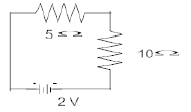
$i.$ the effective resistance of the circuit and the current in the circuit
$ii.$ Potential difference across $10$ resistor of a circuit shown in the figure.
Image
What are the advantages of sexual reproduction over asexual reproduction?
A large coal-fired power station produces 2000MW of electrical energy. A wind turbine with 33m blades can produce 300kW.
  1. How many turbines would be needed to replace the power station?
  2. Why, in actual practice, this number of turbines could not replace the coal-fired power station?
$a.$ What is the heating effect of electric current?
$b.$ Write an expression for the amount of heat produced in a resistor when an electric current is passed through it stating the meanings of the symbols used.
$c.$ Name two appliances based on heating effect of electric current.
What is a period in a periodic table? How do atomic structures (electron arrangements) change in a period with increase in atomic numbers from left to right?
A forest ecosystem having a lot of green plants has some foxes, lions and rabbits in it.
  1. Write a food chain comprising all the four organisms mentioned above.
  2. Name (i) one herbivore, and (ii) two carnivores, in this food chain.
  3. Name the link which is a predator as well as a prey.
  4. Name (i) second trophic level, and (ii) third trophic level.
  5. Which link of this food chain can feed on second trophic level as well as third trophic level, independently?
  6. If the sun provides 1000 J of energy to the plants, then how much energy will be transferred to fox through the food chain.
Why does the size of the atoms progressively become smaller when we move from sodium (Na) to chlorine (Cl) in the third period of the periodic table?
An object is kept at a distance of 100cm from each of the above lenses. Calculate the (i) image distance and (ii) magnification in each of the two cases.
P, Q and R are 3 elements which undergo chemical reactions according to the following equations
a. $P _2 O _3+2 Q \rightarrow O _2 O _3+2 P$
b. $3 RSO _4+2 Q \rightarrow Q _2\left( SO _4\right)_3+3 R$
c. $3 RO +2 P \rightarrow P _2 O _3+3 R$
Answer the following questions:
i. Which element is most reactive?
ii. Which element is least reactive?
iii. State the type of reaction listed above.
‘‘Energy flow in a food chain is unidirectional.’’ Justify this statement. Explain how the pesticides enter a food chain and subsequently get into our body.