Questions · Page 1 of 3

[3 Mark Questions]

🎯

Test yourself on this topic

50 questions · timed · auto-graded

Question 13 Marks
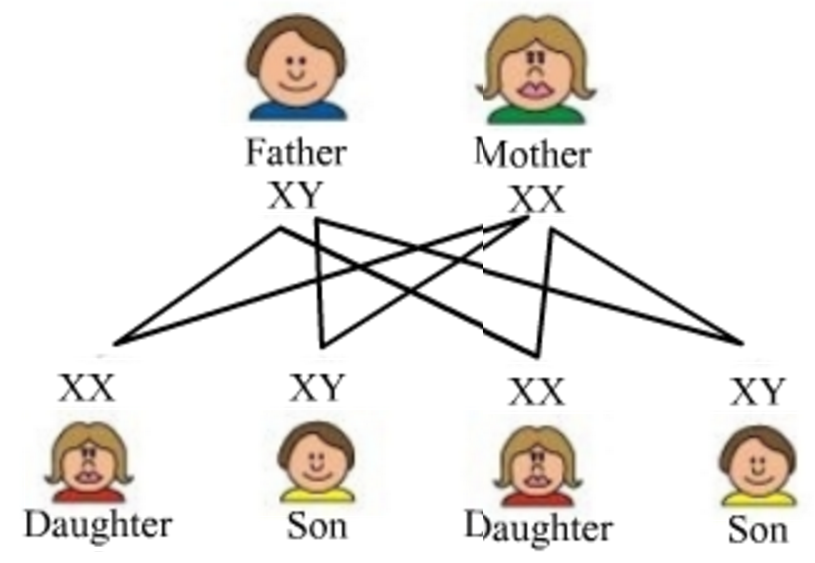
‘‘It is a matter of chance whether a couple will give birth to a male child or a female child.’’ Justify this statement with the help of a flow chart showing the fusion of sex chromosomes.
Answer
Sex of a child is dependent on the type of the male gamete fusing with the female gamete. Human beings possess 23 pairs of chromosomes. Out of these, 22 pairs are known as autosomes, while the remaining one pair comprises sex chromosomes (XX in females and XY in males). At the time of fertilisation, the egg cell fuses with the sperm cell, resulting in the formation of the zygote. If the egg cell carrying an X chromosome fuses with the sperm carrying an X chromosome, the resulting child would be a girl. If the egg cell carrying an X chromosome fuses with the sperm carrying a Y chromosome, the resulting child would be a boy.
View full question & answer
Question 23 Marks
What do you understand about the independent inheritance of traits?
Answer
It is explained by Mendel in the form of Law of Independent Assortment. when two or more characteristics are inherited, individual hereditary factors assort independently during gamete production, giving different traits an equal opportunity of occurring together. It was based upon the observation in the dihybrid cross.
View full question & answer
Question 33 Marks
A study found that children with light-coloured eyes are likely to have parents with light-coloured eyes. On this basis, can we say anything about whether the light eye colour trait is dominant or recessive? Why or why not?
Answer
We can say that light eye colour trait is dominant because only dominant traits are expressed in the first generation.
View full question & answer
Question 43 Marks
How is the refractive index of a medium related to the speed of light? Give an expression for refractive index of a medium with respect to another in terms of speed of light in these two media?
Answer
Refractive index compares the speed of light in a particular medium with the speed of light in vacuum
Relation between refractive index and speed of light:
Refractive index $(\mu)=\frac{\text{c (speed of light in vaccum)}}{\text{v (speed of light in any medium)}}$
$\Rightarrow\mu=\frac{\text{c}}{\text{v}}$
Let the refractive index of medium 1 be $\mu_1$ and the speed of light in medium 1 is $v_1$.
$\Rightarrow\mu_1=\frac{\text{c}}{\text{v}_1}...(1)$
Similarly;
Let the refractive index of medium 2 be $\mu_2$ and the speed of light in medium 2 is $v _2$.
$\Rightarrow\mu_2=\frac{\text{c}}{\text{v}_2}...(2)$
Dividing (1) by (2)
$\frac{\mu_1}{\mu_2}=\frac{\frac{\text{C}}{\text{V}_1}}{\frac{\text{C}}{\text{V}_2}}=\frac{\text{C}}{\text{V}_1}\times\frac{\text{V}_2}{\text{C}}$
$\Rightarrow\frac{\mu_1}{\mu_2}=\frac{\text{V}_2}{\text{V}_1}$
Hence refractive index of a medium is inversely proportional to the speed of light in that medium.
View full question & answer
Question 53 Marks
Give an example of the characteristics being used to determine how close two species are in evolutionary terms.
Answer
Different organisms with common ancestry in the past are more likely to have similar characteristics due to inheritance. These similar characteristics are used to determine evolutionary relationships. Basic structure of Forelimbs in human and birds is one such example of a characteristic which shows closeness of two species in evolutionary terms. The forelimbs in both the species have similar bones structure and similar origin, but, over period of time, spanning generations, they have been developed to perform different suitable functions as per the need. Such organs that have similar basic structure but perform different functions are called homologous organs. These are used to find out evolutionary relationships.
View full question & answer
Question 63 Marks
In a monohybrid cross between tall pea plants (TT) and short pea plants ( tt ) a scientist obtained only tall pea plants ( Tt ) in the $F _1$ generation. However, on selfing the $F_1$ generation pea plants, he obtained both tall and short plants in $F_2$ generation. On the basis of above observations with other angiosperms also, can the scientist arrive at a law? If yes, explain the law. If not, give justification for your answer.
Answer
Based on the given experiment, two laws were formulated by Mendel. They are as follows:-Law of Dominance:
i. According to this law, characters are controlled by discrete units called factors that occur in pairs, with one member of the pair dominating over the other in a dissimilar pair.
ii. This law explains the expression of only one of the parental characters in $F_1$ generation and expression of both in $F_2$ generation.

Law of Segregation:
i. This law states that the two alleles of a pair segregate or separate during gamete formation in such a way that a gamete receives only one of the two factors.
ii. In homozygous parents, all gametes produced are similar; while in heterozygous parents, two kinds of gametes are produced in equal proportions.
View full question & answer
Question 73 Marks
Describe any three methods of tracing evolutionary relationship amongst organisms.
Answer
Methods of tracing evolutionary relationships.
  1. Studying homologous organs: Organs having same structural plan or origin but are modified to perform different functions.
Example: Forelimbs of vertebrates.
  1. Studying analogous organs: Organs have different structural plan or origin but are modified to perform same function.
Example: Wings of birds and wings of bat/wings of insects and wings of bat.
  1. Study of fossils: By studying fossils,we can know about the species which once existed.
Example: Dinosaur skull/Invertebrate.
View full question & answer
Question 83 Marks
Distinguish between homologous organs and analogous organs. In which category would you place wings of a bird and wings of a bat? Justify your answer giving a suitable reason.
Answer
Homologous Organs
Analogous Organs
Homologous organs have similar origin n basic structure but perform different functions in different organisms.
Analogous organs are different in basic structure but perform same functions.
Homologous organs show divergent evolution.
Analogous organs show convergent evolution.
They develop in related orgainsms.
They develop in unrelated organisms.
Example: Forelimb of a frog and man seem to be built from the same basic design of bones but they perfrom different functions.
Example: Wings of birds and bats look similar. But in birds wings are covered bt feathers all along the arm but the wings of bats is skin folds between elongated fingers.
The wings of a bird and a bat are similar in function but are different in their origin. If we carefully look at these structures, then we will find that the wings of a bat are just the folds of skin that are stretched between its fingers whereas the wings of birds are present all along the arm. Hence, these organs can be classified as analogous organs.
View full question & answer
Question 93 Marks
Explain with the help of an example each, how the following provide evidences in favour of evolution:
  1. Homologous organs.
  2. Analogous organs.
  3. Fossils.
Answer
  1. Homologous Organs– The study of these organs suggests that these organisms with organs having same structure but performing different functions have evolved from a common ancestor, e.g. forelimbs of different vertebrates.
  2. Analogous Organs– The study of these apparently similar organs suggests that the organisms with apparently similar organs do not share common ancestory. Similarity in these organs is superficial/Design and the structure of these organs are very different, e.g. Wings of bird and wings of butterfly.
  3. Fossils– Provide the missing link between the species, e.g. Fossils of dinosaurs with feathers/fossils of prehistoric horse.
View full question & answer
Question 103 Marks
A light ray is incident on a rectangular glass slab at an angle of $60^{\circ}$. What is the angle between the ray coming out of the slab and the normal to the face of rectangular slab from which it comes out?
Answer
Ray of light strikes the mirror at an angle of $60^{\circ}$.
$\Rightarrow$ It will make an angle of $300\left(90^{\circ}-60^{\circ}\right)$ with the normal.
$\therefore$ Angle of incidence $=30^{\circ}$.
Now, By laws of refraction,
$\mu=\frac{\text{Sin i}}{\text{Sin r}}$
Angle of incidence is $60^{\circ}$Refractive index of glass slab is 1.5
Putting the value in the above equation, we get
$1.5=\frac{0.866}{\text{sin r}}$
On solving the above equation, we get
$\text{sin r}=\frac{0.866}{1.5}$
Angle of refraction, $r=35.26^{\circ}$
Thus the angel of refraction is $35.26^{\circ}$ from the normal.
View full question & answer
Question 113 Marks
Explain with an example how traits get expressed.
Answer

The gene which decides the appearance of an organism even in the presence of an alternative gene is known as a dominant gene. The trait expressed is known as a dominant trait.
  • The dominant gene is represented by a capital letter.
  • The gene which decides the appearance of an organism only in the presence of another identical gene is called a recessive gene. The trait expressed is known as a recessive trait.
  • The recessive gene is represented by a small letter.
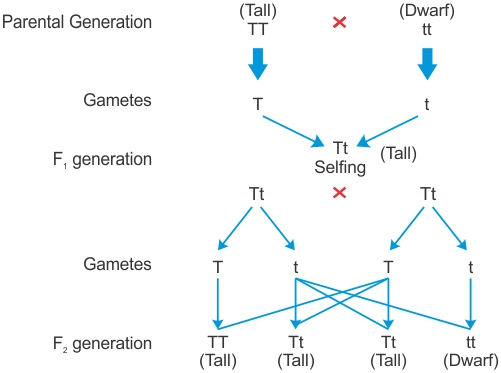
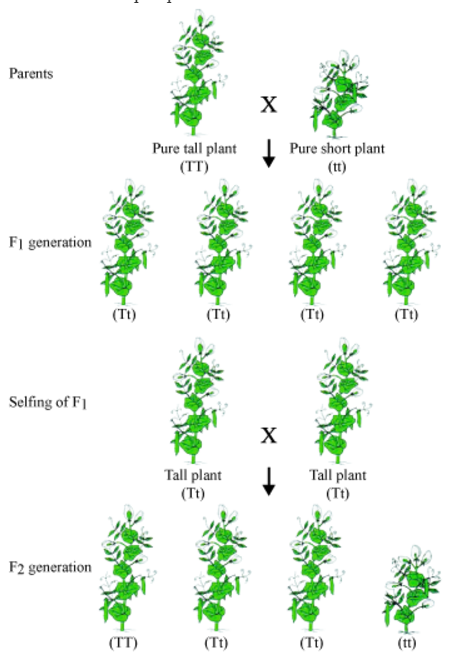
  • For example, Pure tall (TT) pea plant was crossed with dwarf (tt) plant.

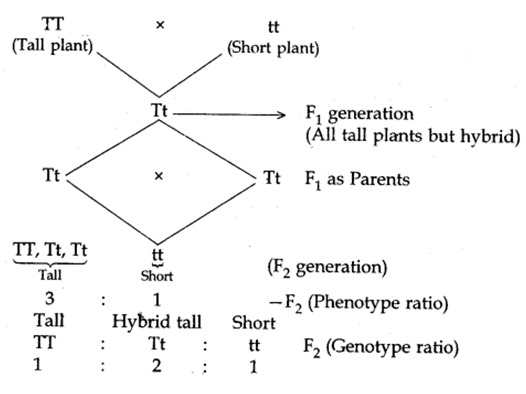
Phenotypic Ratio: 3 : 1
Genotypic Ratio: 1 : 2 : 1
- $F_1$ Generation: All plants obtained were heterozygous tall $(T t)$. Plants from $F_1$ generation were self-pollinated to obtain $F_2$ generation.
- $F _2$ Generation: One homozygous tall plant $( TT )$, two heterozygous tall plants ( Tt ) and one homozygous dwarf plant ( tt ) were obtained.
View full question & answer
Question 123 Marks
a. Mendel crossed tall pea plants with dwarf pea plants in his experiment. Write his observations giving reason on the $F_1$ and $F_2$ generations.
b. List any two contrasting characters other than height that Mendel used in his experiments in pea plants.
Answer
  1. Mendel crossed tall pea plants with dwarf pea plants.

Mendel's Observation: The $F_1$ generation contained all tall plants. When $F_1$ generation underwent selfing, the trait that was unexpressed in $F_1$ (dwarf) was observed in some $F_2$ progeny. Thus, both traits, tall and dwarf, were expressed in $F_2$ generation in the ratio $3: 1$.
Mendel proposed that something was being passed unchanged from generation to generation. He called these things factors (presently called genes). Factors contain and carry hereditary information.
He also observed that traits might not show up in an individual but were passed to the next generation.
b. The two contrasting traits other than height used by Mendel are:
i. Pod colour:- Green pod colour was dominant over yellow colour.
ii. Seed shape:- Round seed shape was dominant over wrinkled seed shape.
View full question & answer
Question 133 Marks
Explain with the help of suitable examples why certain traits cannot be passed on to the next generation? What are such traits called?
Answer
Certain traits cannot be passed on next generation because:
  1. Acquired traits which occur in the somatic cells bring about some changes in them.
  2. Changes in the somatic cells are not passed on to the offspring belonging to next generation.
  3. Only the changes in the genetic material of the reproductive cells can be inherited.
Example: Muscles developed by strenuous exercise cannot be inherited to offspring as these changes occur in somatic cells. These are called as acquired traits.
View full question & answer
Question 143 Marks
Tabulate two distinguishing features between acquired traits and inherited traits with one example of each.
Answer
  1. Characters that are passed on from parents to offspring are inherited characters.
For example: colour of seeds, colour of eyes, etc.
  1. Characters appearing in an individual’s lifetime but cannot be transmitted to next generation are acquired characters.
For example: obese body, loss of a finger in an accident, etc.
Acquired Inherited
The acquired traits are the traits which are experienced by an indiavidul during his life time. Inherited traits are distinguishing qualites of characteristics which one acquires from the ancestors.
The acquired traits of an organism cannot be passed on to its future generations. The inherited traits of an organism are passed on to its future generations.
For e.g, 'low weight' of beetle. ' cut tail' of a mouse. For e.g., red colour of beetles, fur coat of guinea pigs.
View full question & answer
Question 153 Marks
What role does sexual reproduction play in evolution?
Answer
In sexual reproduction the offspring formed will not be exactly similar to the parent. The progeny formed will undergo various modification in his body according to the environment and when this progeny develops into an adult he will have many evolved characters which are not present in his parents. He when reproduces sexually then his offspring will undergo more modification and adapt to the environment. In this way sexual reproduction helps in evolution. This is the basis to Daltons theory of evolution.
View full question & answer
Question 163 Marks
Outline a project which aims to find the dominant coat colour in dogs.
Answer

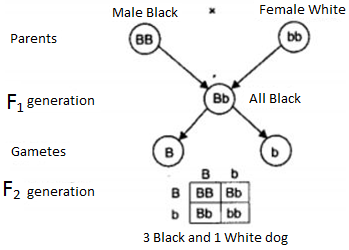
A homozygous black (RB) male dog and a homozygous white (bb) female dog is taken and given to mate and produce offspring in $F_1$ generation. If black colour is dominant out of every 4 dogs, 3 will be black and if white colour is dominant 3 out of 4 dogs will be white.
View full question & answer
Question 173 Marks
A cross was carried out between a pure bred tall pea plant and a pure bred dwarf pea plant and $\text{F}_{1}$progeny was obtained. Later, $\text{F}_{1}$ the progeny was selfed to obtain $\text{F}_{2}$progeny. Answer the following questions:
  1. What is the phenotype of the $\text{F}_{1}$ progeny and why?
  2. Give the phenotypic ratio of the $\text{F}_{2}$ progeny.
  3. Why is the $\text{F}_{2}$ progeny different from the $\text{F}_{2}$ progeny?
Answer
When plants of two different traits of character are crossbred to get a progeny ($\text{F}_{1}$ generation), only the dominant trait is visible in this generation. But when plants of $\text{F}_{1}$ generation are selfbred then the two traits of character get separated and the recessive traint also appears in the plant of $\text{F}_{2}$ generation. This is known as Law of Segregation (separation) of traits.
flow chart:
View full question & answer
Question 183 Marks
Write the full form of DNA. Name the part of the cell where it is located. Explain its role in the process of reproduction of the cell.
Answer
DNA = Deoxyribo Nucleic Acid.
It is located inside the nucleus on the chromosomes as genes.
Basic event in reproduction is the creation of a DNA copy. Cells use chemical reactions to build copies of their DNA. This creates to build copies of their DNA. This creates two copies of the DNA in the reproducing cell. DNA copying is accompanied by the creation of an additional cellular apparatus and then the DNA copies separate with its own cellular apparatus. This way a cell divides to give rise to two cells.
View full question & answer
Question 193 Marks
How do Menders experiment show that traits are inherited independently?
Answer
  • When a cross was made between a tall pea plant with round seeds and a short pea plant with wrinkled seeds, the F1 progeny plants are all tall with round seeds: this indicates that tallness and round seeds are the dominant traits.
  • When the F1 plants are self-pollinated the F2 progeny consisted of some tall plants with round seeds and some short plants with wrinkled seeds which are the parental traits.
  • There were also some new combinations like tall plants with wrinkled seeds and short plants with round seeds.
  • Thus it may be concluded that tall and short traits and round and wrinkled seed traits have been inherited independently.
View full question & answer
Question 203 Marks
Calculate the angle of incidence of light ray incident of surface of a plastic slab of refractive index $\sqrt{3}$, if the angle of refraction is 30°.
Answer
Given;
Angle of refraction(r) = 300.
Angle of incidence = i.
Refractive index $(\mu)=\sqrt{3}.$
Refractive index $(\mu)=\frac{\text{sin i}}{\text{sin r}}$
$\Rightarrow\sqrt{3}=\frac{\text{sin i}}{\text{sin 30}}=\frac{\text{sin i}}{\frac{1}{2}}$
$\Rightarrow\sqrt{3}=2\times\text{sin i}$
$\Rightarrow\text{sin i}=\frac{\sqrt{3}}{2}$
$\Rightarrow\text{i}=60^\circ$
Hence angle of incidence is 60°.
View full question & answer
Question 213 Marks
Evolution of cauliflower, broccoli, cabbage, red cabbage has occurred from wild cabbage. Is this an example of natural selection or artificial selection?
Answer
This is an example of artificial selection since humans have generated the different vegetables from cabbage by selectively breeding for specific characteristics.
Some farmers selected for very short distances between leaves, and have bred the cabbage we eat. Some have wanted to select for arrested flower development, and have bred broccoli, or for sterile flowers, and have made the cauliflower. Selecting swollen parts led to production of kohlrabi. Selecting the characteristic of slightly larger leaves led to producing a leafy vegetable called kale.
View full question & answer
Question 223 Marks
How does DNA help in defining evolutionary relationship?
Answer
The simplest answer for this question is "using sequence of DNA" the relationship between the organism is determined by their DNA sequence The arrangement of the nucleotides in DNA of the organisms are specific and are determined by the scientist who use this information and compare the sequence and find the similarities thus helping in the defining the evolution relationship of organisms. These information also used to defines the difference between organisms. Scientist also used the gene sequence to find it.
View full question & answer
Question 233 Marks
Explain with example how the following are evidences in favour evolution inganisms.
  1. Homologous organs.
  2. Analogous organs.
  3. Fossils.
Answer
  1. Study of homologous organs suggests that the organisms having same structure of organs but performing different functions have evolved from a common ancestor.
eg. forelimbs of a frog, lizard, bird and man.
  1. Analogous organs show adaptations of organs for common use.
eg. wings of butterfly and wings of bat.
  1. The fossil Archaeopteryx looks like a bird but bears a number of other features found in reptiles. This observation provides a clue that the birds have evolved from reptiles.
View full question & answer
Question 243 Marks
What are homologous structures? Give an example. Is it necessary that homologous structures always have a common ancestor. Justify your answer.
Answer
Structures which have a common basic structure but perform different functions are called homologous structures.For example: Forelimbs of mammals, birds, reptiles and amphibians.
The forelimbs of humans and the wings of birds perform different functions, but their skeletal structures are similar.Yes, homology indicates common ancestry. Homologous organs follow the same basic plan of the organisation during their development but in the adult condition, these organs are modified to perform different functions as an adaptation to different environments.
View full question & answer
Question 253 Marks
What is speciation? List four factors responsible for speciation.
Answer
The process by which a new species develops from the existing species is known as speciation. Factors that lead to speciation:
  1. Genetic drift.
  2. Natural selection.
  3. Reduction in Gene flow.
  4. Reproductive isolation.
View full question & answer
Question 263 Marks
Variations are the basis of heredity. Explain.
Answer
Variation is the basis of heredity. When an organism reproduce through sexual reproduction copying of DNA take place which is not accurate, thereby causing variations. If these variations are favourable they help individuals to survive and pass these variations to their progeny. Variation acquires any trait in its genome, during a large course of time, it gets transmitted to its progeny. This forms heredity.
View full question & answer
Question 273 Marks
If your mother has pierced ears, will you inherit the trait? If not, why?
Answer
In India almost all the girls have their ears pierced still we never see any girl born with her ears pierced already. It happens because the piercing is done on the body of the organism and no effect is caused on the genetic material. The traits we inherit depends solely on the genetic material of the parents and not on the physical features. Piercing is an acquired trait, not inherited one.
View full question & answer
Question 283 Marks
Distinguish between the acquired traits and the inherited traits in tabular form, giving one example for each.
Answer
Acquired
Inherited
The acquired traits are the traits which are experienced by an individual during his life time.
 
Inherited traits are distinguishing qualities or characteristics which one acquires from the ancestors.
The acquired traits of an organism cannot be passed on to its future generations
The inherited traits of an organism are passed on to its future generations.
For e.g., 'low weight' of beetle. 'cut tail' of a mouse.
For e.g., red colour of beetles, fur coat of guinea pigs.
View full question & answer
Question 293 Marks
What is the essence of the idea of evolution?
Answer
Evolution is the process by which organisms develop and accumulate changes in them over time, so as to be better suited to the surrounding environment and survive. Evolution is a slow process and helps in the selection and survival of only those organisms that are best suited for the environment and can successfully reproduce. This is the essence of the idea of evolution.
View full question & answer
Question 303 Marks
List the two types of reproduction. Which one of the two is responsible for bringing in more variations in its progeny and how?
Answer
  • Sexual reproduction, asexual reproduction.
  • Sexual reproduction is responsible for bringing in more variations.
  • Because of process of DNA copying which may result in some error in it.
  • Because it involves fusion of male and female gametes from two different parents.
View full question & answer
Question 313 Marks
Give an example which shown that organs of features may be adapted to new functions during the course of evolution.
Answer
  1. Organs or features can be adopted to new. Functions during evolution Example - Feathers were developed form providing insulation in cold weather (in dinosaurs) but in birds they were adopted for flight.
  2. “Older body designs are not inefficient”. Example -Simplest life forms like Bacteria, which inhibit most inhospitable habitats like, hot springs, deejs sea, thermal vents and ice in antarctica.
View full question & answer
Question 323 Marks
With the help of an example, explain how variation leads to evolution.
Answer
Some amount of variations are produced even during asexual reproduction but it is very small. The number of variations produced during sexual reproduction is, however, very large. It is due to these variations that no two human beings look alike. The number of successful variations is maximized by the process of sexual reproduction, so we can conclude that the variation is a necessity for organic evolution.
Example: Animal reproduced by sexual reproduction show large number of variations.
View full question & answer
Question 333 Marks
What are the two causes of speciation between two population?
Answer
The two causes of speciation are:
  1. Genetic drift: If the DNA changes are severe enough, such as a change in the number of chromosomes, eventually the germ cells of the two groups cannot fuse with each other.
  2. Natural selections: If a new variation emerges in which females are only able to mate with few males due to their specific trait. This allow natural selection.
View full question & answer
Question 343 Marks
What evidence do we have for the origin of life from inanimate matter (lifeless matter)?
Answer
The evidence was given by Stanley L. Miller and Harold C. Urey in 1953. They assembled an apparatus to create an early earth atmosphere which was supposed to consist of gases like ammonia, methane and hydrogen sulphide, but no oxygen) over water. This was maintained by them at a temperature just below 100 C and electric sparks were passed through the mixture of gases to stimulate lightning. At the end of a week, they found that 15% of the carbon (from methane) had been converted to simple compounds of carbon including amino acids which make up protein molecules.
View full question & answer
Question 353 Marks
State Mendel’s second law of inheritance.
Answer
According to Mendel’s second law of inheritance: In the inheritance of more than one pair of traits in a cross simultaneously, the factors responsible for each pair of traits are distributed independently to the gametes.
View full question & answer
Question 363 Marks
State the various factors which could lead to the formation of new species.
Answer
The important factors which could lead to the rise (or formation) of a new species are the following:
  1. Geographical isolation of a population caused by various types of barriers (such as mountain ranges, rivers and sea). The geographical isolation leads to reproductive isolation due to which there is no flow of genes between separated groups of population.
  2. Genetic drift caused by drastic changes in the frequencies of particular genes by chance alone.
  3. Variations caused in individuals due to natural selection.
View full question & answer
Question 373 Marks
How do homologous organs help in determining the evolutionary trend?
Answer
Homologous organs are defined as the structures that differ in appearance or perform different functions but have similar basic structure or developmental origin.
For example: Wings of bats and forelimbs of lizards are homologous structures. They have same basic structure of bones, but perform different functions. Presence of homologous organs confirm divergent evolution, i.e., different organisms develop from a common ancestor. Presence of the same basic structure indicates that the organisms have common ancestral origin but evolved to perform different functions over the course of time. Therefore, homologous organs helps in establishing evolutionary relationship between organisms.
View full question & answer
Question 383 Marks
What is speciation? Explain in brief the role of natural selection and genetic drift in this process.
Answer
Speciation: The formation of new and distinct species in the course of evolution. Speciation involves the splitting of a single evolutionary lineage into two or more genetically independent lineages.
Natural selection is the process whereby organisms better adapted to their environment tend to survive and produce more offspring, whereas other less favourable traits tend to become eliminated. Genetic drift refers to random changes in gene frequencies that usually occurs in a small population and results from chance processes alone.
Example: A population of red beetles live in an area. Suppose a colour variation arises during reproduction, giving rise to one green coloured beetle instead of red. This beetle passes the colour on to its progeny, so that all its progeny beetles are green. Crows cannot see green-coloured beetles on the green leaves of the bushes, and therefore cannot eat them. So the progeny of green beetles is not eaten, while the progeny of red beetles continues to be eaten. This gives rise to more green beetles than red ones in the beetle population. Here the green coloured variation became common because it gave a survival advantage.
View full question & answer
Question 393 Marks
  1. Mendel in one of his experiments with pea plants crossed a variety having round seeds with one having wrinkled seeds. Write his observations, giving reasons, of $F_1$ and $F_2$ progeny.
  2. List any two contrasting characters other than roundness of pea plants that Mendel used in his experiments with pea plants.
Answer
  1. In Mendel's experiment with pea plants, when he crossbred a round seed plant with a wrinkled seed plant, he found that the first generation $\left(F_1\right)$ was only round seed plants. In the $F_1$ progeny, no wrinkled seed plants were obtained. However, in the $F_2$ progeny both traits round seed and wrinkled seed were obtained in the ratio $3: 1$ respectively. The trait which is obtained in $F_1$ generation is dominant trait, therefore round seed character was dominant.
Flow chart:
Phenotype Round : Wrinkled    
Ratio 3 : 1 :  
Genotype RR : Rr : rr
Ratio 1 : 2 : 1
  Round   Hybrid   Wrinkled
  1.  
  • Tallness and dwarfness.
  • Green seed and yellow seed These are the two contrasting characters that Mendel used in his experiment with pea plants.
View full question & answer
Question 403 Marks
How do Mendel's experiment show that traits are inherited independently?
Answer
  • When a cross was made between a tall pea plant with round seeds and a short pea plant with wrinkled seeds, the F1 progeny plants are all tall with round seeds: this indicates that tallness and round seeds are the dominant traits.
  • When the F1 plants are self pollinated the F2 progeny consisted of some tall plants with round seeds and some short plants with wrinkled seeds which are the parental traits.
  • There were also some new combinations like tall plants with wrinkled seeds and short plants with round seeds.
  • Thus it may be concluded that tall and short traits and round and wrinkled seed traits have been inherited independently.
View full question & answer
Question 413 Marks
Rays from the sun converge at a point 15cm in front of a concave mirror. Where an object should be placed, so that its image formed is equal to the size of the object?
Answer
The same ‘size of the image’ object will be placed at 30cm.
Explanation:
Given:
The focal length F of concave mirror is 15cm.
The rays from sun are parallel to main axis after reflection coverage at a point, known as focus. And we know that, same size real and inverted image is formed by concave mirror when object is placed at focus 2F or center of curvature.
So, to form same size image object will be placed at
$15\times2=30\text{cm.}$
View full question & answer
Question 423 Marks
"We cannot pass on to our progeny the expenences and qualifications earned during our life time". Justify the statement giving reason and examples.
Answer
The experience and qualifications you earn during your lifetime are called acquired traits. The experience achieved during lifetime of an individual does not make any change in the gene. For example, if a person read books on birds the knowledge he earns by reading the book does not make any change in the gene, hence, this knowledge will not get automatically transmitted to his next generation. These traits earned during the lifetime make changes to the systematic cells in our body and not the germ cells. So they are not passed to the next generation.
View full question & answer
Question 433 Marks
How are contributions of Darwin different from that of Mendel?
Answer
Mendel learned about genetics. He figured out how traits carried by a parent would be passed onto their offspring. He didn't figure out that all organisms come from a single source through evolution and the formation of new species.
Darwin learned that when certain traits are passed from parents to offspring, this results in variations in individuals that are passes onto the succeeding generations. He realized that offspring which inherit traits that are a better "fit" for their environment would tend to breed more successfully than the less fit - and that this mechanism would result in evolution and the formation of new species.
View full question & answer
Question 443 Marks
Describe any three ways in which individuals with a particular trait may increase in population.
Answer
Individuals with a particular trait may increase in a population due to the following factors-
  1. Natural selection: The variations which give survival advantage to an organism are selected in nature and such traits increase in population.
  2. Genetic Drift: It occurs due to change in gene frequency due to accumulation of a particular type of trait.
  3. Geographical Isolation: It leads to change in gene frequency leading to expression of one type of traits in a geographically isolated population.
View full question & answer
Question 453 Marks
What are fossils? How do they act as an evidence for organic evolution?
Answer
Fossils are the remains of plants, animals or other organisms which are in petrified form. These are formed when plants or animals buried in mud and soil. The soft tissues decay easily by leaving the hard bones and shells. Over a period of time sediment builds over these bones and shells, then hardens to form rock.
Fossils provide direct evidence for the history of evolution. Fossils help scientists to correlate the organisms from the past and present. Calculating the age of fossils gives idea about the occurrence of organism in a particular period.
View full question & answer
Question 463 Marks
How did Mendel interpret his result to show that traits may be dominant or recessive? Describe briefly.
Answer
Mendel demonstrated that traits can be either dominant or recessive through his monohybrid cross. He crossed true-breeding tall (TT) and dwarf (tt) pea plants. The seeds formed after fertilisation were grown and the plants that were formed represent the first filial or $F_1$ generation. All the $F_1$ plants obtained were tall. Then, Mendel self-pollinated the $F_1$ plants and observed that all plants obtained in the $F_2$ generation were not tall. Instead, one-fourth of the $F_2$ plants were short. From this experiment, Mendel concluded that the $F_1$ tall plants were not true breeding; they were carrying traits of both short height and tall height. They appeared tall only because the tall trait was dominant over the dwarf trait. This shows that traits may be dominant or recessive.
View full question & answer
Question 473 Marks
“The sex of a newborn child is a matter of chance and none of the parents may be considered responsible for it.” Justify this statement with the help of flow chart showing determination of sex of a newborn.
Answer
 In human body, there are 23 pairs of chromosomes in the cell. Out of these, 22 pairs have a maternal and a paternal copy of genes, but do not take part in sex-determination in human being. The $23^{\text {rd }}$ pair, which is not always a perfect pair, is called sex chromosomes. Women have a perfect pair of sex chromosomes XX. But men have a mismatched pair of chromosomes in the form XY. This cell is divided meiotically in both men and women to form gametes. All children will inherit an X chromosome from their mother regardless of whether they are boys or girls and an X or Y chromosomes from their father. Thus, the sex of the children will be determined by what they inherit from their father. A child who inherits an X chromosome from her father will be a girl, and one who inherits a $Y$ chromosome from him will be a boy.
View full question & answer
Question 483 Marks
What is meant by acquired and inherited traits? Explain with one example each.
Answer
A trait of an organism which is ‘not inherited’ but develops in response to the environment is called an acquired trait.
Example: If a beetle does not get sufficient food for a considerable time, its weight will be reduced due to starvation. The low weight of the beetle is an example of acquired trait. A trait of an organism which is caused by a change in its genes (DNA) is called an inherited trait.
Example: The change of colour from red beetle to green beetle is an example of inherited trait.
View full question & answer
Question 493 Marks
A blue colour flower plane denoted by BB is crossbred with that of white colour flower plane denoted by bb.
a. Statethecolourof flower you would expect in their $F_1$ generation plants.
b. What must be the percentage of white flower plants in $F _1$ generation if flowers of $F _1$ plants are self-pollinated?
c. State the expected ratio of the genotypes $B B$ and $B b$ in the $F _1$ progeny.
Answer
i. Parents - BB And ww
$F_1=Bw$
So $F_1$ is Blue
ii. When we self $F _1$ That is Bw * Bw
We get BB, Bw, Bw, ww
So The white flowers ww will be $25 \%$
iii. The expected ratios of BB and Bw is $1: 2$
View full question & answer
Question 503 Marks
Explain the terms:
  1. Speciation.
  2. Natural selection.
Answer
SPECIATION: A species may be defined as a group of organization capable of interbreeding and producing fertile off springs. The process of formation of new species from existing one by evolutionary means is known as speciation.
Natural selection: According to Darwin's theory of evolution., natural selection may be defined as the process by which the organisms which are better adaptive to a particular kind of environment tends to survive, leading in the elimination of the organism less adaptive to that environment.
View full question & answer