Question
What is meant by concurrent forces? What is the necessary condition for the balance of concurrent forces? Explain their conclusion also.

Answer

self

Need a full question paper?

Generate a complete, print-ready paper with questions like this in minutes — across 16+ boards, with answer keys.
Start Generating Free

Similar questions

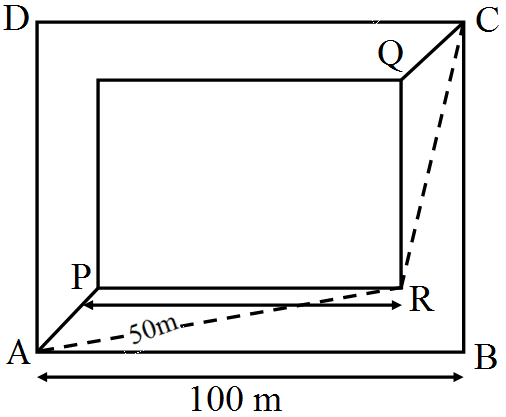
A man wants to reach from A to the opposite corner of the square C Fig. The sides of the square are 100m. A central square of 50m × 50m is filled with sand. Outside this square, he can walk at a speed 1m/ s. In the central square, he can walk only at a speed of $\upsilon\text{m/ s}(\upsilon<1)$. What is smallest value of v for which he can reach faster via a straight path through the sand than any path in the square outside the sand?
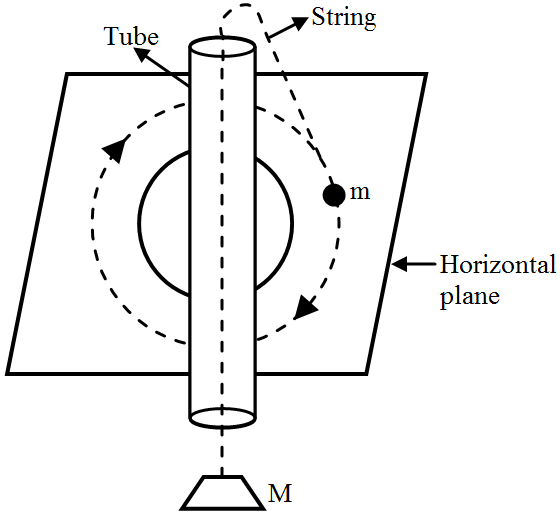
A large mass 'M' and a small mass ‘m' hang at the two ends of a string that passes over a smooth tube. The mass m moves around in a circular path which
lies in the horizontal plane. The length of the string from the mass m to the top of the tube is l and $\theta$ is the angle this length makes with the vertical. What should be the frequency of rotation of the mass m so that mass M remains stationary?
A cord of negligible mass is wound round the rim of a fly wheel of mass $20 \ kg$ and radius $20 \ cm$. A steady pull of $25 N$ is applied on the cord as shown in Fig. $6.31$. The flywheel is mounted on a horizontal axle with frictionless bearings.
$(a)$ Compute the angular acceleration of the wheel.
$(b)$ Find the work done by the pull, when $2m$ of the cord is unwound.
$(c)$ Find also the kinetic energy of the wheel at this point. Assume that the wheel starts from rest.
$(d)$ Compare answers to parts $(b)$ and $(c).$
Two molecules of a gas have speeds of $9 \times 10^{16} ms^{-1}$ and $1 \times I0^6ms^{-1}$ respectively. What is the root mean square speed of these molecules?
A hundred metre sprinter increases his speed from rest uniformly at the rate of $1m/s^2$ for three quarters of the length and covers the last quarter with a uniform speed. How long does he take to cover the first half and second half of the run?
A mass m is placed on a platform from a height 'h'. The platform is attached to a spring whose other end is fixed to the ground. Find the compression in the spring, if the spring constant is k.
If the earth were a homogeneous sphere and a straight hole bored in it through its centre, show that if a body were dropped into the hole it would execute a simple harmonic motion. Also find its time period.
A ball is dropped from a building of height 45m. Simultaneously another ball is thrown up with a speed 40m/s. Calculate the relative speed of the balls as a function of time.
The velocity of a body of mass 2kg as a function of t is given by $\text{v}(\text{t})=2\text{t}\hat{\text{i}}+\text{t}^2\hat{\text{j.}}$ Find the momentum and the force acting on it, at time $\text{t}=2\text{s}.$
Define and explain the following:
(i) Weight
(ii) Action and reaction forces
(iii) Tension
(iv) Impulse
(v) Spring force.