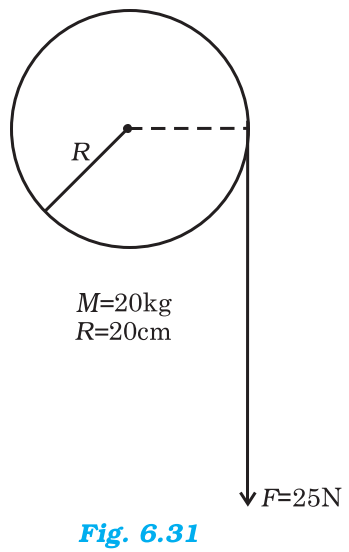
A cord of negligible mass is wound round the rim of a fly wheel of mass $20 \ kg$ and radius $20 \ cm$. A steady pull of $25 N$ is applied on the cord as shown in Fig. $6.31$. The flywheel is mounted on a horizontal axle with frictionless bearings.
$(a)$ Compute the angular acceleration of the wheel.
$(b)$ Find the work done by the pull, when $2m$ of the cord is unwound.
$(c)$ Find also the kinetic energy of the wheel at this point. Assume that the wheel starts from rest.
$(d)$ Compare answers to parts $(b)$ and $(c).$
$(a)$ Compute the angular acceleration of the wheel.
$(b)$ Find the work done by the pull, when $2m$ of the cord is unwound.
$(c)$ Find also the kinetic energy of the wheel at this point. Assume that the wheel starts from rest.
$(d)$ Compare answers to parts $(b)$ and $(c).$
Example-(6.12)
Download our app for free and get started
$(a)\text { We use } I \alpha=\tau$
$\text { the torque } \tau=F R$
$ =25 \times 0.20 Nm (\text { as } R=0.20 m )$
$ =5.0 Nm$
$I=$ Moment of inertia of flywheel about its
$\text { axis }=\frac{M R^2}{2}$
$=\frac{20.0 \times(0.2)^2}{2}=0.4 \ kg m ^2$
$\alpha=\text { angular acceleration }$
$=5.0 N m / 0.4 \ kg m ^2=12.5 s ^{-2}$
$(b)$ Work done by the pull unwinding $2 m$ of the cord
$=25 N \times 2 m =50 J$
$(c)$ Let $\omega$ be the final angular velocity.
The kinetic energy gained $=\frac{1}{2} I \omega^2$, since the wheel starts from rest.
Now, $\omega^2=\omega_0^2+2 \alpha \theta, \omega_0=0$
The angular displacement $\theta=$ length of unwound string / radius of wheel $=2 m / 0.2 m =10 rad$
$\omega^2=2 \times 12.5 \times 10.0=250( rad / s )^2$
$\therefore \text { K.E.gained }=\frac{1}{2} \times 0.4 \times 250=50 J$
$(d)$ The answers are the same, i.e. the kinetic energy gained by the wheel $=$ work done by the force.
There is no loss of energy due to friction.

Download our appand get started for free
Experience the future of education. Simply download our apps or reach out to us for more information. Let's shape the future of learning together!No signup needed.*
Similar Questions
- 1View SolutionShow that a(b × c) is equal in magnitude to the volume of the parallelepiped formed on the three vectors a, b and c.
- 2Calculate the angular momentum and rotational kinetic energy of earth about its own axis. How long could this amount of energy supply one kilowatt power to each of the $3.5 \times 10^9$ persons on earth? (Mass of earth = $6.0 \times 1024kg$ and radius = $6.4 \times 10^{24}km)$.View Solution
- 3From a uniform disk of radius R, a circular hole of radius $\frac{\text{R}}{2}$ is cut out. The centre of the hole is at $\frac{\text{R}}{2}$ from the centre of the original disc. Locate the centre of gravity of the resulting flat body.View Solution
- 4A uniform wheel of radius R is set into rotation about its axis at an angular speed $\omega.$ This rotating wheel is now placed on a rough horizontal surface with its axis horizontal. Because of friction at the contact, the wheel accelerates forward and its rotation decelerates till the wheel starts pure rolling on the surface. Find the linear speed of the wheel after it starts pure rolling.View Solution
- 5Separation of Motion of a system of particles into motion of the centre of mass and motion about the centre of mass: Show $\text{p}=\text{p}'_\text{i}+\text{m}_\text{i}\text{V}$ where $p_i$ is the momentum of the ith particle (of mass $m_i$ ) and $p′_i = m_iv′_i.$ Note: $v′_i$ is the velocity of the ith particle relative to the centre of mass. Also, prove using the definition of the centre of mass.View Solution
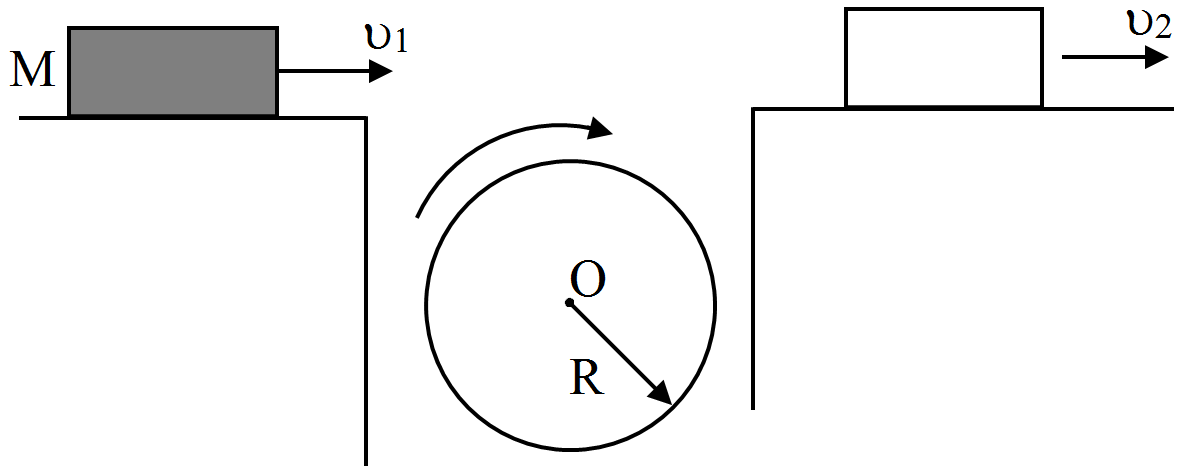
- 6A block of mass M is moving with a velocity $v_1$ on a frictionless surface as shown in fig. It passes over to a cylinder of radius R and moment of inertia I which has fixed axis and is initially at rest. When it first makes contact with the cylinder, it slips on the cylinder, but the friction is large enough so that slipping ceases before it losses contact with the cylinder. Finally it goes to the dotted position with velocity $v_2$ compute $v_2$ in terms of $v_1, M, I$ and $R$.View Solution
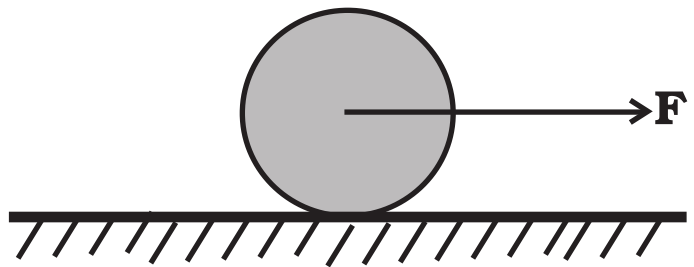
- 7A uniform disc of radius R, is resting on a table on its rim.The coefficient of friction between disc and table is $\mu.$Now the disc is pulled with a force F as shown in the figure. What is the maximum value of F for which the disc rolls without slipping?View Solution
- 8A hollow sphere is released from the top of an inclined plane of inclination $\theta.$View Solution
- What should be the minimum coefficient of friction between the sphere and the plane to prevent sliding?
- Find the kinetic energy of the ball as it moves down a length 1 on the incline if the friction coefficient is half the value calculated in part (a).
- 9View SolutionEstablish the relationship between Torque and Moment of Inertia.
- 10A solid sphere of mass 0.50kg is kept on a horizontal surface. The coefficient of static friction between the surfaces in contact is $\frac{2}{7}.$ What maximum force can be applied at the highest point in the horizontal direction so that the sphere does not slip on the surface?View Solution