Question
What is meant by electric potential? Calculate the electric potential generated by a point charge. Draw the equipotential surfaces resulting from this.

Answer

SELF

Need a full question paper?

Generate a complete, print-ready paper with questions like this in minutes — across 16+ boards, with answer keys.
Start Generating Free

Similar questions

A circular coil of 200 turns has a radius of 10cm and carries a current of 2.0A.
  1. Find the magnitude of the magnetic field. B at the centre of the coil.
  2. At what distance from the centre along the axis of the coil will the field B drop to half its value at the centre? $\big(\sqrt[3]{4}=1.5874\ ...\big)$
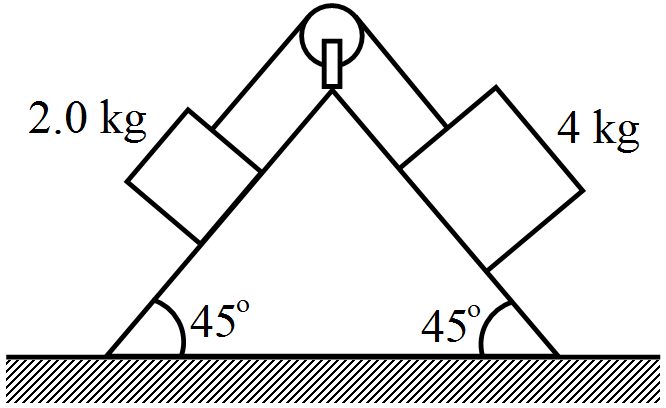
The pulley shown in figure has a radius 10cm and moment of inertia $0.5kg-m^2$ about its axis. Assuming the inclined planes to be frictionless, calculate the acceleration of the 4.0kg block.
Obtain expression for force on unit length of two straight parallel current carrying conductors. Under what conditions is this force attractive or repulsive? Define the standard unit of electric current.
What is the minimum energy that must be given to a H atom in ground state so that it can emit an $\text{H}_\gamma$ line in Balmer series. If the angular momentum of the system is conserved, what would be the angular momentum of such $\text{H}_\gamma$ photon?
An ideal gas is trapped between a mercury column and the closed-end of a narrow vertical tube of uniform base containing the column. The upper end of the tube is open to the atmosphere. The atmospheric pressure equals 76cm of mercury. The lengths of the mercury column and the trapped air column are 20cm and 43cm respectively. What will be the length of the air column when the tube is tilted slowly in a vertical plane through an angle of 60°? Assume the temperature to remain constant.
A hollow tube has a length $l_1$ inner radius $R_1$ and outer radius $R_2$. The material has a thermal conductivity K. Find the heat flowing through the walls of the tube if.
  1. The flat ends are maintained at temperatures $T_1$ and $T_2(T_2 > T_1)$
  2. The inside of the tube is maintained at temperature $T_1$ and the outside is maintained at $T_2.$
A bar magnet of magnetic moment m and moment of inertia I (about centre, perpendicular to length) is cut into two equal pieces, perpendicular to length. Let T be the period of oscillations of the original magnet about an axis through the mid point, perpendicular to length, in a magnetic field B. What would be the similar period T' for each piece?
Describe Davisson and Germer’s experiment to demonstrate the wave nature of electrons. Draw a labelled diagram of apparatus used.
Consider a particle moving in simple harmonic motion according to the equation $\text{x}=2.0\cos(50\pi\text{t}+\tan^{-1}0.75)$ where x is in centimetre and t in second. The motion is started at $t = 0.$
  1. When does the particle come to rest for the first time?
  2. When does the acceleration have its maximum magnitude for the first time?
  3. When does the particle come to rest for the second time?
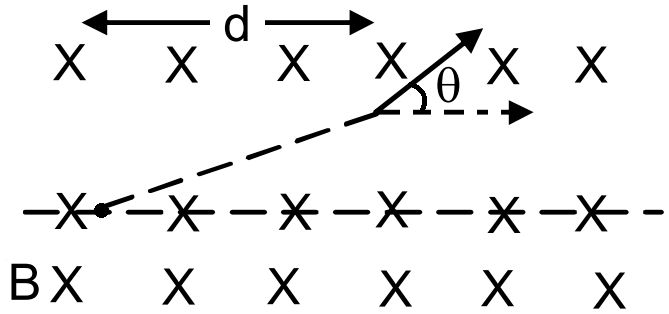
A particle of mass m and charge q is projected into a region that has a perpendicular magnetic field B. Find the angle of deviation of the particle as it comes out of the magnetic field if the width d of the region is very slightly smaller than
  1. $\frac{\text{mv}}{\text{qB}}$
  2. $\frac{\text{mv}}{2\text{qB}}$
  3. $\frac{2\text{mv}}{\text{qB}}.$