Question
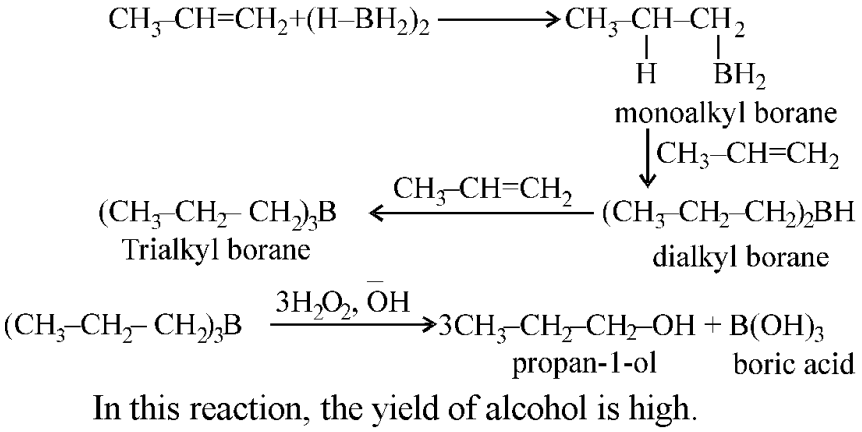
What is meant by hydroboration-oxidati on reaction? Illustrate it with an example.

Answer

Hydroboration-Oxidation : The addition of borane followed by oxidation is known as the hydroboration0oxidation reaction. For example, propan-1-ol is produced by the hydroboration-oxidation reaction of propene. In this reaction, propene reacts with diborane $\left( B _2 H _6\right)$ to form tri alkyl borane as an addition product. This addition product is oxidised to alcohol by hydrogen peroxide in the presence of aqueous NaOH .
Image

Need a full question paper?

Generate a complete, print-ready paper with questions like this in minutes — across 16+ boards, with answer keys.
Start Generating Free

Similar questions

How the following conversions can be carried out?
i. 2-Bromopropane to 1-bromopropane
ii. Chloroethane to butane
iii. Benzene to diphenyl
Calculate the mass of ascorbic acid $($Molar mass $= 176\text{g mol}^{-1})$ to be dissolved in $75g$ of acetic acid, to lower its freezing point by $1·5^\circ C. (K_f = 3.9K \ \text{kg mol}^{-1})$
Write a note on molecularity of a reaction and its different types.
How would you account for the following:
i. Phenols are much more acidic than alcohols.
ii. The boiling point of ethers are much lower than those of the alcohols of comparable molar masses.
When fruits and vegetables that have dried are placed in water, they slowly swell and return to the original form. Explain why. Would a temperature increase accelerate the process? Explain.
An element 'X' (At mass = 40 g $ mol^{-1} $) having fcc structure has unit cell edge length of 400 pm. Calculate the density of 'X' and the number of unit cell in 4 g of 'X'. $ (N_{A}=6.022\times10^{23}mol^{-1}) $.
What are lyophobic and lyophilic sols ? Give their chief distinguishing characteristics.
An organic compound $'A\ ’$ having molecular formula $\ce{C_3H_6}$ on treatment with aqueous $\ce{H_2SO4}$ gives $'B\ ’$ which on treatment with $\ce{HCl/ ZnCl_2}$ gives $'C\ ’.$ The compound $C$ on treatment with ethanolic $\ce{KOH}$ gives back the compound $'A\ ’.$ Identify the compounds $A, B, C.$
Calculate the potential of hydrogen electrode in contact with a solution whose PH is 10.
When a steady current of $2A$ was passed through two electrolytic cells $A$ and $B$ containing electrolytes $ZnSO_4$ and $CuSO_4$ connected in series, $2g$ of $Cu$ were deposited at the cathode of cell $B.$ How long did the current flow? What mass of $Zn$ was deposited at cathode of cell $A$?
$[$Atomic mass: $Cu = 63.5 g \text{mol}^-¹, Zn = 65 \text{ g mol}^{-1}; 1F = 96500\  C \text{ mol}^-¹]$