Questions

3 Marks Question

Take a timed test

14 questions · self-marked practice — reveal the answer and mark yourself.

Question 13 Marks
Give reasons :
(i) Carbon-oxygen bond length in phenol is slightly less than that of methanol.
(ii) The $C - O - C$ bond angle present in ether is greater than the tetrahedral angle.
(iii) The boiling point of isomeric alcohols decreases with increase in branching.
Answer
(i) This is due to partial double bond character on account of oxygen of - OH (phenol) resonants with the benzene ring ( + M effect).
(ii) The reason for the $C - O - C$ bond angle present in ether is greater than the tetrahedral angle is the presence of ethyl group which have repulsion between them due to their large size. Along with this there is also a repulsion between the lone electron pairs present on oxygen.
(iii) This is because with increase in branching, Van der Waals forces of attraction decreases with decrease in surface area, hence boiling point decreases.
View full question & answer
Question 23 Marks
Give the equations of reaction of phenol with the following compounds:
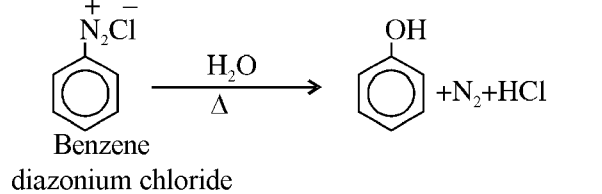
(i) Benzene diazonium chloride
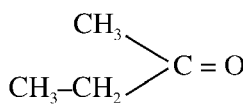
(ii) Acetone
(iii) Phthalic anhydride.
View full question & answer
Question 33 Marks
Explain the following reaction of $C _2 H _5 OH$ :
(a) Schotten Baumann reaction
(b) Reaction with concen. $HNO _3$
(c) Reaction with excess of $NH _3$
(d) Reduction with Red P and HI
View full question & answer
Question 43 Marks
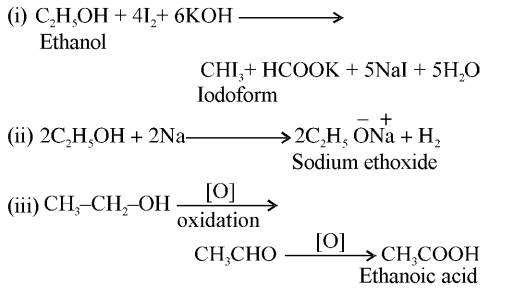
An organic compound gives hydrogen on reacting with sodium metal. It also gives iodofom test and the end product of its oxidation is ethanoic acid. Name the compound and give the equation of these reactions.
Answer
According to question the comound gives iodo- form test, hence it must be alcohol or carbonyl compound but carboxyl compound does not react with sodium metal and the end product of oxidation of this compound is ethanoic acid, hence this compound will be ethanol. The equation of the reactions are as follows:
Image
View full question & answer
Question 53 Marks
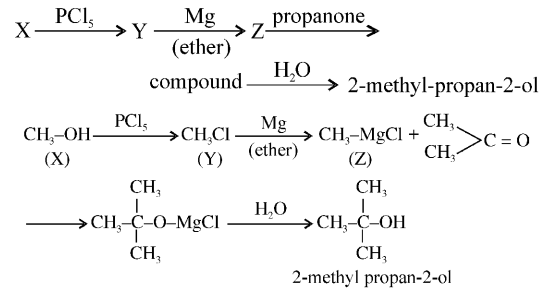
A compound $(X)$ reacts with $PCl_5$ to form compound $Y.$ Compound $Y$ reacts with ethereal solution of magnesium to form compound $(Z),$ which on treating with propanone and further hydrolysis to give $2-$ Methyl propan$-2-ol.$ What are the compounds $X$ and $Y$ and also give the equations of the reactions.
Answer
The final product is $3^\circ$ alcohol of four carbon, which is obtained by reacting compound $Z$ with propanone.
Therefore compound $Z$ is a carbon containing Grignard reagent, hence the starting compound will be a alcohol having one carbon. The reaction sequence will be as follows:
Image
View full question & answer
Question 103 Marks
While separating a mixture of ortho and para nitrophenols by steam distillation, name the isomer which will be steam volatile. Give reason.
Answer
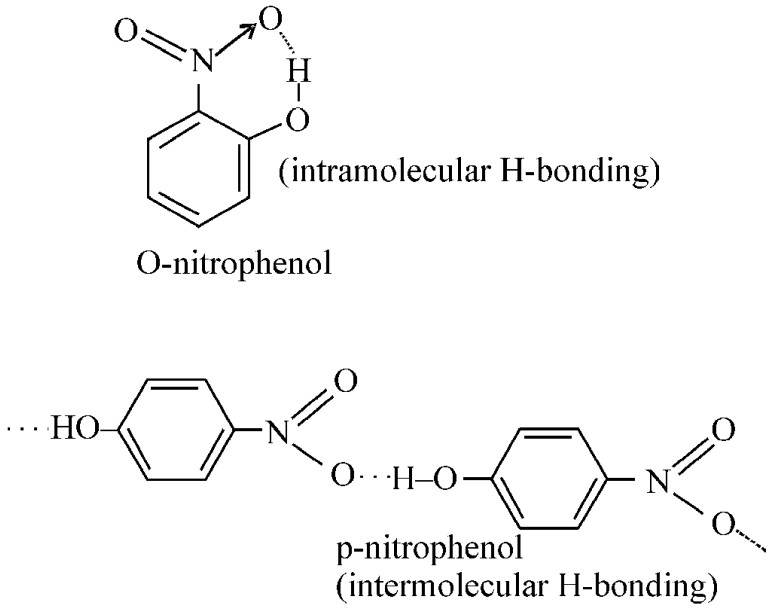
Ortho-nitrophenol is steam volatile. The reason is chelation due to intramolecular H-bonding. So, it can be separated by steam distillation from $p$-nitrophenol. Paranitrophenol is not steam volalite due to the presence of inter molecular H-bonding.
Image
View full question & answer
Question 113 Marks
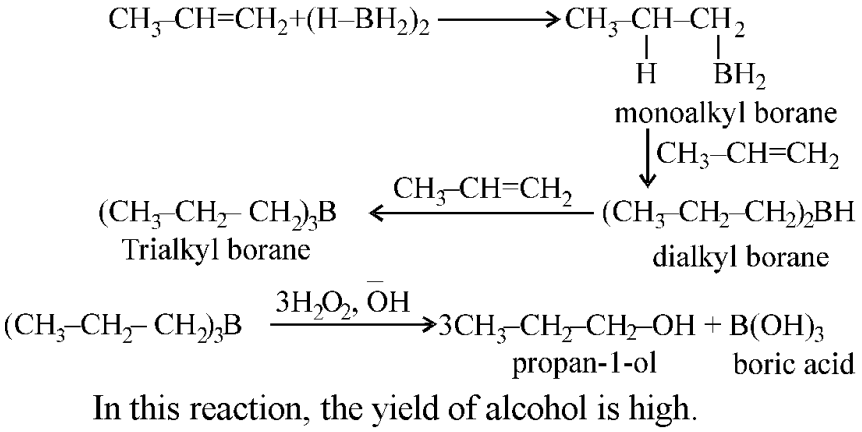
What is meant by hydroboration-oxidati on reaction? Illustrate it with an example.
Answer
Hydroboration-Oxidation : The addition of borane followed by oxidation is known as the hydroboration0oxidation reaction. For example, propan-1-ol is produced by the hydroboration-oxidation reaction of propene. In this reaction, propene reacts with diborane $\left( B _2 H _6\right)$ to form tri alkyl borane as an addition product. This addition product is oxidised to alcohol by hydrogen peroxide in the presence of aqueous NaOH .
Image
View full question & answer
Question 123 Marks
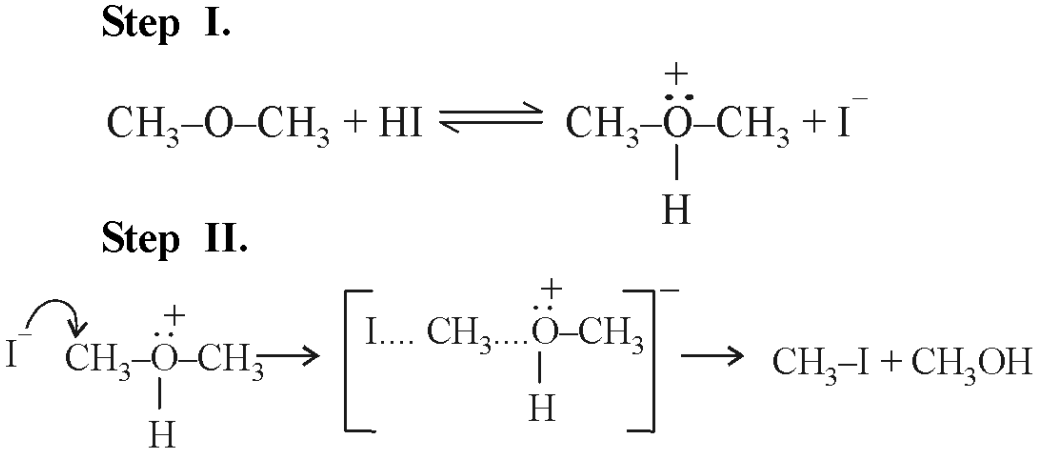
Write the mechanism of the reaction of HI with methoxymethane.
Answer
The reaction of hydroxy methane with HI takes place by $S_N 2$ mechanism.
Image
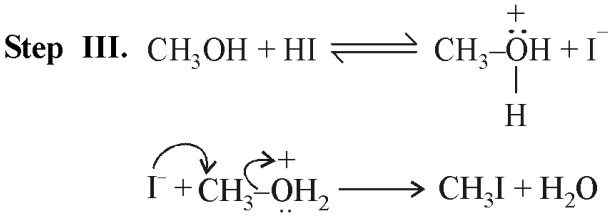
When HI is in excess, $CH _3 OH$ again reacts with HI to form $CH _3 I$.
Image
View full question & answer
Question 133 Marks
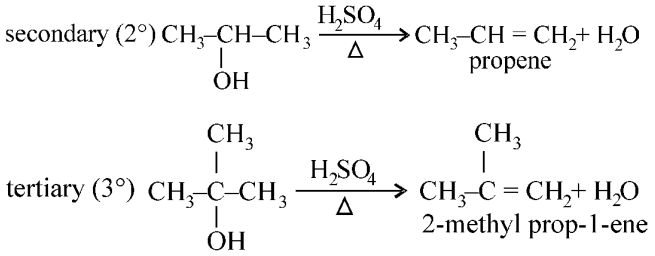
Preparation of ethers by acid dehydration of secondary or tertiary alcohols is not a suitable method. Give reason.
Answer
In secondary and tertiary alcohols, the alkyl groups create steric hindrance and the nucleophilic attack becomes difficult. Hence, elimination to form alkene is favoured over substitution to form ether. Hence, preparation of ethers by acid dehydration of secondary or tertiary alcohols is not a suitable method.
Image
View full question & answer
Question 143 Marks
Explain the following with an example :
Kolbe's reaction.
Answer
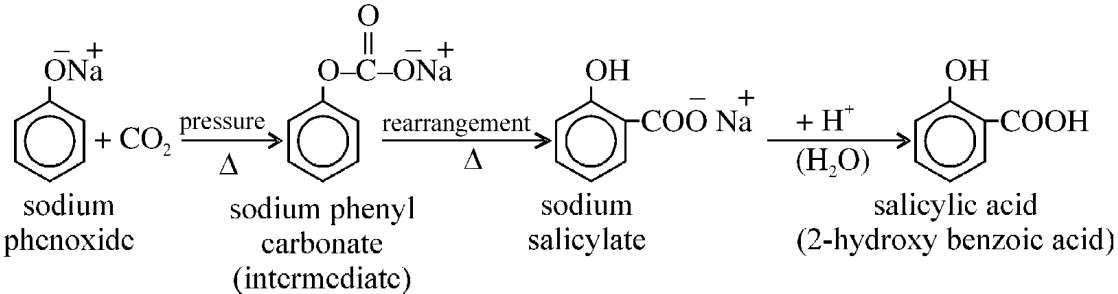
Sodium phenoxide is heated with $CO _2$ at $130^{\circ} C$ temp. and high pressure (4-7 atm. pressure), sodium phenyl carbonate (intermediate) is first formed, which on further rearrangement gives sodium salicylatic. Acidification of sodium salicylate gives salicylic acid.
Image
View full question & answer