Question
What is meant by nuclear mass defect?

Answer

Nuclear Mass Defect :
The difference between the total mass of protons and neutrons present in the nucleus and the actual mass of the nucleus is called mass defect.
Mass defect $=$ Mass of the nucleus obtained by
calculation $-$ Actual mass of the nucleus
$\Delta m=m_c-m_a$
Here, the calculated mass is abbreviated as $m _{c}$ and the actual mass is shown as $m_a$.
Therefore, $ \Delta m=[$ Mass of protons $+$ Mass of neutrons$] -$ Actual mass of nucleus
or $\quad$
$\Delta m=\left[ Z \cdot m_p+(A-Z) m_n\right]-m$
where$, Z$ is the atomic number of the atom$, A$ is the mass number, $m_p$ is the mass of the proton, $m_n$ is the mass of the neutron and $m$ is the actual mass of the nucleus.

Need a full question paper?

Generate a complete, print-ready paper with questions like this in minutes — across 16+ boards, with answer keys.
Start Generating Free

Similar questions

Can we perform Young's double slit experiment with sound waves? To get a reasonable "fringe pattern", what should be the order of separation between the slits? How can the bright fringes and the dark fringes be detected in this case?
An inductor 200mH, a capacitor $100\mu\text{F}$ and a resistor $10\Omega$ are connected in series to an a.c. source of 100V, having variable frequency.
  1. At what frequency of the applied voltage will the power factor of the circuit be 1?
  2. What will be the current amplitude at this frequency?
  3. Calculate the Q-factor of the circuit.
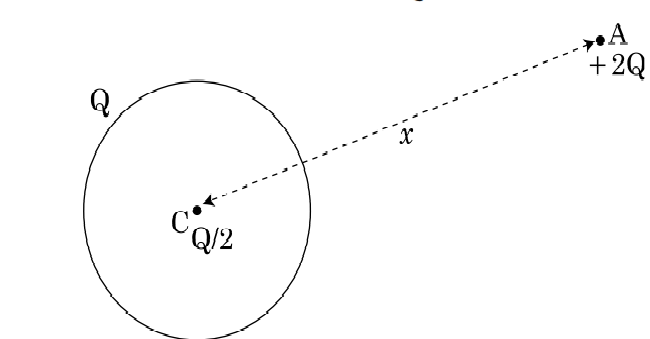
A thin metallic spherical shell of radius $R$ carries a charge $Q$ on its surface. $A$ point charge $Q/2$ is placed at the centre $C,$ and another charge $+ 2Q$ is placed outside the shell at $A$ at a distance $x$ from the centre as shown in the figure.
  1. Find the electric flux through the shell.
  2. State the law used.
  3. Find the force on the charges at the centre $C$ of the shell and at the point $A.$
A 60\ kg man skating with a speed of $10m/s$ collides with a $40\ kg$ skater at rest and they cling to each other. Find the loss of kinetic energy during the collision.
A horizontal straight wire $10 m$ long extending from east to west is falling with a speed of $5.0 ms^{-1}$, at right angles to the horizontal component of the earth's magnetic field, $0.30 \times 10^{-4} Wb m ^{-2}$.
$a$. What is the instantaneous value of the emf induced in the wire?
$b$. What is the direction of the emf?
$c$. Which end of the wire is at the higher electrical potential?
Obtain approximately the ratio of the nuclear radii of the gold isotope $^{197}_{79}\text{Au}$ and the silver isotope $^{107}_{47}\text{Ag}.$
  1. Depict the equipotential surfaces for a system of two identical positive point charges placed a distance $‘d\ ’$ apart.
  2. Deduce the expression for the potential energy of a system of two point charges $q_1$ and $q_2$ brought from infinity to the points$\overrightarrow{\text{r}_{1}}$ and $\overrightarrow{\text{r}_{2}}$ respectively in the presence of external electric field $\overrightarrow{\text{E}}.$
A circular coil of one turn of radius 5.0cm is rotated about a diameter w!th a constant angular speed of 80 revolutions per minute. A uniform magnetic field B = 0.010T exists in a direction perpendicular to the axis of rotation. Find
  1. The maximum emf induced.
  2. The average emf induced in the coil over a long period.
  3. The average of the squares of emf induced over a lone period.
A capacitor is connected to an alternating-current source. Is there a magnetic field between the plates?
In a series $\text{LCR}$ circuit connected to an ac source of variable frequency and voltage $v v_m= \sin,$ draw a plot showing the variation of current $(I)$ with angular frequency$ (\omega)$ for two different values of resistance $R_1$ and $R_2(R_1 > R_2 )$. Write the condition under which the phenomenon of resonance occurs. For which value of the resistance out of the two curves, a sharper resonance is produced? Define $Q-$factor of the circuit and give its significance.