Question
What is meant by the term average bond enthalpy? Why there is difference in bond enthalpy of O–H bond in ethanol $\left(\mathrm{C}_2 \mathrm{H}_5 \mathrm{OH}\right)$ and water?

Answer

Average bond enthalpy is obtained by dividing total bond dissociation enthalpy by the number of bonds broken. All the identical bonds ina molecule do not have there are two but breaking of first, the second some change bond is used by total bond dissociation by the number of bond broken.
Average bond enthalpy $=\frac{502+427}{2}=464$
The bond are differentent because of differentent around oxygen atom.

Need a full question paper?

Generate a complete, print-ready paper with questions like this in minutes — across 16+ boards, with answer keys.
Start Generating Free

Similar questions

Explain the half reaction method (ionelectron method) to balance the redox reaction with example.
Give reasons:
i. LiCl is more covalent than NaCl .
ii. Lil has lower melting point than LiCl .
iii. CaCl, is ionic than KCI .
iv. CuCl is more covalent than NaCl .
1. Explain hyperconjugation effect. How does hyperconjugation effect explain the stability of alkenes?
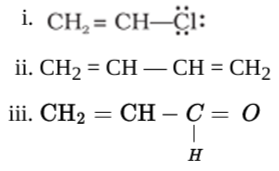
2. Draw the resonance structures of the following compounds:
Image
 The ionization constant of $HF , HCOOH$ and HCN at 298 K are $6.8 \times 10^{-4}, 1.8 \times 10-4$ and $4.8 \times 10^{-9}$ respectively. Calculate the ionization constants of the corresponding conjugate base.
What is the energy in joules, required to shift the electron of the hydrogen atom from the first Bohr orbit to the fifth Bohr orbit and what is the wavelength of the light emitted when the electron returns to the ground state? The ground state electron energy is $-2.18 \times 10^{-11}$ ergs.
Write short notes on the following: (i) Hydroboration of alkenes (ii) Polymerisation of alkenes
What is photoelectric effect? Explain with diagram.
The ionization constant of nitrous acid is $4.5 \times 10^{–4}$. Calculate the pH of $0.04M$ sodium nitrite solution and also its degree of hydrolysis.
  1. Balance and complete the following reactions:
  1. $\text{Fe(s)}+\text{H}_2\text{O}\xrightarrow{\ \ \ \ \ \ \ \ }$
  2. $\text{Zn(s)}+\text{NaOH}(\text{aq})\xrightarrow{\ \ \ \ \ \ \ \ \ \ }$
  3. $\text{Mg(s)}+\text{HNO}_3(\text{aq})\xrightarrow{\ \ \ \ \ \ \ \ \ }$
(b) Write chemical equations for the following:
(1) $H_2O_2$, as an oxidising agent in acidic medium.
(ii) $H_2O_2$ as an reducing agent in basic medium.
(iii) $H_2O_2$ as an reducing agent in basic medium.
(iv) $H_2O_2$ as an reducing agent in acidic medium.
Discuss the factors affecting electron gain enthalpy and the trend in its variation in the periodic table.